
Autumn hits differently at the front of the house. The porch is the one part of an American home that everybody sees, and by the third week of September it starts asking for pumpkins, mums, and something warm glowing after dark. That’s why fall entry photos flood Pinterest boards every year — people want a look they can copy on a Saturday afternoon with a trip to the garden center and whatever’s already in the garage. Below are 22 ideas for fall 2026, from a full eucalyptus arch to a wheelbarrow of mums, with enough detail to actually build them.
1. Mums in Weathered Zinc Pots

Nothing announces the season on a front porch faster than a row of mums in dull silver zinc, burgundy and gold heads spilling just past the rim. Zinc reads quieter than the orange plastic nursery pots the plants arrive in, so the flowers carry the moment, and the metal only softens as it ages. Group them in odd numbers along one side of the steps and keep the colors within two shades of each other, and the run of fall outdoor decorations looks planned rather than piled up.

Mums drink far more than most people expect, and a pot sitting in full afternoon sun can go bone dry by dinner. Water at the soil line instead of over the blooms, pinch off spent heads every few days, and a single plant holds its shape from Labor Day into November. Zinc has no drainage of its own, so leave the plant in its nursery pot and lift it out when you water. That one habit is the difference between six weeks of color and two.
2. A Hay Bale Welcome

Stack two hay bales beside the steps, set a fat orange pumpkin on top, and half the season’s work is finished. Bales bring bulk and texture that potted plants simply can’t, and they read from the street the way a wreath never will. Farm stands start selling them by the bale in early September, and a pair anchors the corner of a yard or the outside edge of a walkway. Of all the low-effort ideas on this list, this one still manages to look generous.
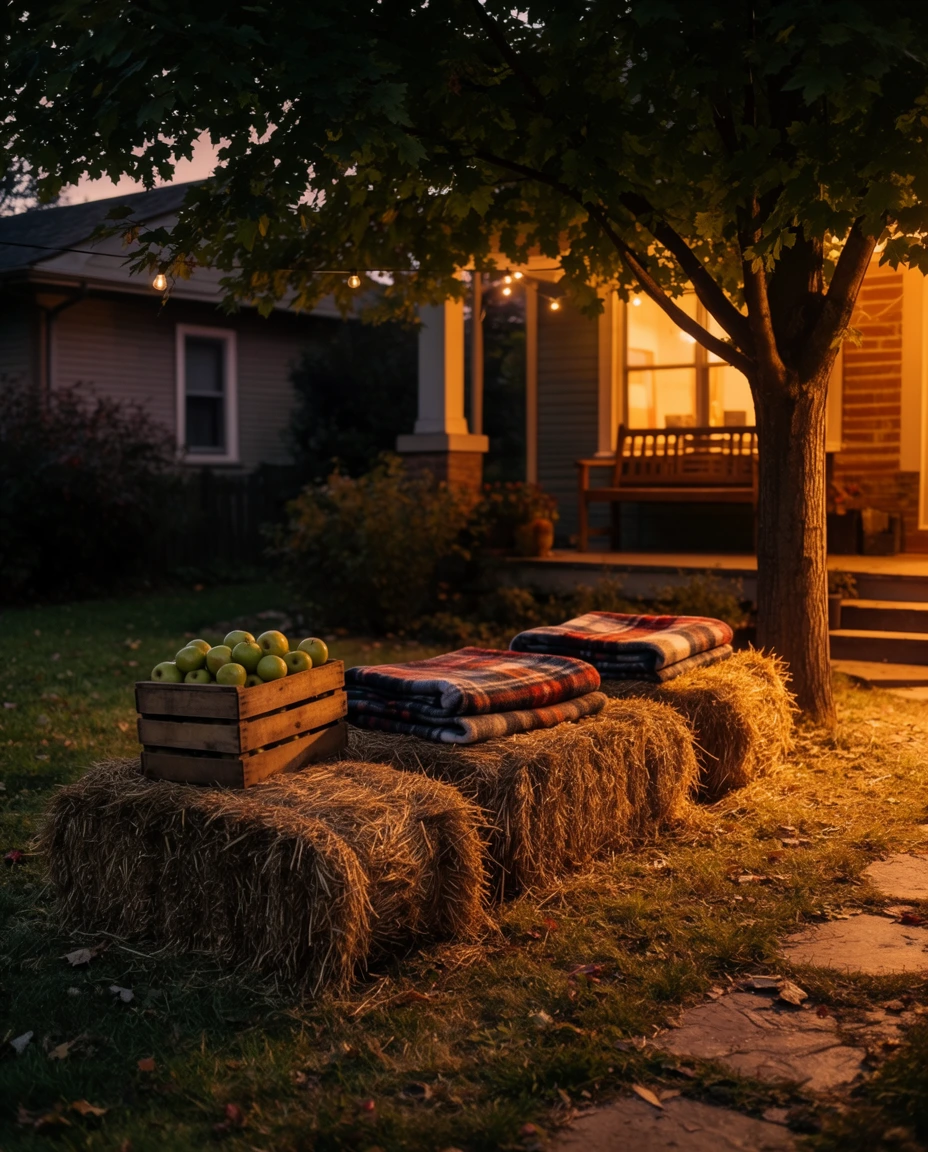
Straw bales are practically a regional currency across the Midwest and upstate New England, where roadside stands price them in the single digits from mid-September through the last week of October. In neighborhoods with football Saturdays, the bale often doubles as extra seating for anyone waiting on a ride. Southern porches tend to swap straw for pine straw bales, which shed less in humidity. Either way, set them on a tarp scrap if your boards are freshly painted.
3. Copper Lanterns for Cool Nights
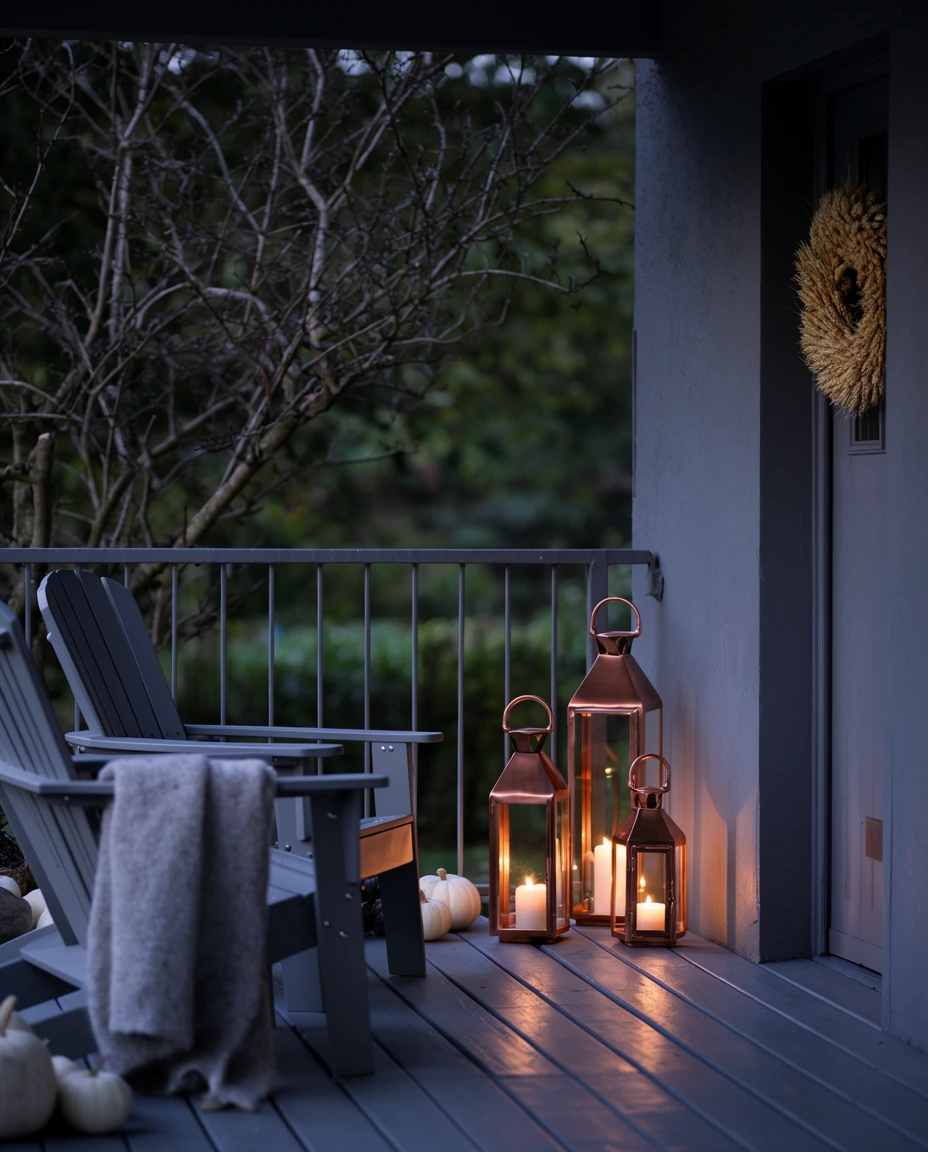
Three copper lanterns in graduated heights, lined along one side of the porch floor, do more after sunset than any amount of daytime styling. Copper throws a warmer cast than black metal, and by October that warmth matters — the light reads gold instead of blue against the cold air. Battery pillar candles on a timer keep the whole thing simple, switching on at dusk without anyone touching them. It’s the cheapest way to make a house look occupied and cared for after the lights go on inside.

A friend in Ohio bought her first two lanterns at a church rummage sale for four dollars, planning to spray them black. She never got around to it, and now the tarnished copper is the thing every neighbor comments on. Ten years later she’s added a third, taller one, and the mismatched trio looks better than a matched set ever did. Aged metal earns its patina outdoors faster than you’d think, and that’s entirely the point.
4. Dried Grasses and Cotton Stems

For a modern entry that skips orange entirely, fill a tall matte vessel with dried pampas, wheat, and a few cotton stems. The palette stays bone, wheat, and soft gray, so it holds up against stucco, black window frames, and flat-panel doors better than a pumpkin pile would. It’s also one of the easy options that lasts — no watering, no wilting. More front porches are going this direction because the arrangement carries straight through to Thanksgiving without a single swap.

This look performs best on a covered porch or a recessed entry where rain can’t flatten the plumes. Full exposure to a week of Pacific Northwest drizzle turns pampas into a soggy mop, and Gulf Coast humidity makes cotton bolls droop. Under an overhang facing east or north, though, the same stems hold their shape for two full seasons. Shake them out on the lawn once a month and they look fresh again.
5. Front Porch Arch in Eucalyptus

The front porch arch has quietly become the centerpiece shot of every fall board, and eucalyptus makes the most forgiving version. Wire a flexible base to both sides of the door surround, then build outward with silver dollar eucalyptus, preserved oak, and a few dried hydrangea heads. As a weekend diy, it’s mostly zip ties and patience. Keep the greenery weighted toward the two lower thirds and let the top stay airy, or the whole thing reads heavy and closes in the doorway.

Florists who build these commercially will tell you the mistake amateurs make is symmetry — a perfectly even arch looks manufactured. They stagger the density instead, going fuller on one shoulder and letting the opposite side taper, which is why professional versions photograph with movement. They also anchor to the trim with removable hooks rather than nails, since the weight of wet greenery after a storm can pull staples straight out of soft pine.
6. Pumpkin Steps Without the Clutter
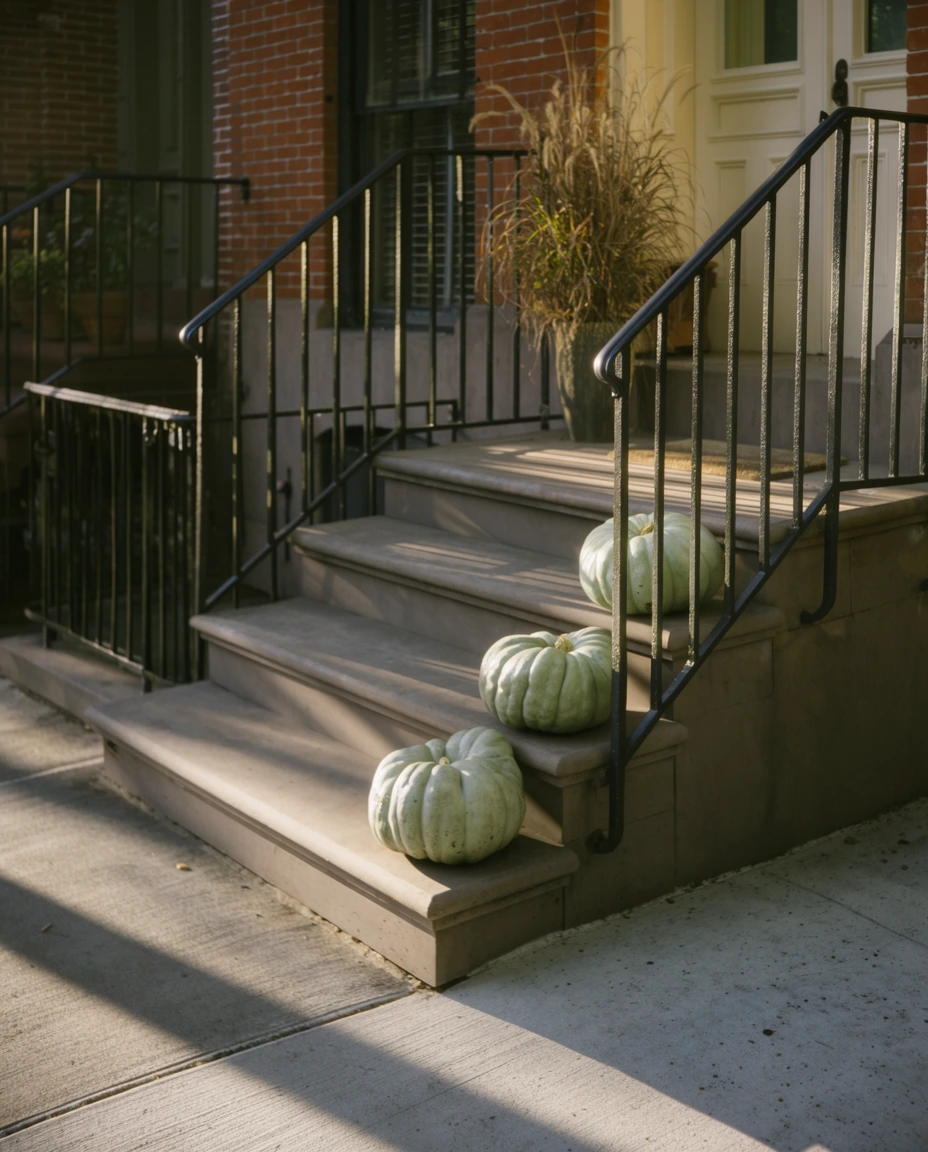
One pumpkin per tread, all on the same side, all the same color — that’s the whole formula, and it’s why it works on a small front porch where a full display would swallow the walking path. The repetition does the visual heavy lifting while the opposite half of each step stays completely clear. Keeping it simple also keeps it safe for anyone carrying groceries up in the dark. It’s the most restrained set of fall outdoor decorations here and probably the most copied.

Cost stays modest because you’re buying five or six pumpkins, not twenty. Standard field pumpkins run about six to ten dollars each at a grocery store or roadside stand, while the pale heirloom varieties — Cinderella, Jarrahdale, Casper — sit closer to twelve to eighteen. Buying all one variety in the smaller size class usually lands the entire staircase under sixty dollars, and uncarved fruit set on dry boards will hold through Thanksgiving.
7. Warm Bistro Lights Overhead

Run warm bistro lights in two straight passes across the porch ceiling and the space stops being a place you walk through and becomes a place you sit. Choose 2200K bulbs — anything cooler reads like a parking lot. Against a modern black-and-cedar exterior the bulbs look intentional rather than leftover from summer, and on a traditional porch they soften the whole roofline at dusk. Screw hooks into the beams and pull the strands taut so they don’t sag toward anyone’s head.

Here’s what actually happens: people put these up in June for a graduation party and never take them down, then in October they finally notice the porch is the best room in the house. Sales data from hardware chains backs it up — commercial-grade strand lights move steadily from spring through the holidays, not in a single seasonal spike. Once they’re up on hooks, swapping a burnt bulb takes a minute, so there’s no reason to.
8. Small Porch With Big Impact
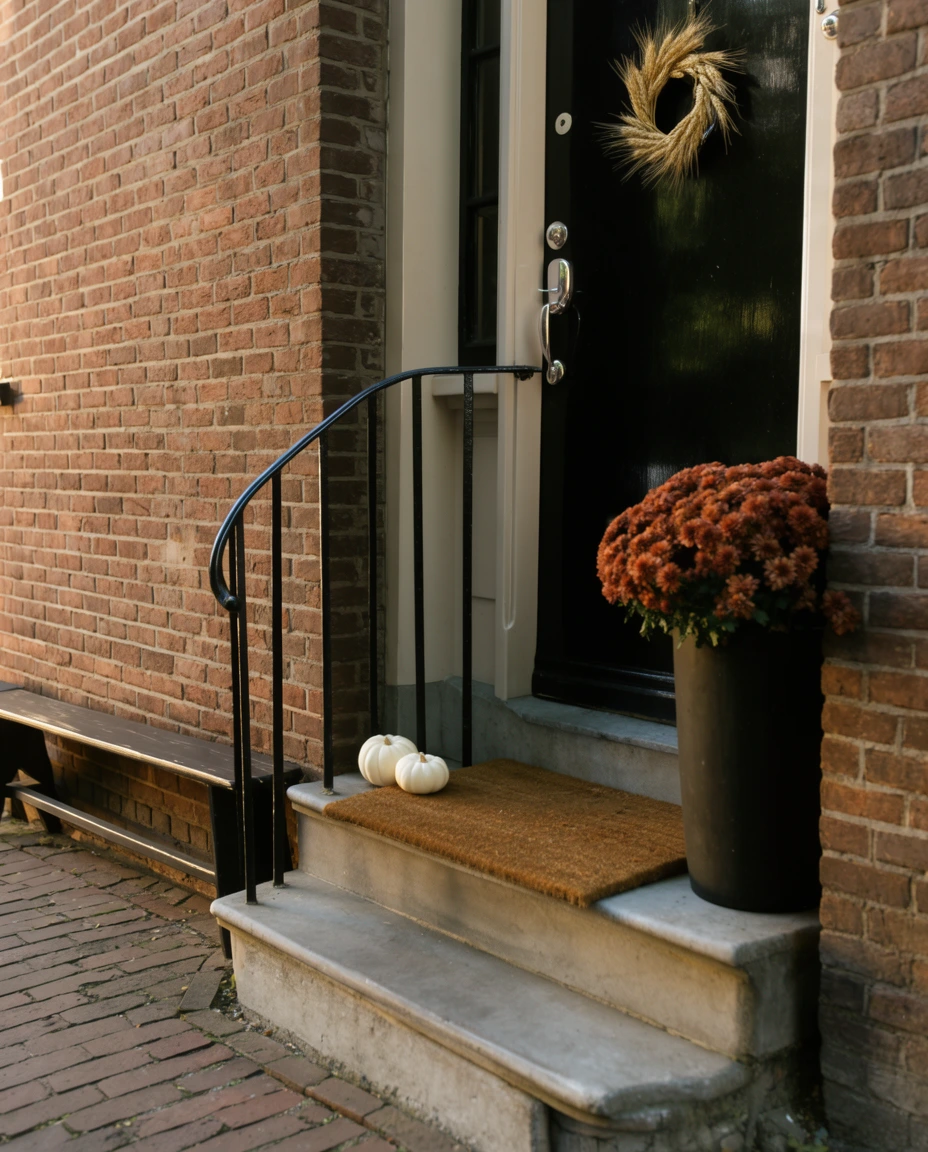
On a small front porch, one oversized element beats six little ones every time. A single tall planter of rust mums beside the door, a wreath at eye level, two white pumpkins on the top step — done. The scale trick is counterintuitive but reliable: big objects make a tight space feel deliberate, while a scatter of small ones makes it feel cramped. These are the ideas that stay easy precisely because there’s so little to arrange.
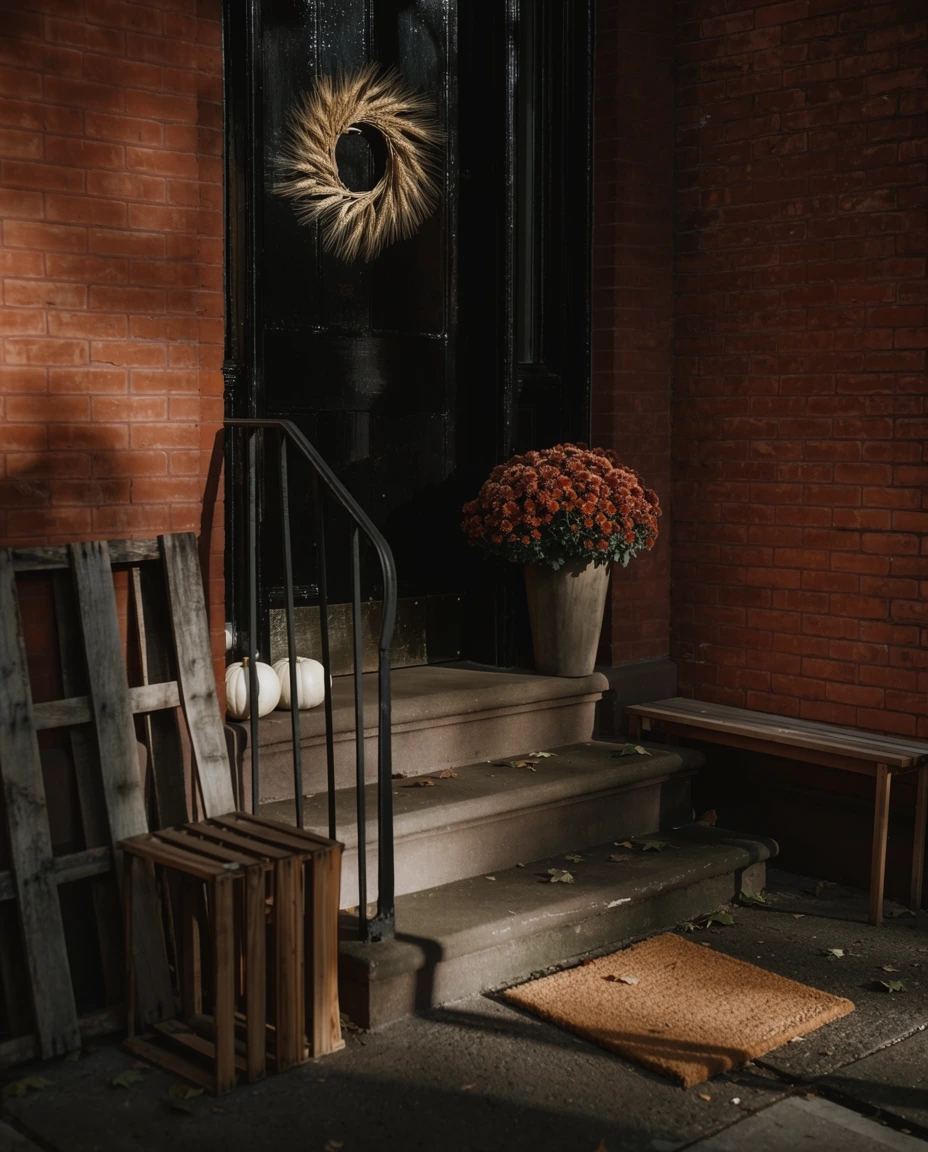
The usual misstep is lining both sides of a four-foot stoop with pots, which turns the entry into an obstacle course by the first rainy night. Pick one side and commit to it. The other frequent error is buying a wreath sized for a photo rather than a door — anything under eighteen inches disappears on a standard thirty-six-inch slab. Measure the door, then go one size up from what looks right in the store.
9. Cornstalks for the Front Door

Cornstalks tied to the porch posts are the oldest move in American autumn styling and still the most dramatic. Bundle six to eight stalks, wrap twine twice around the middle, and lash them to each column so the husks fan upward and outward, well clear of the doorway. Set a hay bales base underneath if you want more mass. On a deep front porch the height finally has room to register, and from across the yard the whole entry reads instantly.

Dry stalks catch wind like a sail, so the twine matters more than the arrangement does. Two wraps at chest height and one near the base, all cinched to something structural, will hold through an October storm. Buy stalks that still have some flex in them rather than the brittle, papery bundles that have been sitting out for weeks — those shed husks all over the walkway. A quick shake before you tie tells you which you’ve got.
10. Simple Wreath in Wheat and Oak

A simple wreath of dried wheat and preserved oak leaves is the quiet workhorse of the season. Skip the ribbon, skip the plastic berries, and let the two textures — smooth grain heads against papery leaves — carry it. As a diy it takes about forty minutes with a grapevine base and floral wire, working in small bundles all angled the same direction. It’s the one piece that suits almost all front porches, from a brick colonial to a shingled cottage.

Wheat wreaths have deep roots in Pennsylvania Dutch and Midwestern farm tradition, where the harvest bundle over the door was a genuine marker of the year’s yield before it was a decorating choice. That history is part of why the look still feels grounded in Ohio, Indiana, and Iowa neighborhoods where corn and wheat are visible from the highway. On the coasts it reads more like considered minimalism, which is its own kind of appeal.
11. A Reading Nook for Autumn
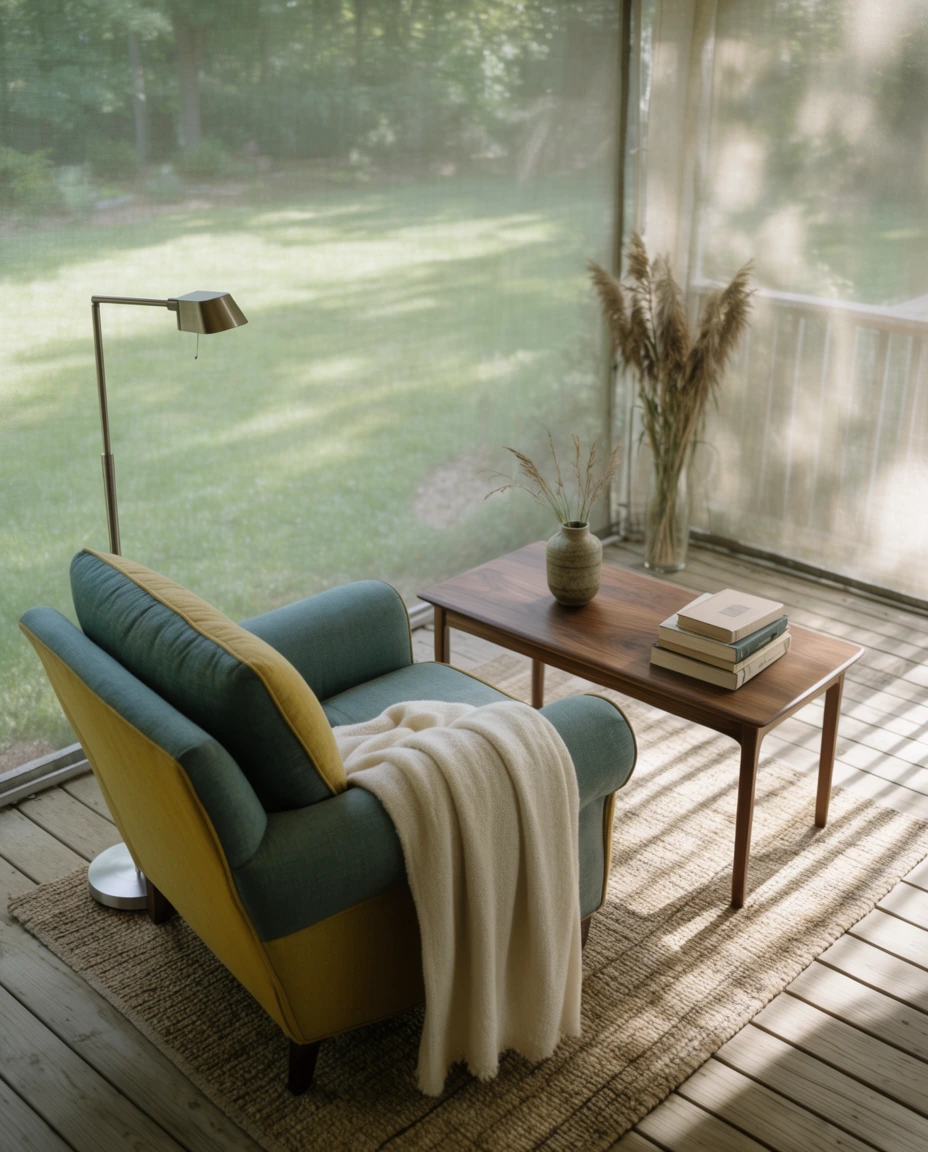
Pull one deep chair into the corner of the porch, angle it toward the yard, add a floor lamp behind the shoulder and a knit throw over the arm. That’s a reading nook, and in October it’s the best seat on the property. A modern rattan daybed works just as well as an old wingback with an outdoor slipcover. Making it easy is the whole trick — if it takes effort to sit down out there, nobody ever does.
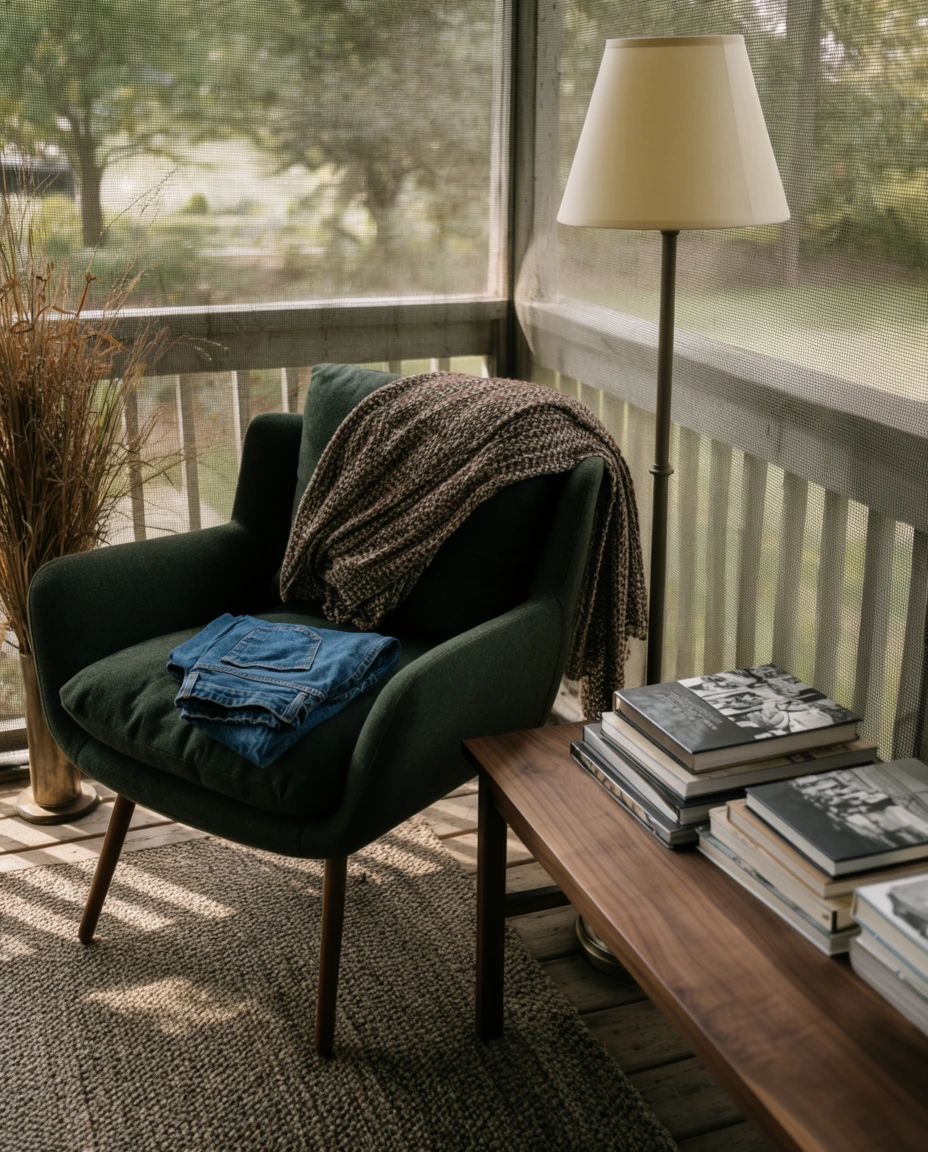
My neighbor set hers up the first week of September as an experiment and hasn’t come inside before dark since. She keeps a wool blanket folded on the seat and a candle in a glass hurricane on the side table, and says the smell of the leaves is half the reason. The chair faces the street, so she’s also become the unofficial mayor of the block, which she claims she didn’t plan.
12. Painted Gourds in Soft Neutrals

Chalk paint in bone, clay, and pale sage turns a bag of grocery store gourds into something that looks bought from a design shop. Two thin coats, no primer, no sealer, and the matte finish sits beautifully next to dried eucalyptus. Among the cheaper ideas here, this one punches far above its cost, and it pairs cleanly with cream mums if you want a fully neutral scheme. It’s also the fastest way to make store-bought fall outdoor decorations feel personal.

The neutral palette earns its keep on houses where orange fights the architecture — gray stone, sage siding, anything with a blue-toned door. It also holds up beautifully on a covered console or shelf where the paint stays dry. Left in the open through a rainy stretch, chalk paint chalks off, so an overhang or an interior porch table is where these belong. On a sunny southwestern stoop they stay perfect for months.
13. Halloween Charm Without the Fright
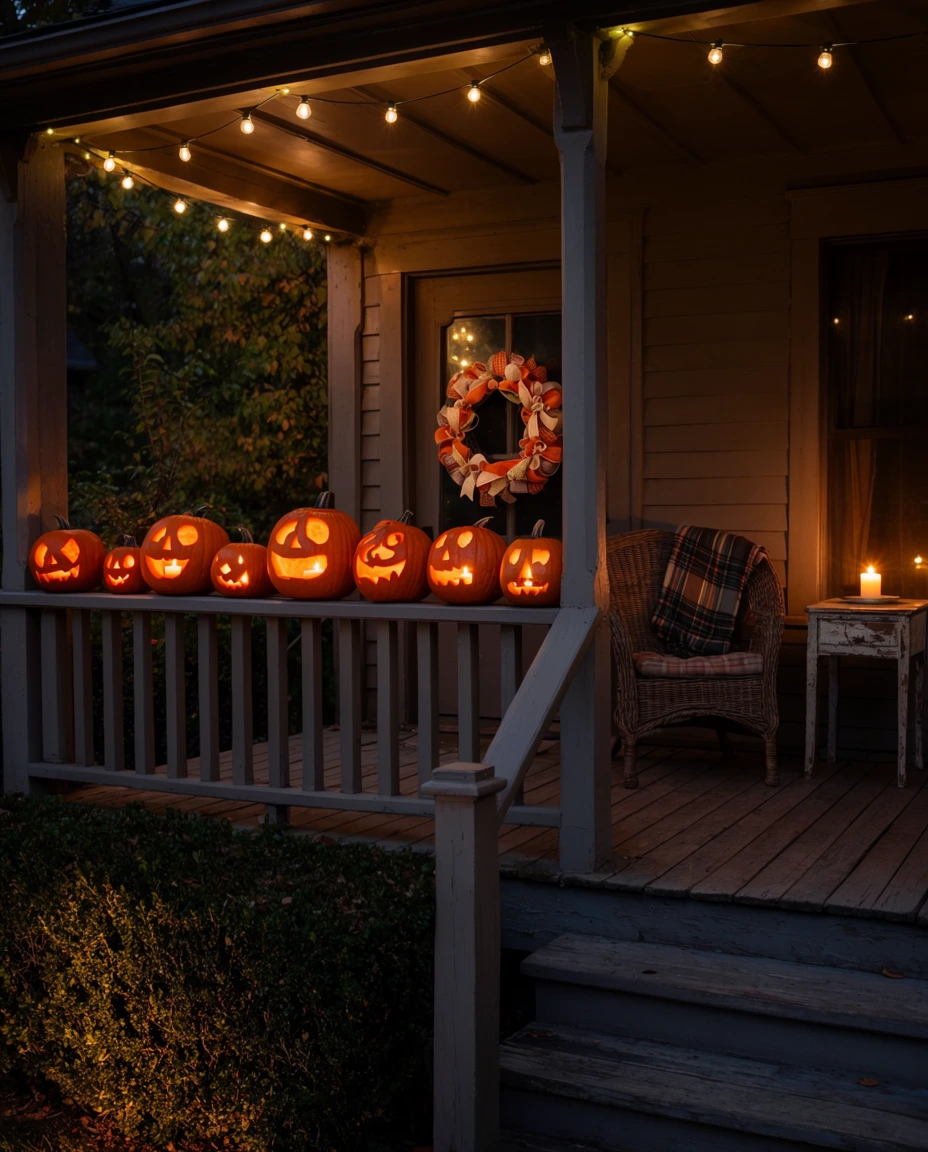
Plenty of people want halloween on the front porch without the gore, cobwebs, or animatronic anything. The friendly version leans on white pumpkins, a black cat silhouette cut from plywood, candle lanterns along the landing, and marigolds in clay pots. It reads festive from the sidewalk and still looks good in daylight on November first. Keeping it simple means the whole display comes down in fifteen minutes and most of it moves straight into the Thanksgiving arrangement.

Set designers who dress porches for photography talk about a single “signal” object — one item that names the holiday so the rest can stay ambiguous. The cat silhouette or a lone carved jack-o’-lantern does that job, letting everything around it be seasonal rather than spooky. They also warn against lighting from below, which is exactly what makes cheap displays look cheap. Candles at railing height, glowing outward, flatter everything they touch.
14. Stacked Crates and Trailing Ivy

Three wooden crates stacked in a stepped tower give you instant height, three display shelves, and a place for ivy to spill over the top. Stain them walnut or leave the raw pine, fill the openings with small pumpkins and gourds, and set a pot of rust mums at the base. As a diy it’s about twenty minutes of stacking. Beside a garden gate or at the edge of the yard, it pairs naturally with hay bales for a fuller corner.

Crates are one of the last genuinely cheap decorating materials. Craft stores sell unfinished pine boxes for eight to twelve dollars, and hardware stores stock sturdier versions around fifteen. Estate sales and orchard stands often let real fruit crates go for a few dollars apiece, and those have the grain and stamping that new ones fake. Three crates, a can of stain, and a four-dollar ivy start puts the whole corner near forty dollars.
15. Yard Path Lined With Luminaries
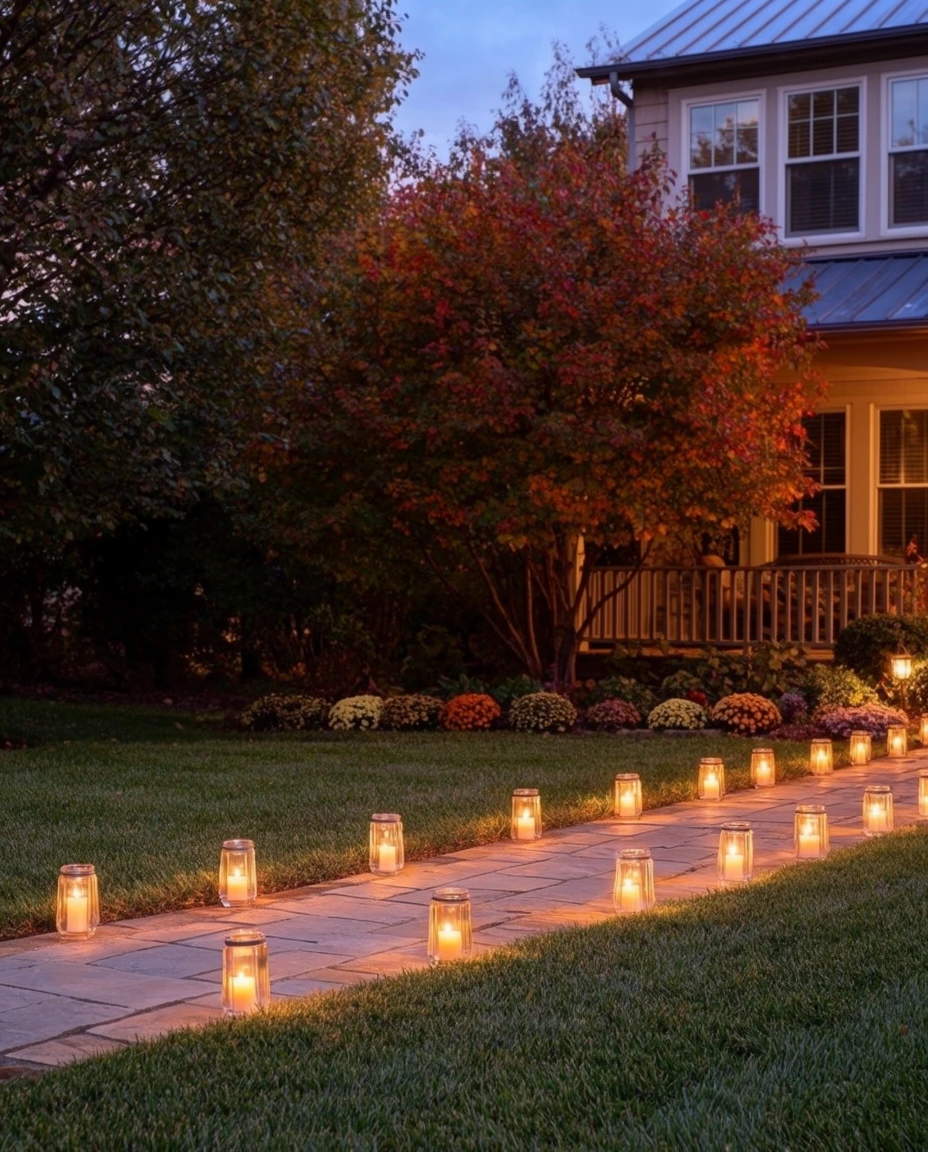
Small glass luminaries set at even intervals down both edges of the walkway turn an ordinary approach into something people slow down for. Space them about three feet apart, keep them low and flush to the pavers, and let the lights pool on the stone rather than shine into anyone’s eyes. Battery tea lights on timers make it easy to leave up all season. Of all the after-dark ideas here, this is the one guests actually remember.
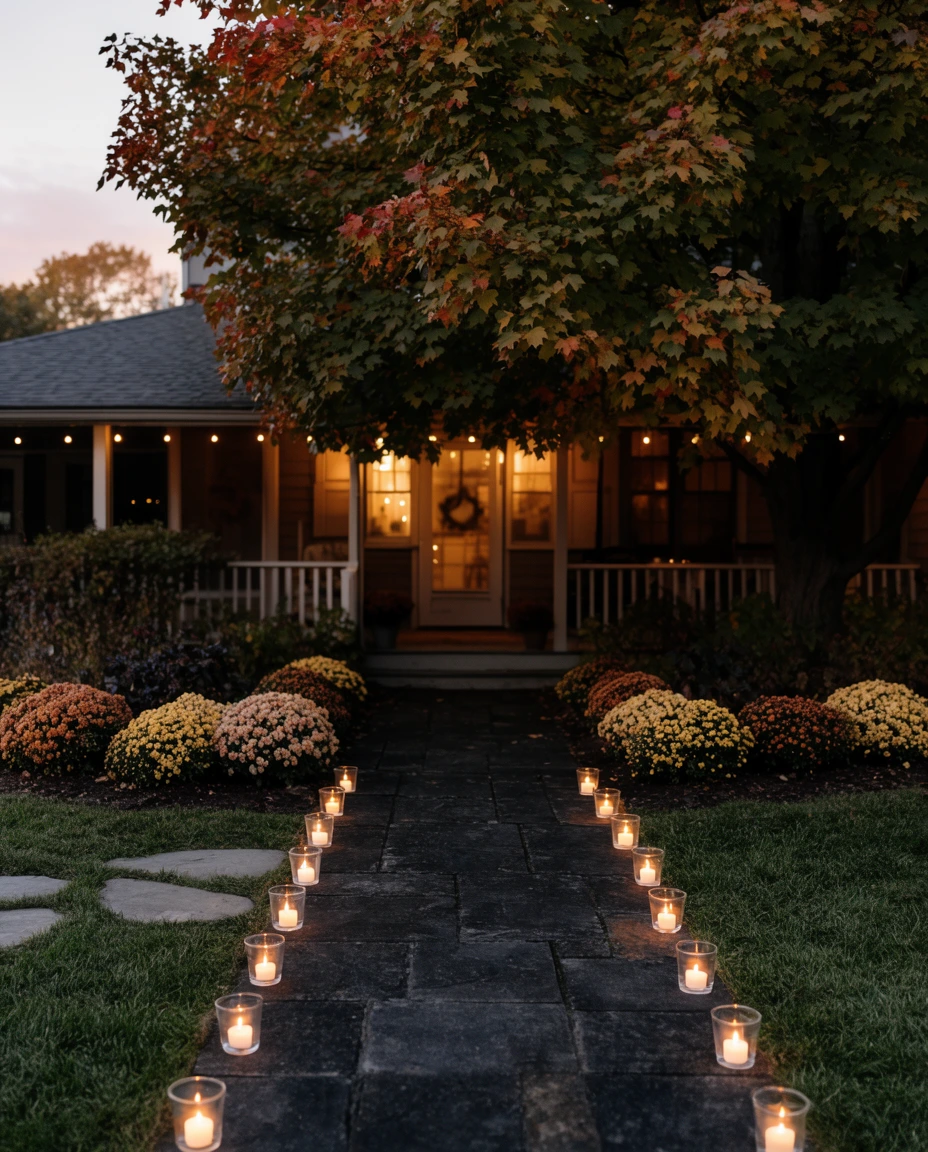
What tends to happen in practice is that families put luminaries out for one October party, then find themselves refilling the timers every weekend because the walk looks so much better lit. In New Mexico and parts of Texas the paper bag version is already an annual ritual, and plenty of households keep the glass jars year-round and just change the candle color. They get stored in a single milk crate, which is why they survive.
16. Plaid Throws for Porch Chairs

Two rocking chairs, two wool throws in red-and-cream buffalo check, and the porch suddenly looks like somewhere you’d want to sit with coffee at seven in the morning. Textiles are the fastest seasonal change available — no planting, no ladder, no cleanup. Drape rather than fold, so the fabric falls over the back and catches the light. It’s why so many front porches in the photos you save look warm without much else going on, and it stays simple.

The error most people make is using an indoor cotton throw, which soaks up dew overnight and stays damp until noon. Wool sheds moisture and dries fast, and acrylic outdoor blankets do nearly as well for less money. The other slip is leaving them out through a hard rain — even wool will mildew if it stays soaked against a wooden seat. A basket by the door solves it, since bringing them in takes seconds.
17. Autumn Door Swag in Minutes

A swag is a wreath with less commitment — a loose bundle of dried wheat, oak leaves, and rust ribbon mounted across the top of the door frame, tails falling well above the handle. For a fast diy, gather the stems, wrap the top third with wire, tie on the ribbon, and hang it from a single hook. On a front porch with a narrow door or a storm door in the way, it solves what a wreath can’t. Among quick-win ideas, it’s near the top.

Because a swag hangs from one point, the weight distribution decides whether it looks graceful or lopsided. Build it slightly heavier at the bound center and let the outer stems get progressively lighter and longer, and it will settle straight on its own. Use an over-the-door hook rather than adhesive, since temperature swings between a warm interior and a cold October night pop most adhesive strips off painted metal within a week.
18. Firepit Corner With Log Seating

A low stone firepit ringed by cut log rounds gives the back yard a reason to stay in use once the evenings drop into the forties. Log stools cost nothing if you know someone taking down a tree, and their rough grain balances a modern steel pit beautifully. Add folded blankets, a stack of split firewood against the fence, and dried grasses along the edge, and the corner does more for the season than most fall outdoor decorations at the front of the house.

Firepit rules vary sharply by region and even by town — much of Colorado and California restricts open wood burning during dry spells, while the Upper Midwest and the Northeast treat a backyard fire as standard September equipment. Propane pits sidestep most local burn bans and light instantly, which matters on a Tuesday night. Checking the municipal code before buying is worth ten minutes, especially in newer subdivisions with HOA setback rules.
19. Wheelbarrow Planted With Fall Mums

An old steel wheelbarrow parked beside the steps and filled with mums is the kind of display that looks like it happened by accident, which is exactly its charm. Line the bed with landscape fabric, drop the nursery pots straight in, and tuck small pumpkins into the gaps so nothing plastic shows. Set the handles level on the ground so it sits stable. Against a porch with white siding and a red door, the gray metal and burgundy blooms read like a photograph.

The barrow itself is usually the cheapest part. Salvage yards, farm auctions, and Facebook Marketplace list retired steel wheelbarrows anywhere from twenty to sixty dollars, and a rusted-through bed is fine since it drains. Six six-inch mums at five dollars each fills it completely, putting the finished arrangement under a hundred dollars for something that reads far more expensive. Wooden barrows cost triple and rot in one wet season.
20. Black Planters for Modern Porches

Matte black cylinders flanking the door are the shortcut to a modern autumn entry — clipped boxwood on top, dark burgundy mums underplanted below, nothing else. The hard geometry plays against stucco, cedar cladding, and black window frames the way terracotta never quite manages. On a small front porch, two are plenty; on wider front porches, a row of three along one wall gives rhythm without crowding the path. The palette is deliberately narrow, and that restraint is the whole look.

This scheme lands hardest on newer construction and renovated mid-century homes, where the exterior already has clean lines to answer. It also works surprisingly well on a city brownstone stoop, where dark planters read as urban rather than rustic. On a Victorian with heavy gingerbread trim or a shingled cottage, the same planters can feel severe — those houses want texture, so straw and grapevine do more. Match the container to the architecture, not the trend.
21. Apple Crates and Amber Glass

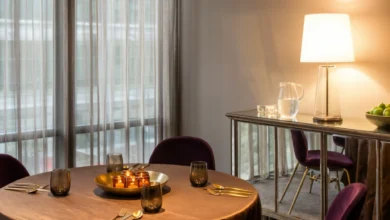
Amber glass is having a real moment on autumn porch tables, and paired with a wooden apple crate of red fruit it looks like a Vermont orchard stand. Cluster jars and hurricanes of varying heights, drop candles inside, and the color the flame throws through the glass is warmer than any bulb. It’s an easy arrangement to assemble from thrift store finds, and once the lights come on at dusk the whole table glows without any wiring at all.

People almost always start this one by accident — a few amber bottles saved from the recycling, a crate from a farm stand run — and then find themselves scanning thrift shelves for months. The collecting is the fun part, which is why these tables never look styled in one trip. Households that keep apples in the crate go through them, too, so the display gets refilled every couple of weeks and stays alive rather than becoming a prop.
22. Harvest Table in the Yard

Setting a long table on the lawn under a mature tree is the most ambitious idea here and the one people save most. Mismatched chairs, a runner of dried wheat and small gourds down the center, stoneware plates, amber glasses, and string lights overhead — the yard becomes the dining room for one perfect October evening. It’s the culmination of every other set of fall outdoor decorations on this list, and among fall entertaining ideas it’s the one worth planning around.

Event stylists who build these regularly plan the light before anything else, since a table lit only from above at nine at night photographs flat and feels colder than it is. They run a low line of candles down the center at seated eye level and keep any strung bulbs high and dim, which is what produces the glow everyone remembers. They also set the table on the firmest ground available, because chair legs sink in soft turf.
That’s 22 directions for the season, and no two porches will interpret them the same way. If you build one of these — or if you’ve got a fall entry trick that’s been working for years — leave it in the comments so everyone else can borrow it. We read every one.