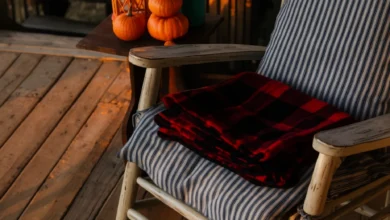

Fall arrives in American entryways long before it arrives in the weather. The first cool morning sends people to the front door with an armful of mums and a vague plan, which is exactly why Pinterest fills up with entry shots every August — everyone wants to see the finished version before they commit. What follows are 22 looks worth copying, from covered porches in Ohio to narrow city hallways where a slim table is the whole design. Some lean modern, some lean farmhouse, and a few take about an afternoon.
1. Warm Neutrals for Early Fall
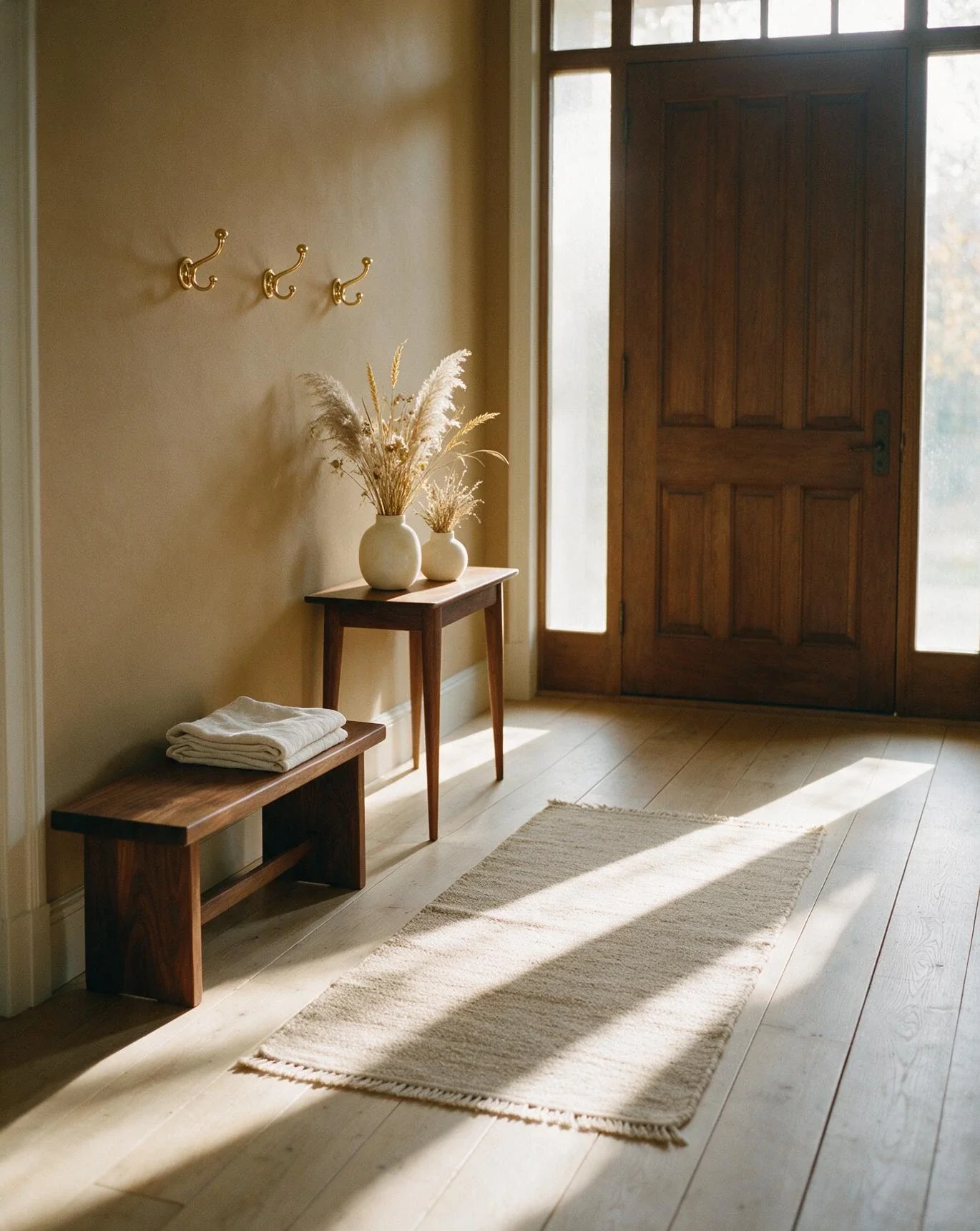
September still runs warm across most of the country, so the first seasonal change doesn’t need a single orange pumpkin. A neutral palette of oat, clay, bone, and soft camel carries autumn quietly. Indoor layers do the heavy lifting here: a nubby wool runner in place of the summer sisal, undyed linen on the bench, two pale ceramic vessels holding dried grasses. Keeping it simple means the entry still looks right in mid-October when the real color shows up outside.

The practical reason this works has nothing to do with taste. Entryways take abuse — wet shoes, dropped bags, dog paws — and a mid-tone neutral hides all of it far better than white or black. Choose a runner with texture rather than pattern, because texture reads as intentional even when it needs a vacuum. Wool and jute both bounce back after a month of traffic, and a washable cotton flatweave is worth the trade if your household runs on the muddy side.
2. Console Tables Dressed for Autumn
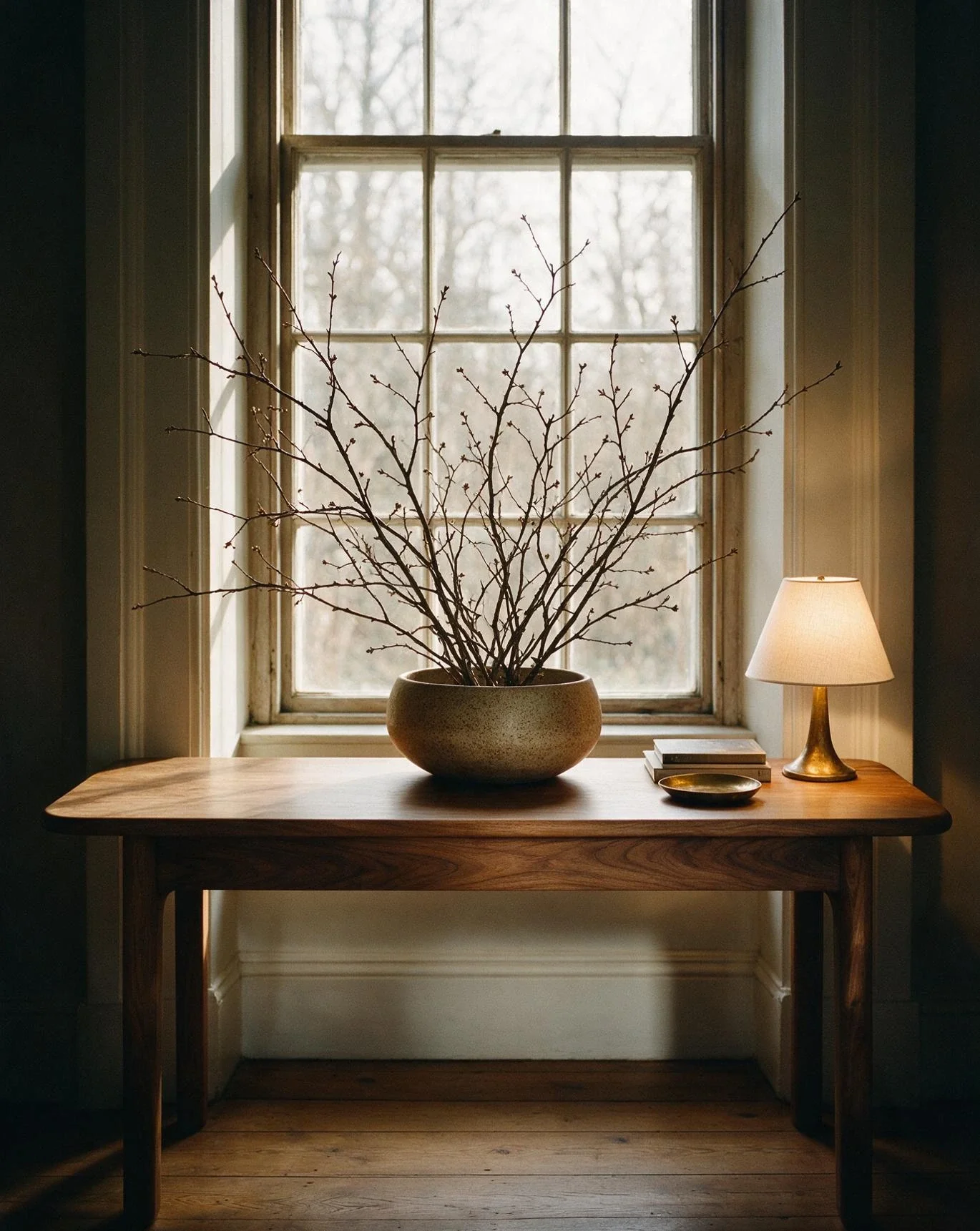
A narrow surface by the door does more seasonal work than any wreath. Console tables give you a stage: one tall branch arrangement, a stack of two books, a small lamp, and a shallow dish for keys. The trick to an elegant result is height variation — something tall, something low, nothing in the middle competing. Keep the table two-thirds full and let the wood show, because a crowded surface stops functioning the moment someone walks in holding groceries.

This setup earns its keep in a wide center-hall entry or along a blank wall opposite the stairs, where there’s room to walk past without turning sideways. Anything under about thirty inches of clear passage starts to feel like an obstacle course. In older Colonials and Craftsman homes the console often lands under a window, which gives the branch arrangement backlight for most of the afternoon and makes the whole arrangement look far more considered than it actually is.
3. Mums in Painted Pots
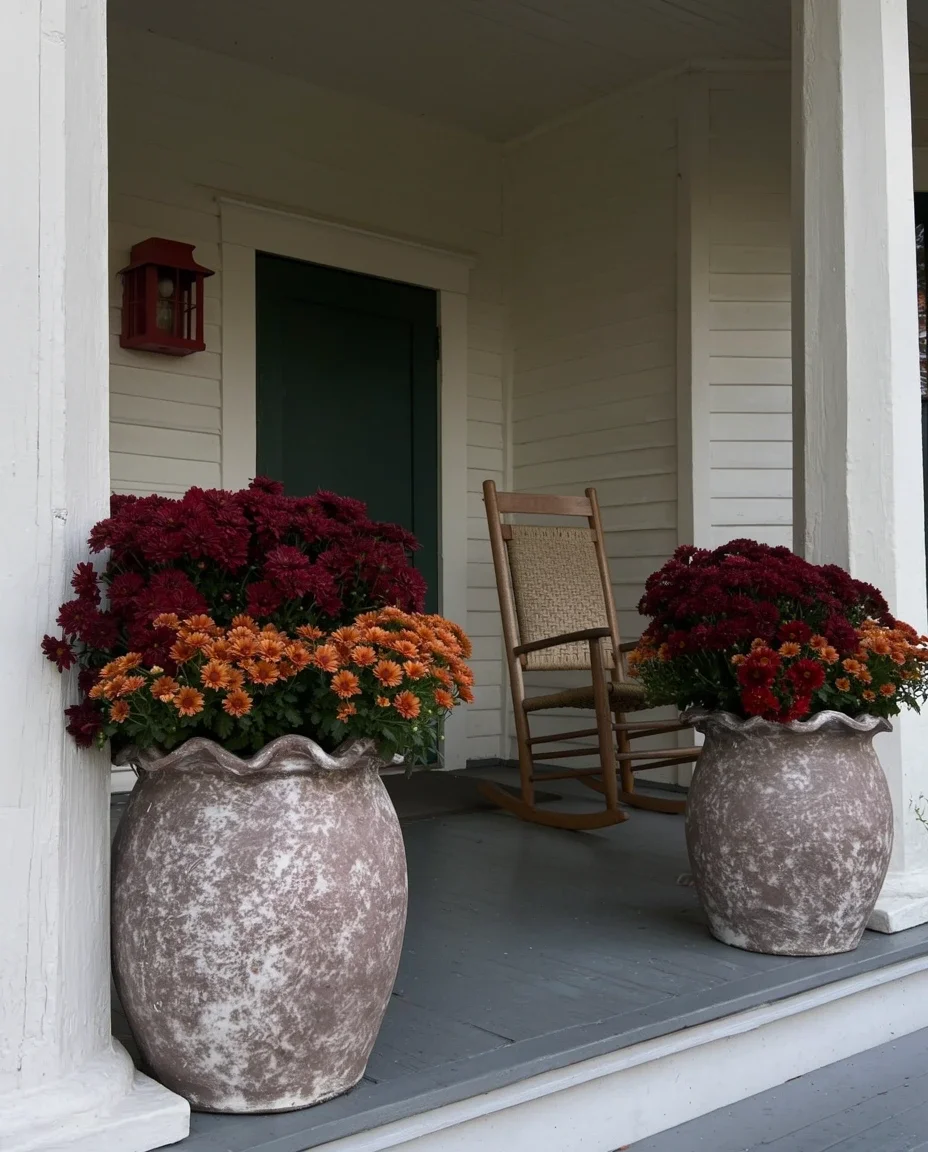
The nursery flat of mums is an American ritual, and the pot is what separates a nice porch from a great one. Skip the plastic grower container and drop each plant into a matte terracotta or hand-painted stoneware vessel. For outdoor mums, odd numbers photograph better — three pots stepped down the entry, or two flanking the door. Most porch ideas fail on scale, so size up: an outdoor pot always looks smaller once it’s next to the house.
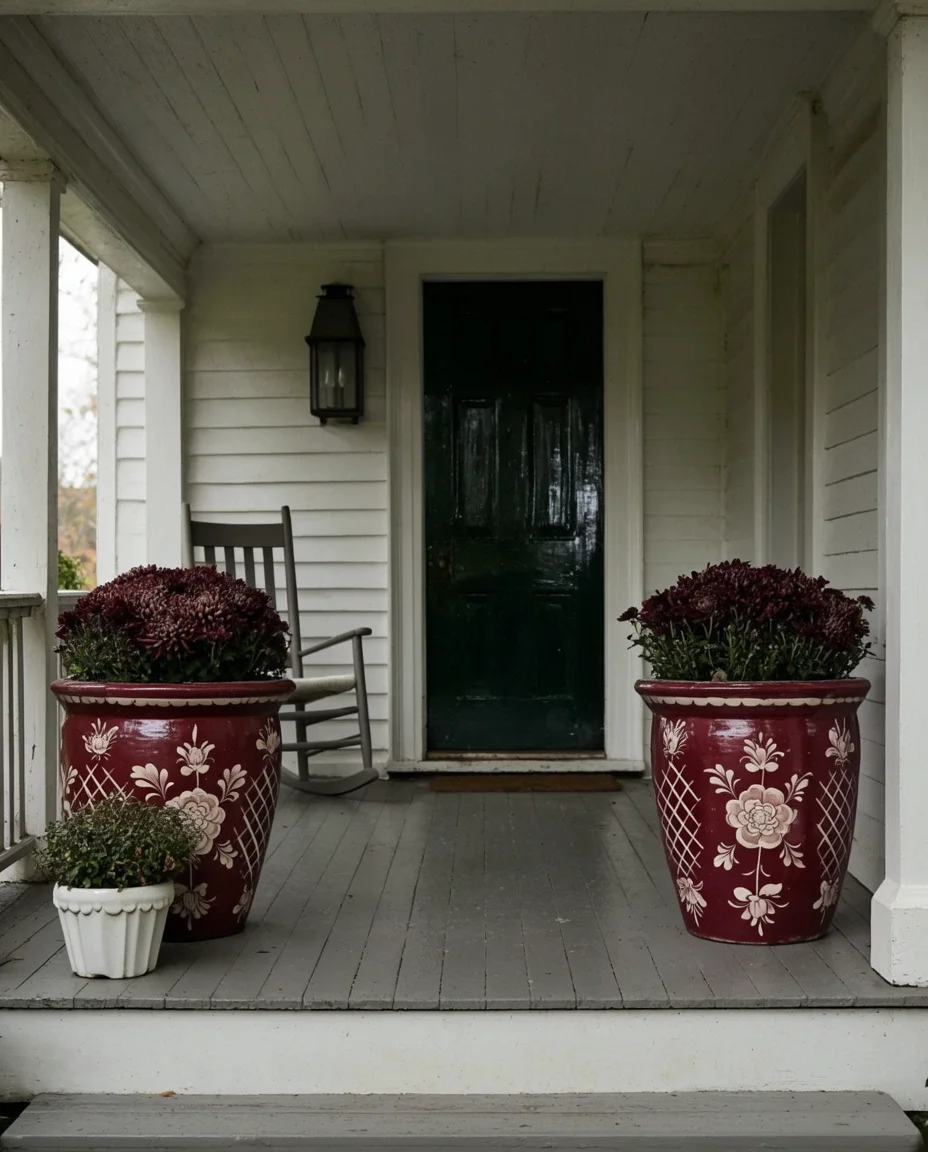
Regional timing matters more than people expect. In the Upper Midwest and New England, garden-center mums hit shelves in late August and are spent by Halloween, while gardeners in the Southeast can plant hardy varieties in the ground and get a second season out of them. If you’re buying for looks, choose plants with tight, barely-opened buds rather than full blooms — they’ll hold their shape through the whole stretch of trick-or-treaters and neighborhood open houses.
4. Rustic Crates and Dried Wheat

Stacked wooden crates give a porch instant structure, and they cost almost nothing at a flea market. Two crates turned on their sides become a low display for gourds and a lantern, while a third stands upright to hold a tall bundle of dried wheat. The rustic version leans on raw pine and jute twine; the polished version uses stained oak with clean corners. Either way it fits the outdoor farmhouse look without a single sign or slogan involved.

Stylists who shoot porches for a living tend to build these arrangements in a triangle and then remove one thing. The removal is the whole technique — three heights, one clear line of sight to the door, and negative space where the eye can rest. They also seal the wood before it goes outside, since untreated crates swell after the first hard rain and start to lean. A coat of exterior matte finish keeps the grain visible and the shape square.
5. Modern Porch with Clean Lines

Not every fall entry needs plaid and pumpkins. The outdoor modern approach uses one strong material and one strong shape: a black steel planter, a monolithic concrete bench, a single ornamental grass moving in the wind. Among porch ideas modern homes actually use, restraint wins — two objects placed precisely instead of eight arranged casually. A modern entry says autumn through color temperature and dried texture rather than through anything costumed.

Budget-wise this is the cheapest look on the list, because you’re buying two pieces instead of a cart full of small ones. A pair of powder-coated aluminum planters runs about sixty to ninety dollars each and lasts a decade outdoors; fill them with pampas or feather reed grass and you’re done for the season. The money that would have gone into disposable decor goes into one planter you’ll still be using in five years.
6. Double Doors in Deep Green

A painted door is the highest-impact change available for under fifty dollars. Deep forest, olive, and near-black green all read beautifully against brick, limestone, and white siding once the light turns golden. An outdoor double door setup needs matched wreaths rather than one centered on the seam — two smaller rings, hung at the same height, keep the symmetry honest. The result feels outdoor elegant without any additional decoration on the porch at all.

What homeowners actually do, according to paint retailers, is test the color on a poster board and carry it outside at three different times of day before committing. Green shifts hard in shade — a shade that looks sophisticated at noon can go gray by evening under a deep overhang. People also underestimate hardware: swapping a builder-grade knob for unlacquered brass or matte black at the same time makes the new paint look like a decision rather than a touch-up.
7. A Bench for Boot Season
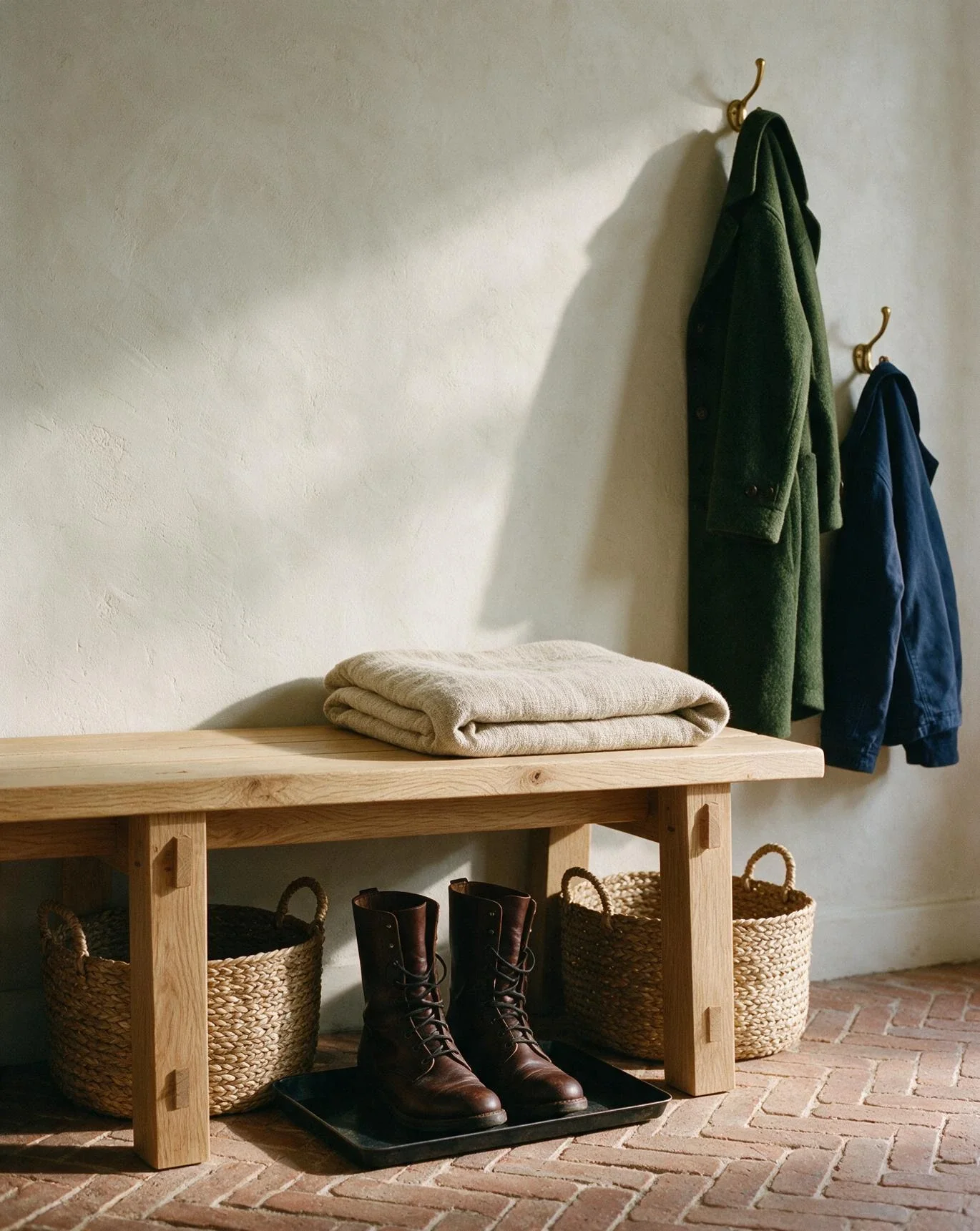
Once October hits, the entry becomes a boot depot whether you planned for it or not. A bench with open storage underneath solves it: baskets below for hats and gloves, a seat above for pulling shoes off, a shallow tray at floor level to catch the wet ones. Of all the seasonal ideas here, this is the one that changes daily life. Keep the upholstery neutral and washable, and the piece stays useful straight through March.

The usual misstep is choosing a bench that’s too deep for the hallway, which turns a seventeen-inch seat into a shin-height hazard every time someone comes through with a coat over one arm. Measure the clear floor width first and stay under a third of it. The second thing that goes wrong is skipping the tray — melted snow soaks into wood and leaves rings, and a low-profile metal boot tray costs less than refinishing anything.
8. Lamplight in the Entry

Overhead light flattens an entryway, and fall is when you notice, since you’re arriving home in the dark by early November. A small lamp on the console at roughly eye level changes the whole feeling of the room the second you open the door. Warm bulbs around 2700K give indoor spaces that amber cast people associate with the season. Pair a linen shade with a ceramic or brass base for something quietly elegant rather than merely functional.

A designer I know keeps a lamp on a smart plug by her own front door, set to switch on at four-thirty from October onward. She calls it the best twelve dollars she has ever spent on atmosphere, and she’s not wrong — walking into a lit entry instead of a dark one reorders the mood of the entire evening. The lamp reads as decor in photos and as a welcome in practice, which is a rare combination.
9. Simple Baskets and Wool Throws

Texture is what makes an entry feel like fall, and baskets deliver it with zero styling skill required. A tall seagrass basket beside the door swallows umbrellas; a flatter one holds rolled throws for the porch swing. This is the most simple layer available and the most forgiving — nothing has to match. For an outdoor cozy version, keep one wool blanket in a lidded basket on the porch so it stays dry between chilly evenings.
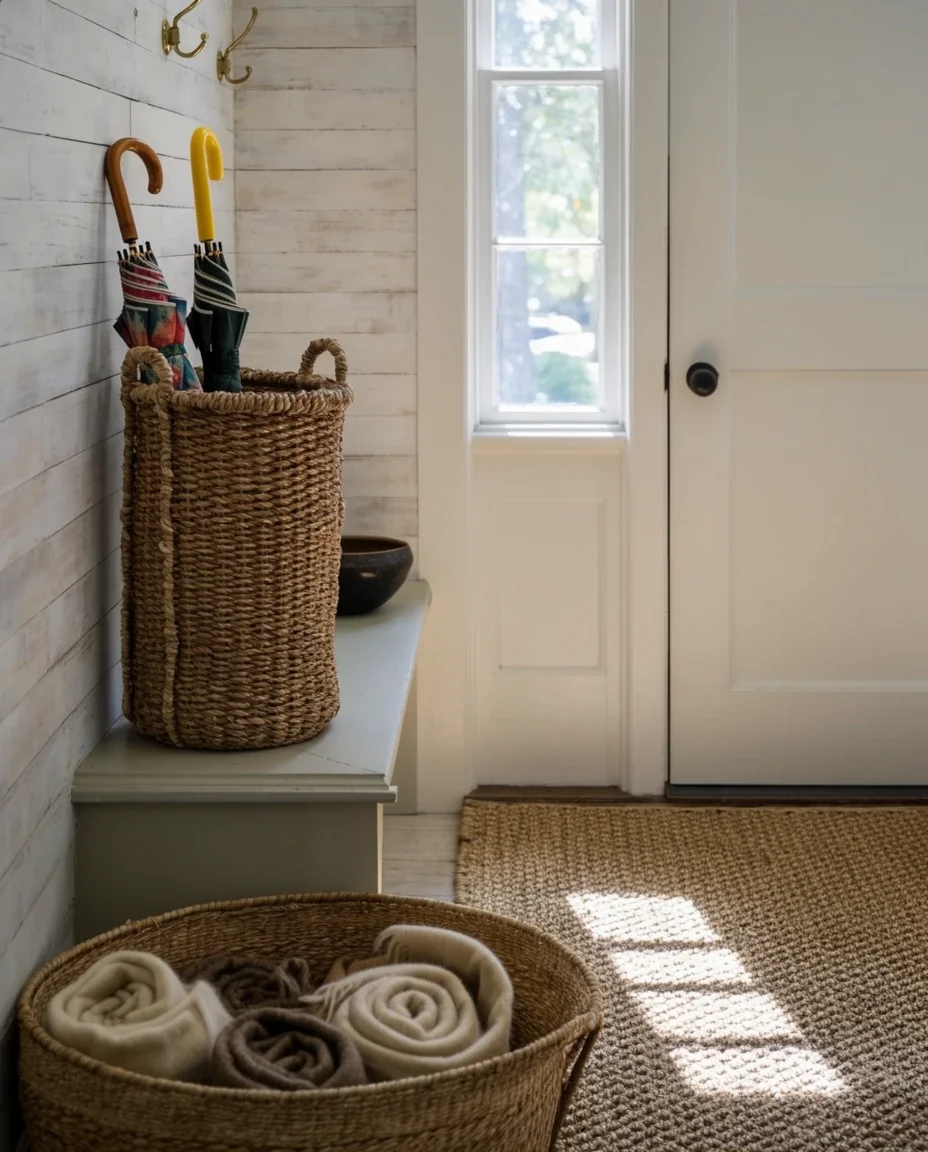
Buy the basket for its weave rather than its label. Hand-woven seagrass and rattan hold their shape for years, while machine-made paper-rope versions collapse at the rim once anything heavy goes in. Check the base: a flat, tightly bound bottom means the basket stands on its own when empty, which matters when it lives somewhere everyone brushes past. Two well-made baskets outlast five cheap ones and photograph considerably better in low light.
10. Farmhouse Porch Without the Clutter

The outdoor farmhouse look gets crowded fast — a bench, a swing, four pumpkins, a galvanized bucket, a doormat with a joke on it. Strip it to three elements and it turns handsome again: white shiplap or clapboard, one weathered-gray rocker, a generous pot of rust chrysanthemums. Among porch ideas this is the hardest edit to make and the most rewarding. An outdoor simple arrangement lets the architecture of the porch itself do the talking.

This restraint works best on a deep porch with a real roofline — the kind common across the Midwest and the mid-Atlantic, where six or seven feet of covered depth gives you shadow to compose against. On a shallow concrete stoop the same three pieces read as sparse rather than serene, so those entries usually want vertical interest instead: a tall planter, a lantern beside the door, something that draws the eye upward toward the trim.
11. Foraged Garland for the Stairs

An interior staircase visible from the front door is a gift, and a garland is the cheapest way to use it. Wind a length of jute rope along the handrail, then tuck in eucalyptus, oak branches, dried hydrangea, and a few sprigs of bittersweet. The stairs become the focal point the moment someone steps inside. As diy projects go it’s forgiving — asymmetry is the point — and a rustic mix of foraged material always beats a uniform store-bought strand.

Cut branches on a cool morning and give them an hour in a bucket of water before you wire anything, or the leaves curl by dinner. Attach the garland to the underside of the rail with floral wire rather than over the top, so hands still land on bare wood going up and down. Dried elements can stay for months; anything fresh wants replacing every two weeks, which is why most people build a base of dried material and add fresh sparingly.
12. Elegant Brass and Cream Pumpkins

Cream pumpkins are the reason this look reads as refined rather than seasonal-aisle. Set three Lumina or Casper varieties on a brass tray with a pair of tapers, and the arrangement lands somewhere between harvest and dinner party. An elegant entry needs metal to catch light, so unlacquered brass, aged bronze, or antique silver all earn their place. The same formula scaled up on a covered step turns outdoor elegant, and it sits comfortably in a modern house.

Florists who style residential entries repeat one rule about this palette: limit yourself to two metals and one organic color, or the tray starts to look like a collection. They also stand the tallest pumpkin off-center and let the smallest overlap the tray’s edge, because perfect centering reads as merchandising. Real pumpkins hold up indoors for six to eight weeks in a cool entry, longer if the stems stay intact and nothing sits in direct afternoon sun.
13. DIY Wreath in Twenty Minutes
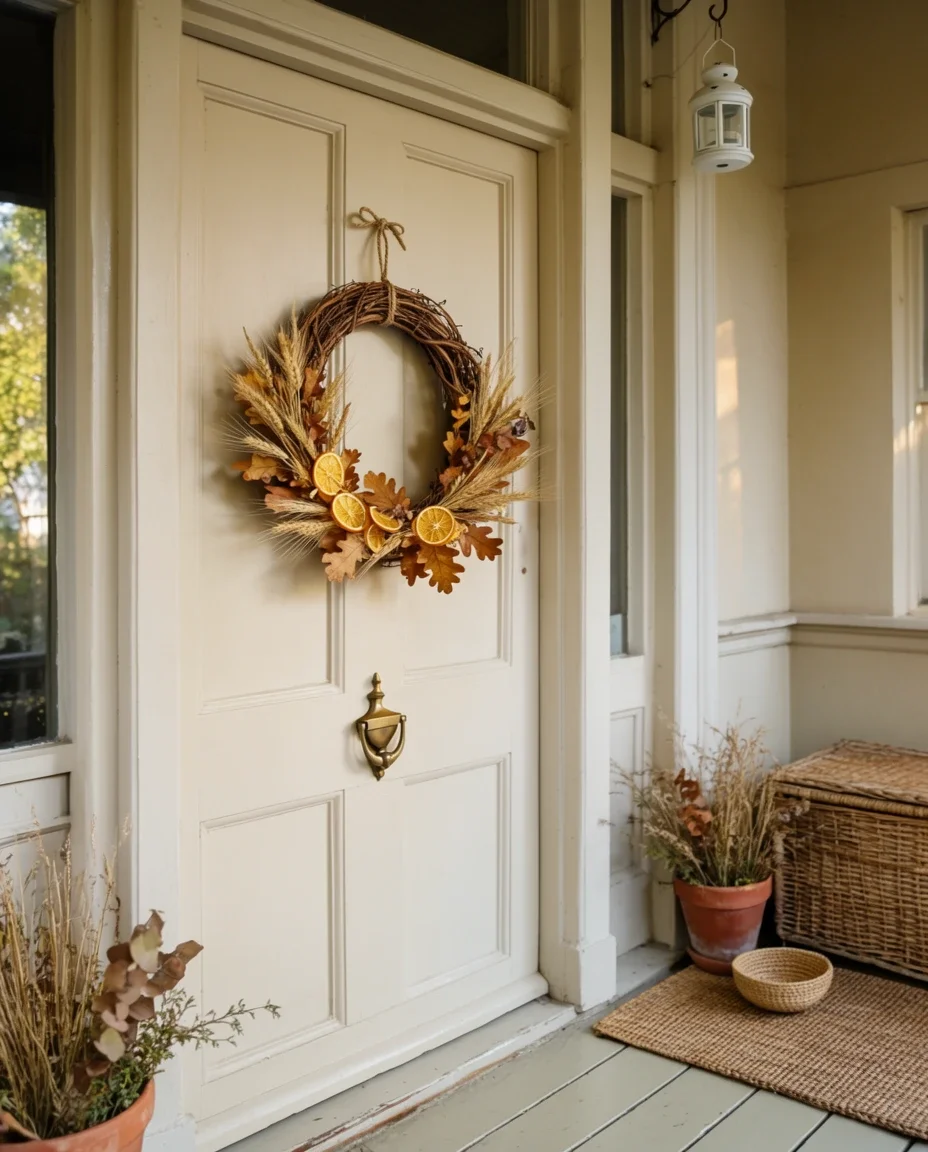
Start with a bare grapevine base, a spool of floral wire, and three kinds of dried material — wheat, preserved oak leaves, and a handful of dried orange slices or seed pods. Work in one direction, overlapping each bundle so the stems stay hidden. This diy takes about twenty minutes and looks nothing like the packaged version. Keep it simple with two materials if you’re unsure, and hang the finished outdoor diy wreath under cover so weather doesn’t shorten its life.

The whole project runs about twenty-five dollars if you buy the base new and considerably less if you cut your own vine in October. Craft-store dried bundles cost six to eight dollars apiece and one bundle covers a third of an eighteen-inch ring, so three is the number. Compare that with sixty-plus for a decent finished wreath and the math makes itself, especially since the grapevine base gets reused every year with new material.
14. Cozy Layers Over Cold Concrete
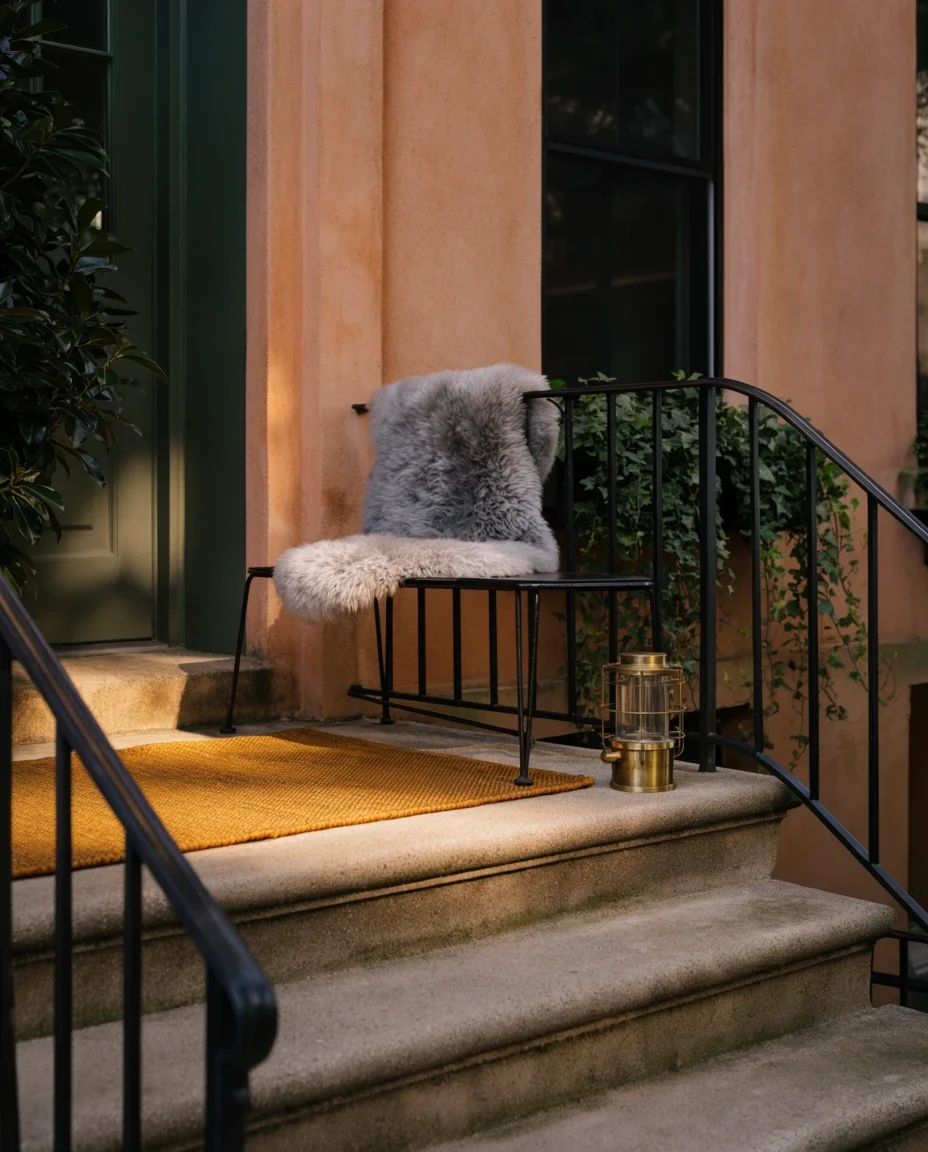
Plenty of American front entries are a concrete slab and three steps, and that’s a workable canvas. Layer a large flatweave outdoor rug over the slab, then a smaller coir mat at the threshold. Add a narrow bench against the house with a wool throw folded on one end. The outdoor cozy effect comes from softness meeting hard material, and it makes an outdoor landing feel like a room rather than a pass-through.
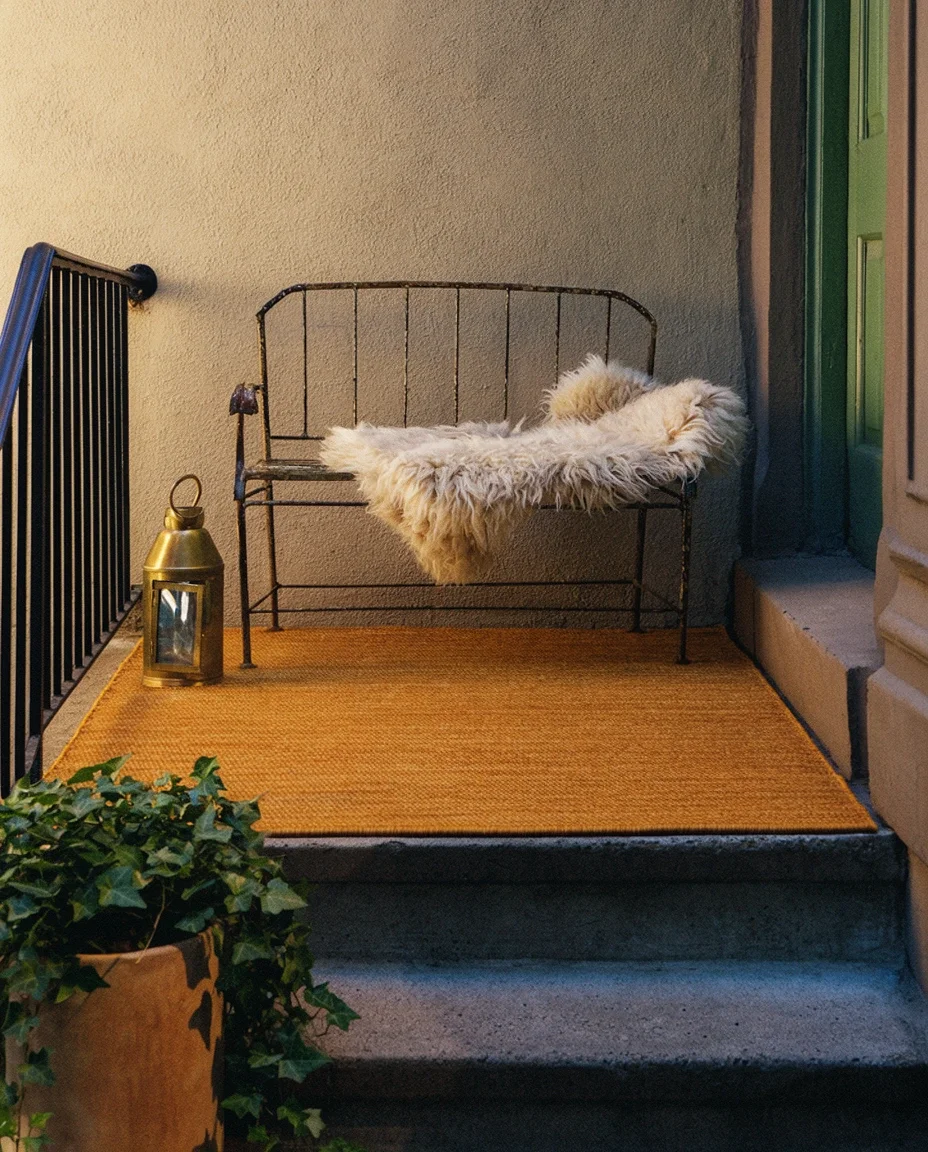
People shop for the rug first and then wonder why it curls at the corners by November. What actually happens in most households is that the rug gets replaced twice before someone buys a polypropylene flatweave with a rubber-backed pad underneath, which stays flat and dries in an afternoon. Bring it in for a rinse once a month during leaf season; grit ground into the fibers is what wears an outdoor rug out, not rain.
15. Indoor Drop Zone for Wet Days

Fall is when the entry has to work, not just look good. A proper drop zone gives every wet thing a destination: hooks at two heights, a slim table for mail and keys, a lidded basket for dog leashes. Indoor entries in older homes rarely have a closet, which is why these open systems have taken over. Of all the ideas on this list, this is the one guests notice least and your household appreciates most.

The mistake almost everyone makes is mounting hooks too high — sixty-six inches looks right on paper but leaves a coat’s hem brushing the wall and puts kids’ jackets out of reach. Set the upper row at about fifty-eight inches and a lower row at forty, and both parents and children stop draping things over the newel post. Anchor into studs or use toggle bolts, because a loaded row of coats pulls far harder than a bare rail suggests.
16. Sculptural Gourds and Beeswax Candles

Swan-neck gourds, warty Hubbards, and pale green Kabocha look like objects rather than produce, which is why designers keep reaching for them. Group three on a linen runner with two beeswax tapers in low brass holders. The neutral green-and-bone palette suits console tables in a hallway or a dining sideboard just as well, and the sculptural shapes hold their own in a modern room where a carved jack-o’-lantern would feel out of place entirely.

My neighbor buys hers every year from the same farm stand outside Lancaster, and the woman who runs it told her to wipe each gourd with a dry cloth and never with water. Two seasons in, the same three gourds are still sitting on her hall table looking sculptural. Cured, hard-shelled varieties genuinely last that long indoors, which makes a fifteen-dollar farm-stand haul the best value in the entire autumn decorating budget.
17. Copper Lanterns in Low Light
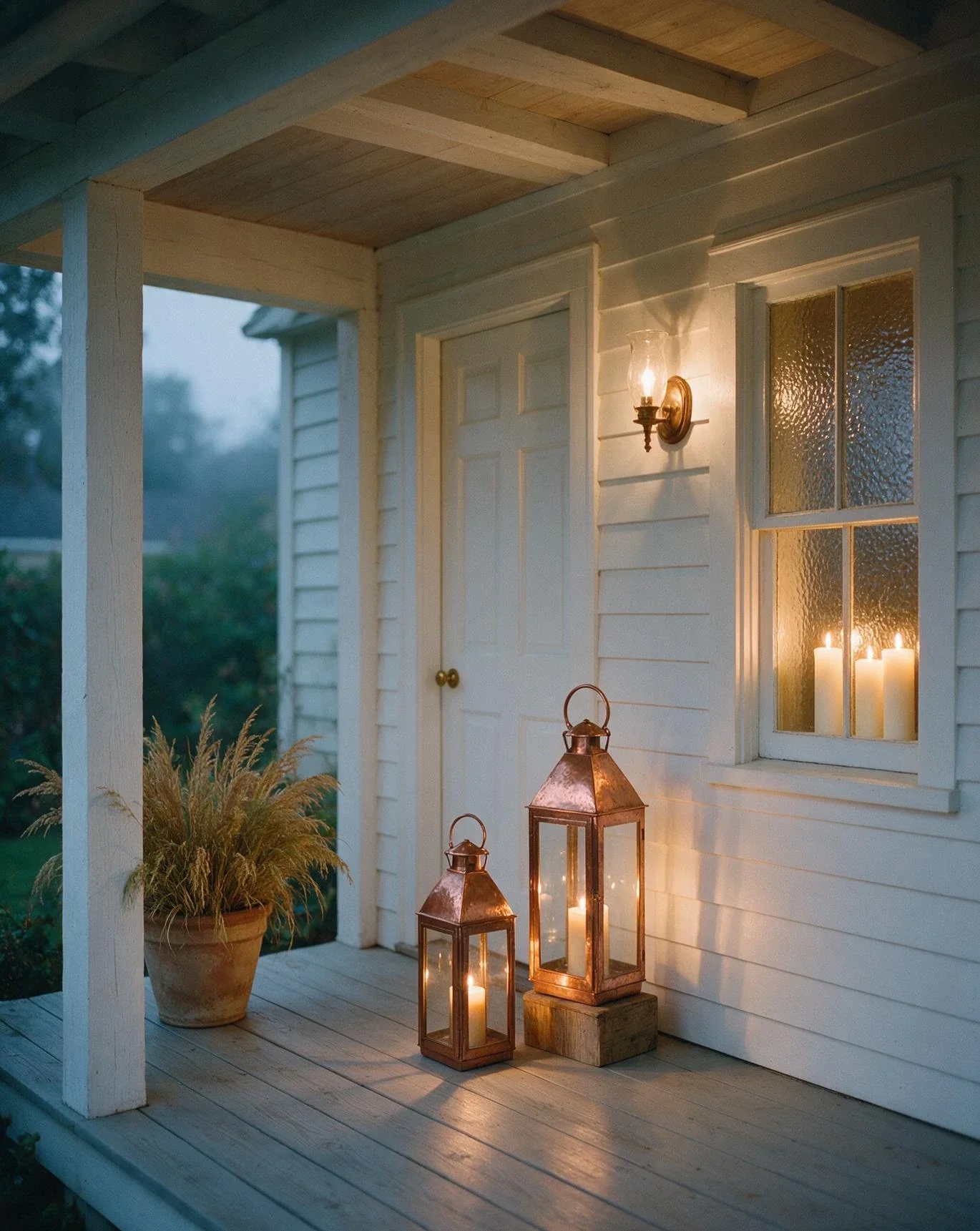
By late October the porch is dark before dinner, and a lantern does what a bare fixture can’t. Set two copper or blackened-steel lanterns on the step beside the door, sized differently, each holding a wide pillar candle. A wall lamp handles the practical light while the lanterns supply the glow. On an outdoor landing this is the fastest route to outdoor cozy, and it costs nothing to repeat on either side of the walkway.

Use flameless pillars with a warm flicker if the lanterns sit anywhere near the door swing or a passing pant leg. The good ones run on a six-hour timer, so they come on around dusk and shut off on their own, and nobody has to remember anything. Glass panels matter too: seeded or slightly wavy glass scatters light across the siding, while flat clear glass just shows you the candle sitting inside it.
18. Bloxburg Entry Ideas for Fall

Virtual builds have quietly become a design sketchbook, and autumn entries are one of the most-copied builds going. A bloxburg foyer follows the same rules as a real one: a symmetrical pair of planters, a runner that pulls the eye forward, warm lighting instead of white. The ideas that translate best into a real house in 2026 are the restrained ones — two colors, one texture, and a clear path from the door to the stairs.
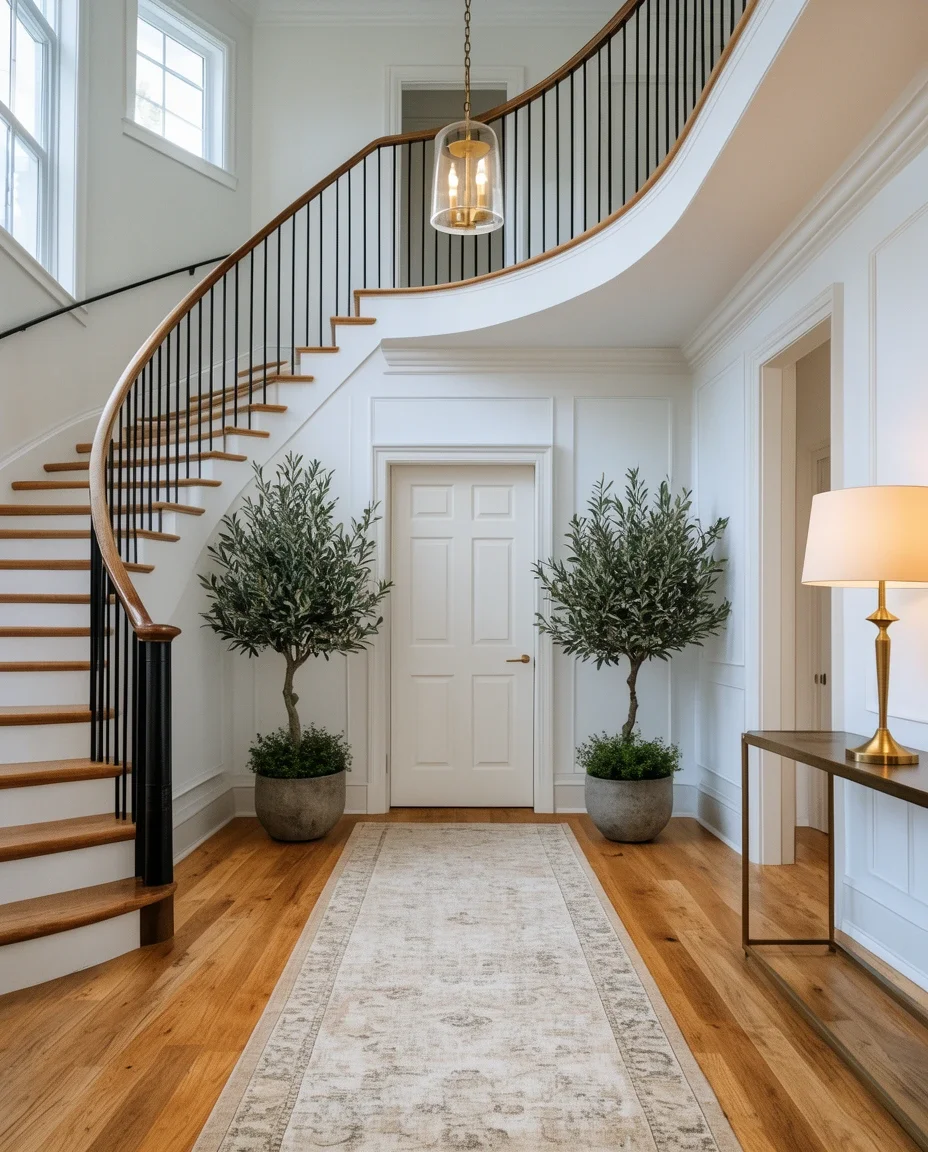
The translation works best in new-construction two-story entries, where the ceiling height and blank drywall match what the game gives you almost exactly. Split-levels and older Capes need more editing, since a low ceiling makes the tall arrangements look crowded. Anyone working with under eight feet overhead is better off borrowing the color palette and the symmetry and leaving the double-height chandelier moment where it came from.
19. A Woven Runner Underfoot

Nothing shifts an entry’s mood faster than what’s on the floor. A hand-loomed wool runner in rust, ochre, or faded indigo warms a hallway instantly, and the same weave carried up the stairs as a stair runner ties two levels together. In indoor entries with wood floors, leave four to six inches of floor showing on each side. The look stays simple because the rug is the only pattern in the room and everything else stands back.
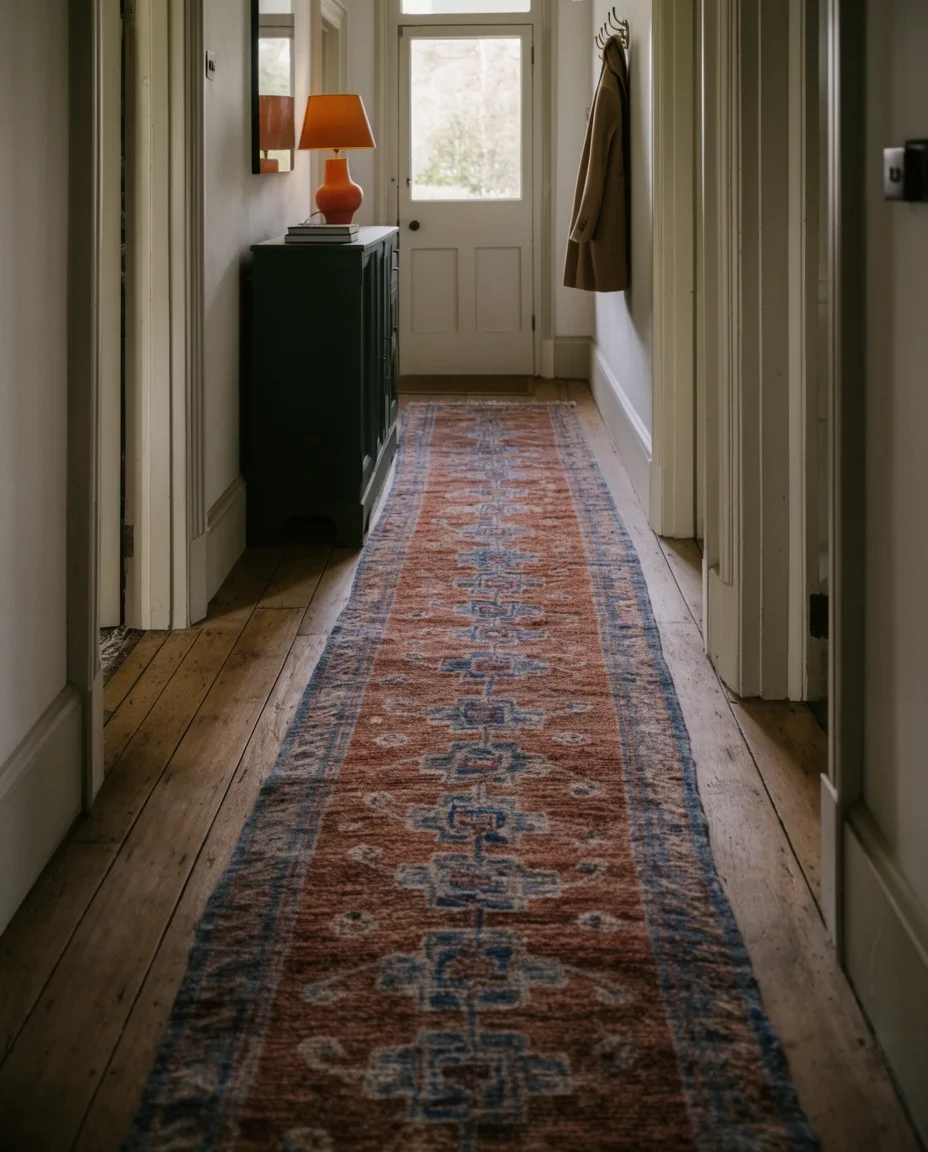
Vintage Turkish and Persian runners have become the default choice in American entries for a reason beyond looks — an older wool rug with an already-softened pile hides autumn grit in a way a new flatweave simply doesn’t. Dealers in Chicago and Atlanta sell plenty of eight-foot runners in the three-to-five-hundred range, and the wear those pieces already carry is exactly what makes them survive a season of boots without looking tired.
20. Slim Tables in Tight Hallways

Apartment entries and narrow rowhouse halls need furniture measured in inches. A ten-inch-deep table against the wall gives you a landing spot without stealing passage, and wall-mounted versions free the floor entirely. The best console tables for tight spots have open bases and slender legs, since visual weight matters as much as actual footprint. Keep the surface styling neutral and low so the hallway still feels like a hallway rather than a storage corridor.

Space planners generally want thirty-six inches of clear walkway and will accept thirty in an entry that isn’t the main route through the house. Below that, mount a floating shelf at thirty-two inches instead and hang a mirror above it — the reflection buys back the depth the hall doesn’t have. A mirror opposite a window is the oldest trick in the book and still the most effective one in a dark autumn hallway.
21. Amber Glass and Candle Glow

Amber and smoke-colored glass does something to lamplight that no other material manages — it turns the whole entry the color of late afternoon. Cluster three vessels of different heights near the lamp, one holding dried stems, two empty and simply catching light. An elegant grouping needs the shapes to differ more than the colors do. Set it against a rustic surface like unfinished oak or old pine, and the contrast between rough and translucent carries the arrangement.

Thrift shops and estate sales are full of this glass at two to five dollars a piece, which makes it the rare seasonal buy where a large grouping stays cheap. New hand-blown amber vases from a home store start around thirty. Buy secondhand and spend the difference on one good candle — a beeswax or soy pillar with a clean burn is what people actually remember about walking into a room in November.
22. Modern Rustic Mix for 2026

The direction everything seems to be heading for 2026 is a blend rather than a style: raw wood against blackened steel, dried grasses in a hard-edged planter, handmade ceramic on a machine-smooth surface. An outdoor modern entry gains warmth from one weathered element, and the sharpest porch ideas modern builders are using now depend on exactly that tension. One rough material, one refined one, and a palette that stops at three colors total.

What people tend to do once they try this mix is keep going until the balance tips, adding a fourth wood tone and a second metal until the entry reads as busy again. The households that get it right usually stop after three purchases and live with the arrangement for a week before deciding anything else is needed. More often than not, nothing is, and the money goes toward a better doormat instead.
Somewhere in those twenty-two looks is the one that fits your front door, your climate, and the amount of energy you actually have this month. Tell us in the comments which entry you’re recreating this fall, and what’s worked in your own house — the best ideas here always come from readers.