
Fall arrives on the coffee table before it arrives anywhere else in the house. It’s the surface everyone circles — where the remote lands, where coffee cools, where guests set down a glass — so a small seasonal shift there changes the whole room’s mood without a single furniture purchase. That’s exactly why American Pinterest boards fill up with autumn tabletop shots every August, long before the leaves actually turn. Below are 21 styled looks, each one broken down so you can see what’s on the tray, how the pieces relate, and why the arrangement holds together.
1. Warm Neutrals on a Round Tray

Oatmeal, bone, mushroom, faded wheat — a neutral palette reads as autumn the moment you swap in matte textures instead of glossy ones. A round tray in pale rattan or limewashed wood gathers three or four low vessels into one soft island on the table, which keeps the living room feeling open rather than crowded. Dried bunny tails, a stubby ceramic jug, and two ivory candles are honestly enough. The color story stays quiet so the texture does all the talking.

The trick most people miss is height variation. Three objects of identical stature turn into a fence, visually, and your eye skims right past them. Stylists usually work in a rough 3-2-1 ratio — one piece tall enough to break the sightline, one mid-height, one low and wide — and that small hierarchy is what separates a considered vignette from a cluster of things. Set the tallest piece off-center, slightly back, and let the shortest sit closest to the tray’s edge.
2. Vintage Brass and Dried Hydrangeas
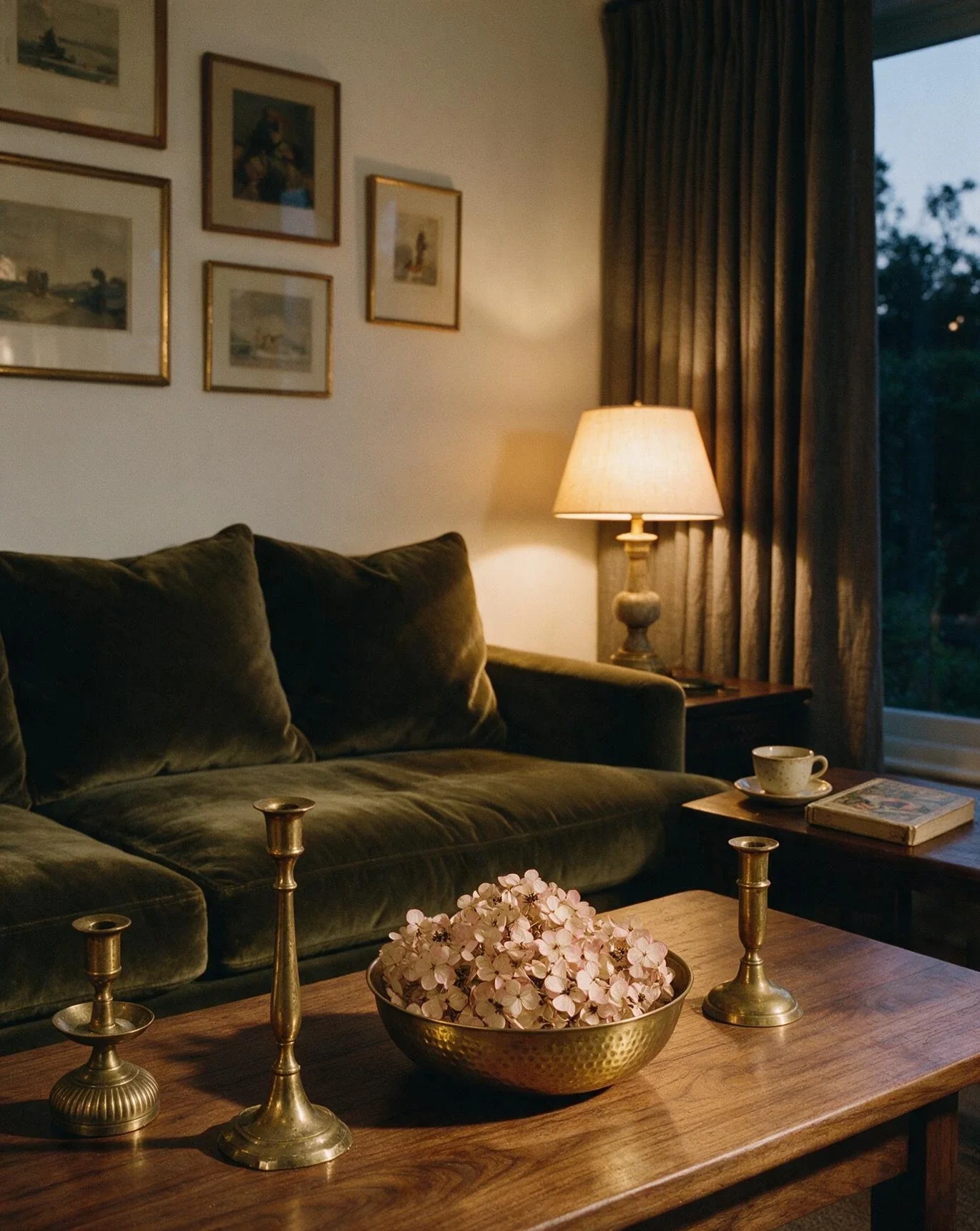
Brass warms up the second the light goes amber in September, which makes it the most seasonally intelligent metal you can own. A trio of vintage candlesticks with mismatched heights, a shallow brass bowl, and one loose armful of dried hydrangea heads makes a look that feels inherited rather than shopped. Among fall centerpieces for 2026, this is the one that photographs best in low light — brass catches every flicker and throws it back into the room.

Estate sales and church rummage tables are where this look actually comes from, and prices reflect that: single brass candlesticks routinely go for three to eight dollars, while a new reproduction runs thirty. Buy the tarnished ones. A soft cloth and a little ketchup — yes, really — cuts the film in about ten minutes, and you’re left with a mellow patina no factory finish replicates. Five candlesticks for the price of one is a fair trade for ten minutes of polishing.
3. A Moody Autumn Centerpiece

Deep aubergine, oxblood, forest, near-black plum — the moody direction skips orange entirely and goes straight for the shadowy end of the harvest. On tray coffee tables, darkness needs an anchor, so start with a black lacquer or dark walnut base and let dahlias, plums, and smoked glass build upward from there. The decorations stay sparse on purpose. Two or three saturated notes against a dark tray hit harder than a dozen scattered pieces ever could.

This palette wants a room that can carry it — north-facing spaces, rooms with deep wall color, apartments where the afternoon light comes in slantwise and low. In a bright white beach-adjacent living room the same arrangement can read heavy, almost funereal. But put it in a Chicago three-flat with olive walls in late October, one lamp on, and it becomes the warmest corner in the house. Match the mood to the light you actually have.
4. Coastal Fall Without the Orange

Autumn on the water looks nothing like autumn in the Midwest. A coastal take on fall leans into driftwood grey, faded indigo, pale sand, and the soft green of eucalyptus — cool tones that still feel seasonal because the textures turn rough and dry. These tray ideas stay deliberately simple: a weathered bleached-wood tray, a bowl of unpainted gourds, one small vase of dried sea lavender. Nothing shiny, nothing bright, everything a little sun-faded.

Designers who work along the New England and Carolina coasts talk about this as “shoulder season styling” — the stretch between beach summer and holiday, when clients want warmth without abandoning the palette their whole house is built on. Their standard move is to hold the colors steady and change only the materials: linen out, wool in; fresh stems out, dried in. It’s a quieter approach to fall, and it means nothing clashes with the room you already love.
5. Rectangle Tray for Long Tables

A long, low coffee table needs a shape that echoes it. A rectangle tray running parallel to the table’s length gives the arrangement a spine, and everything you place inside it reads as intentional rather than adrift. This is the most elegant option for oversized sectionals and generous rooms, where a small round tray simply disappears. For tray living room setups on tables over 50 inches, longer almost always looks better than rounder.
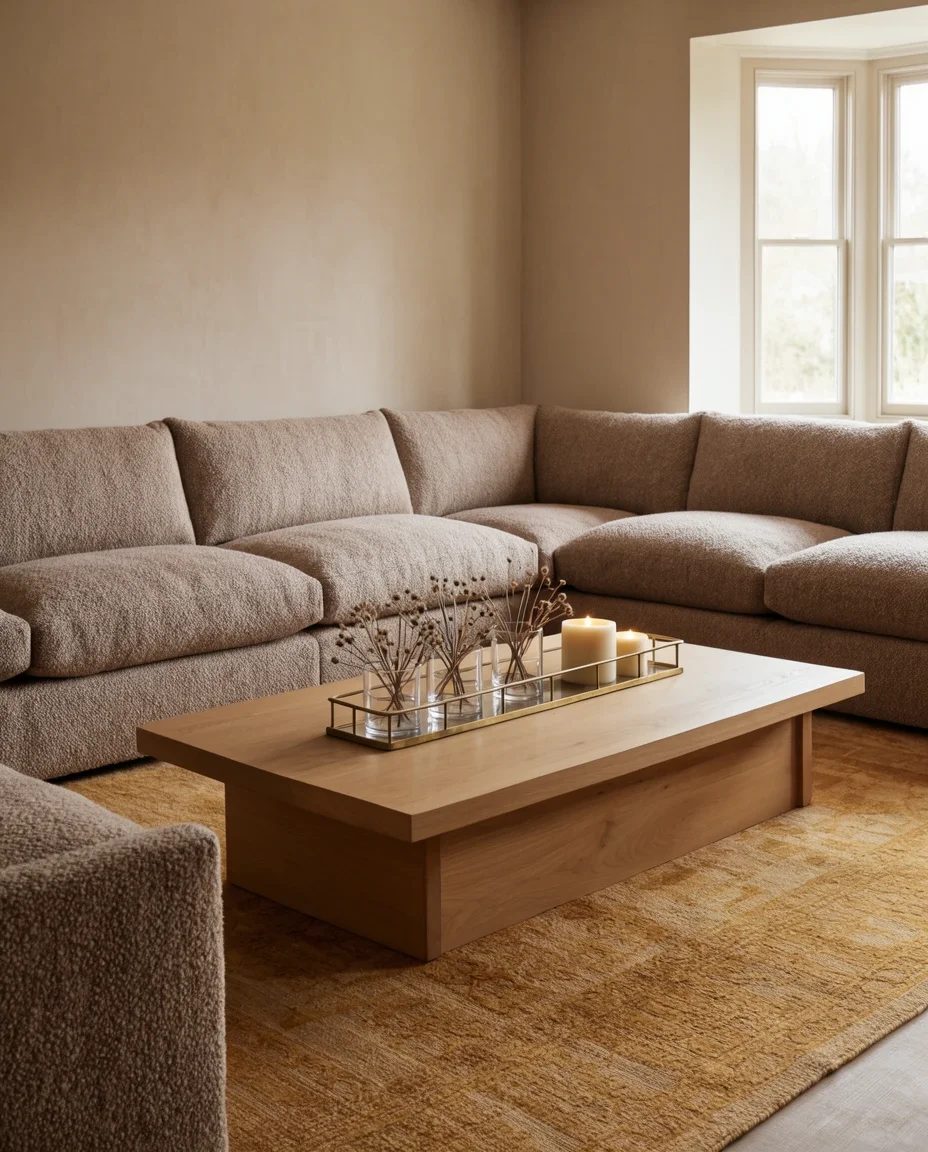
Measure before you buy, because the eye is a liar here. A tray should span roughly half to two-thirds of the table’s length — any shorter and it floats, any longer and there’s nowhere left to put a mug. On a 54-inch table, that puts you somewhere between 27 and 36 inches. Take a tape measure to the table, mark the span with painter’s tape, and live with it a day before ordering anything.
6. Cottage Pumpkins in Milk Glass

Milk glass and miniature white pumpkins were made for each other, and the cottage version of fall leans hard into that pairing. Pile Baby Boo and Casperita pumpkins into a footed milk-glass compote, add a small round dish of acorns, and finish with a sprig of something green from the yard. It’s the most direct route to creating a cozy atmosphere on a budget, because the produce aisle is doing most of the design work.

My aunt in rural Ohio has done a version of this every year since I was small, always with the same chipped compote from her mother, always with pumpkins from a hand-lettered roadside stand two miles down the county road. Real pumpkins last six to eight weeks indoors if you keep them off a heat vent and wipe them dry after handling. She replaces hers exactly once, mid-November, then swaps in pine and calls it done for the year.
7. Elegant Candlelight and Amber Glass

Amber glass does something no other material manages: it turns a plain flame into a pool of honey-colored light. Group three or four elegant amber votives with one taller smoked-glass hurricane, set them on a dark tray, and the living room shifts temperature the moment you strike a match. Fall centerpieces built around light rather than objects have an advantage — they change through the evening as the candles burn down and the shadows lengthen.

Lighting designers will tell you the number that matters is the flame’s height relative to a seated person’s eye. Below eye level, candlelight flatters and warms; at eye level it glares and everyone squints across the table at each other. On a standard 17-inch coffee table with a sofa at 18 inches, that means votives and short pillars, not tapers. Save the tall candlesticks for the dining table where the geometry actually works.
8. Minimal Styling with Three Objects

Three objects. That’s the whole brief. A minimal autumn table might hold one hardback book, one small bowl of chestnuts, and one bud vase with a single dried stem — and it will look more expensive than a table carrying twelve things. Keep the tray simple, ideally in a single material with no pattern, and let negative space function as a design element. This is the modern approach, and it’s forgiving of small rooms.

What happens in real homes, though, is drift. You start with three objects in September and by Halloween there are seven, because every small pretty thing that passes through the room ends up there. The fix is a rule, not willpower: one in, one out. Households that keep a shallow basket on a nearby shelf as a holding spot for displaced objects tend to hold the look all season. Everyone else is back to twelve things by November.
9. Pink Dahlias for Early Fall

Early September isn’t really orange yet, and dusty pink dahlias bridge the gap beautifully — still summery in shape, already autumnal in that faded, tea-stained shade. Cluster them low and dense in a footed bowl on a round tray, add a few figs or plums for weight, and skip everything else. Seasonal decorations don’t have to announce themselves. This one just looks like flowers, which is precisely why it works in a room that isn’t very rustic.
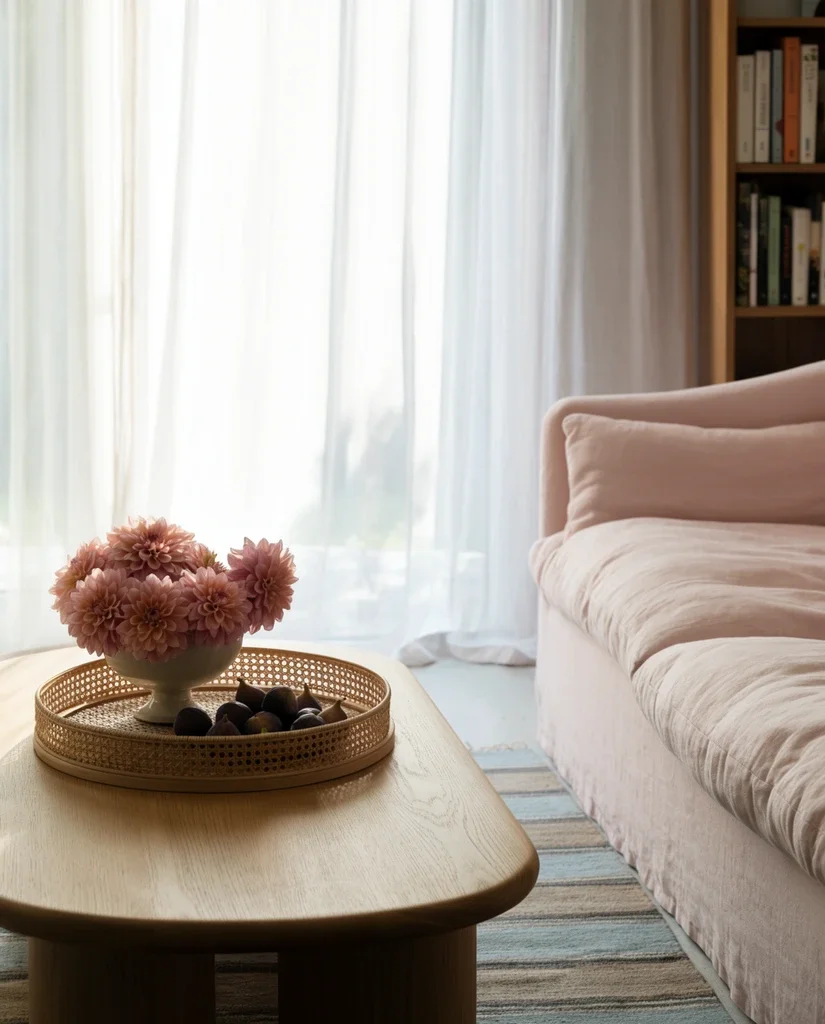
Farmers’ market dahlias run three to six dollars a stem at most American markets in season, and you need five to seven for a dense low bowl — call it twenty-five dollars for two weeks of color. Buy them tight, with the outer petals just opening, and change the water every other day. Late-season vendors often discount by the bucket in the last hour, which is how you get fifteen stems for the price of six.
10. Modern Sculptural Gourds

Some gourds are shaped less like produce and more like small abstract sculptures — swan-necked, ribbed, oddly pale. Set two or three of those on a square tray with nothing else, and the effect turns almost architectural. This is the modern reading of harvest décor, stripped of gingham and hay and left to stand on shape alone. A neutral stone or matte black tray keeps the focus on silhouette rather than color.
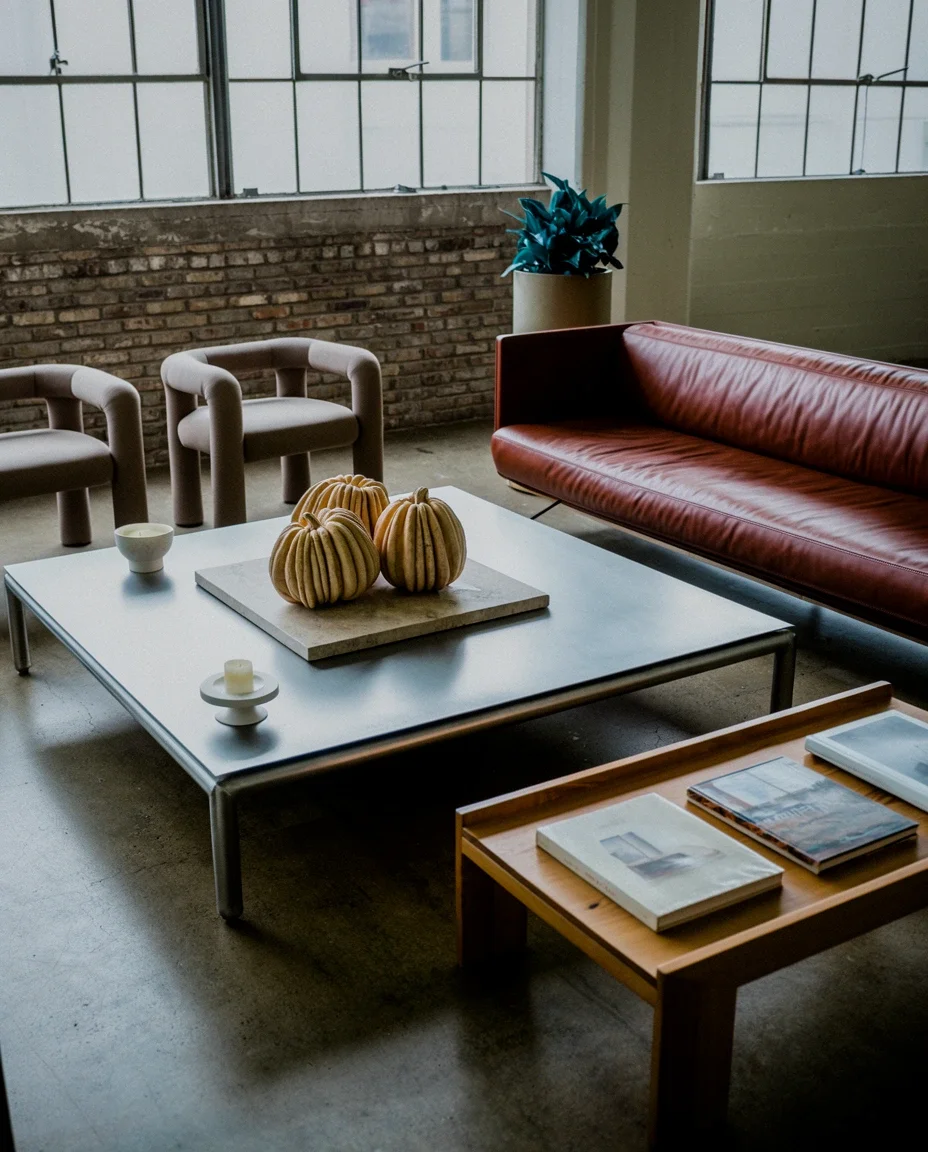
This look belongs in rooms with hard edges to soften — a loft with concrete floors, a mid-century living room with low-slung walnut furniture, any space where a pile of orange pumpkins would feel like a costume. It also does well in open-plan homes where the coffee table sits in a sightline from the kitchen, because the forms hold up when viewed from twenty feet away. Fussy vignettes don’t survive that distance; sculptural ones do.
11. Square Tray Layered Books

Books are the most underrated tool in tabletop styling — they add height, introduce color through their spines, and give smaller objects a plinth to stand on. Stack two or three large-format hardbacks inside a square tray, then set a candle and a small vessel on top of the pile. Among tray coffee tables arrangements this is the most flexible, and it stays simple enough to leave up long after the season turns.

Pull the dust jackets off if the printed covers are loud. Underneath, most publishers use plain cloth or paper in ochre, oxblood, or deep green — colors that happen to be exactly right for October, and far quieter than a glossy jacket photograph. Arrange them largest on the bottom, rotated slightly so the corners don’t align perfectly, and the stack reads as casual instead of stacked. It’s a two-minute edit that changes the whole tray.
12. Halloween Charm Without the Kitsch

You can do Halloween on the coffee table without a single plastic skeleton. The grown-up version runs on vintage materials and a restrained palette — mercury glass, black wax tapers, a cluster of inky Black Beauty pumpkins, one antique brass candle snuffer left in the tray. Keep it moody rather than spooky, and the arrangement carries you from the first week of October straight through Thanksgiving with only a small swap.

The one thing to plan around is scent. A coffee table sits at nose height for anyone on the sofa, and a strongly fragranced candle at that range competes with whatever you’re drinking and overwhelms the room within twenty minutes. Unscented black tapers give you the visual drama with none of that, and if you want fragrance, put a scented candle across the room on a console instead. The nose and the eye want different things here.
13. Simple Baskets Instead of Bowls

Swap the ceramic bowl for a shallow woven basket and the whole table softens. Seagrass, split oak, coiled pine needle — any of them bring a simple, hand-made warmth that glazed pottery can’t. Borrow the shape from the tray kitchen world, where flat gathering baskets have always held bread and fruit, and fill it with acorns, walnuts, or small dried corn. It’s the shortcut to a cottage feeling in a room that’s otherwise fairly plain.

Basket weavers make a distinction worth knowing about: a tightly woven basket holds small loose contents, while an open-weave one is meant for bulk — pinecones, gourds, larger things that won’t slip through. Filling an open weave with acorns means finding acorns under the sofa for months. Match the weave density to what you’re putting in it, and check the base sits flat, because a slightly domed bottom will rock every time someone sets down a cup.
14. Copper, Rust, and Cream Together

Three colors, properly balanced, beat a whole rainbow of autumn shades. Copper supplies the shine, rust the depth, cream the breathing room — and the ratio that works is roughly 60 percent cream, 30 percent rust, 10 percent metal. Most tray ideas for 2026 lean toward exactly this kind of tight, considered palette rather than the maximalist harvest look. In a living room with warm wood floors, the three tones knit right into the architecture.

Interior colorists frame this as choosing a dominant, a secondary, and an accent, then holding the line — the discipline is in refusing the fourth color, not in picking the first three. Once mustard or sage joins the group, the arrangement stops reading as a palette and starts reading as whatever was in the closet. If a piece you love falls outside the three, move it to another surface in the room where it can lead its own small scheme.
15. Stacking Books Under a Bud Vase

The smallest arrangement in this whole list, and one of the prettiest: two books, one narrow bud vase, one stem. A single dried allium head or a curl of eucalyptus is plenty. Keep the tray simple and small — a round saucer-style tray about ten inches across is ideal — because a minimal vignette on an oversized tray just looks lonely. Scale the tray to the objects, not to the table.
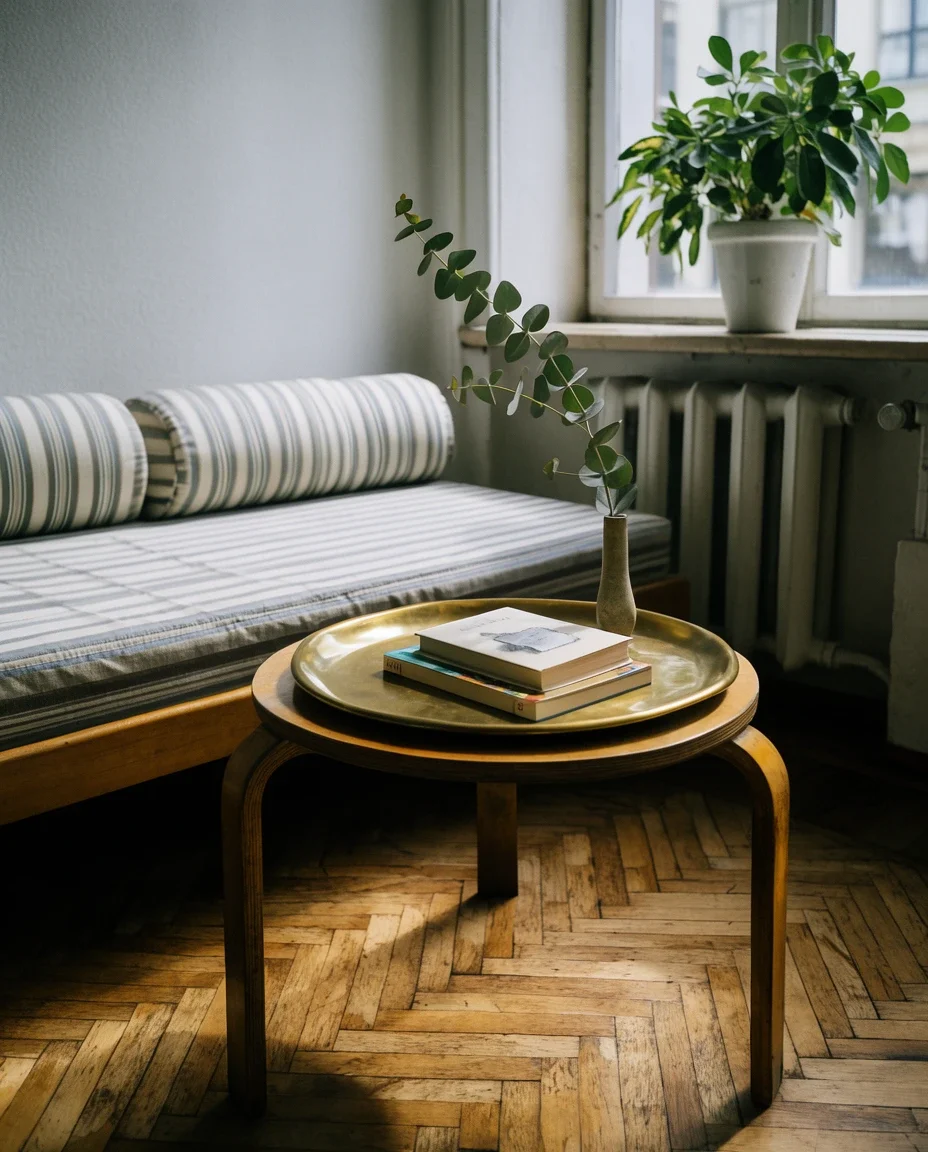
Small-space renters have quietly perfected this one out of necessity. When the coffee table is also the dinner table, the laptop desk, and the place the mail lands, nothing elaborate survives past Tuesday. A tray this size lifts off in one hand, which means the whole arrangement relocates to a windowsill in three seconds and comes back when the table’s clear again. Portability is a design feature, not a compromise.
16. Woven Texture for Cozy Evenings
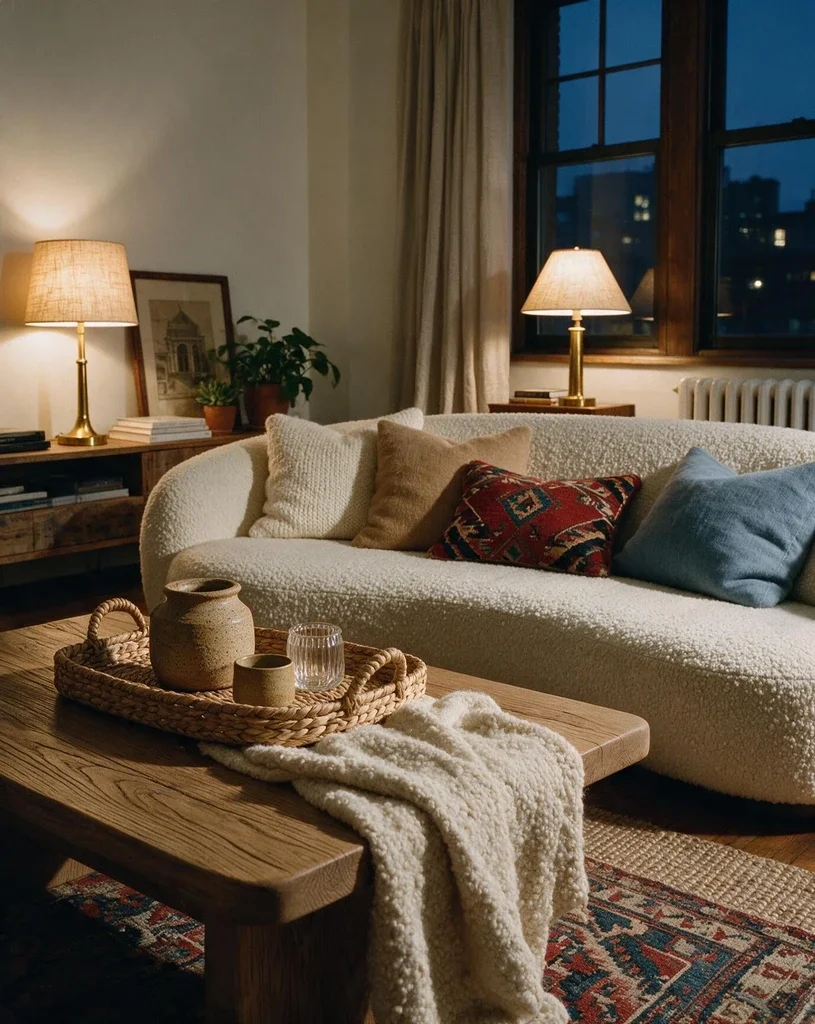
Texture is what your hand notices before your eye catches up, and layering three or four rough surfaces is the fastest route to creating a cozy atmosphere. Think rattan under stoneware under bouclé, a folded throw draped across one corner of the table, wool nubs against smooth glass. It suits a coastal room as easily as a mountain one. For tray living room styling in the colder months, texture reliably outperforms color.

Last October a friend spent an entire Saturday hunting for the right burnt-orange accessories, gave up, and instead pulled a nubby cream throw and a woven basket out of her hall closet. The room looked warmer that evening than it had all month, and she’d spent nothing. She still brings it up. The lesson stuck for both of us: warmth in a room is mostly a matter of surface, and surfaces you already own count.
17. Marble Coffee Table Styling

A marble top is already doing a lot, so autumn styling has to work with the veining instead of fighting it. Pick up one color from the stone — the grey, the faint gold, the cool white — and build from there. A slim brass or smoked-glass tray keeps things elegant without adding visual noise. Of all tray coffee tables looks, this is the most modern, and it needs the fewest pieces to feel finished.

There’s a practical reason to use a tray here rather than placing objects directly on the stone. Marble is porous and stains from beneath — a candle that weeps wax, a gourd that softens where it touches, a glass that sweats — and the mark can be permanent. Anything with moisture or oil in it belongs inside the tray. Homeowners who learn that after the fact usually learn it from a ring that no poultice quite lifts.
18. Apothecary Jars and Foraged Branches

Glass apothecary jars have a slightly scientific, slightly old-world look that suits fall perfectly. Fill them at different levels with acorns, dried orange slices, or star anise, then lean a few foraged branches in a heavy-bottomed vase alongside. The vintage pharmacy shapes and dark contents lean naturally moody, and unlike most autumn decorations, these fill themselves — everything inside came off the ground during a walk.

Anything brought in from outside needs a day in a low oven or a week in a paper bag before it goes near a jar, because acorns in particular arrive with weevils inside them. Two hours at 200 degrees handles it. Branches want a fresh angled cut and a shake-out over the porch. That small step is the difference between a display that lasts all season and one that quietly develops a problem in November.
19. Borrowing a Kitchen Tray

The best tray in most houses is already in a cabinet. Enamelware, an old wooden bread board, a battered sheet pan with a nice patina — tray kitchen pieces have proportions and worn edges that decorative trays spend a fortune imitating. A rectangle bread board is especially good on a narrow table. Keep the styling simple so the tray itself stays the most interesting thing in the arrangement.

Vintage enamelware is worth watching for at flea markets — cream with a navy or red rim, ideally with a little honest crazing in the glaze — and it typically lands between eight and twenty dollars depending on the region. Prices run higher in the Northeast, lower across the Plains. Check the underside for rust before buying, and give it a wash regardless, since these pieces spent decades doing actual work before they became décor.
20. Ceramic Vessels in Muted Clay

Handmade ceramics in unglazed terracotta, ash grey, and soft oatmeal bring a grounded quality that nothing factory-made replicates. Group three vessels of varying height and mouth width — one bulbous, one narrow, one shallow — on a round tray and leave them empty. A neutral, minimal grouping like this reads as sculpture, and it carries from September clear into February without a single seasonal swap.

Odd numbers and uneven spacing do the work here. Pair two vessels and the eye reads them as a matched set, which flattens the whole thing; add a third of a different height and it becomes a composition. Potters tend to say the same about their own studio shelves — three is where a group starts to feel alive. Cluster them close enough to touch on one side and leave more air on the other.
21. Two Trays for Big Tables

Oversized square and round coffee tables defeat the single-tray approach — one tray in the middle of a 48-inch square just looks marooned. The fix is two smaller trays set diagonally across from one another, each with its own small story. These paired tray ideas give a large living room two focal points instead of one, and they let the centerpieces stay low enough for conversation to carry straight across.

Give the two trays one shared thread and one point of difference — same material, different contents, or same palette, different shapes. Complete symmetry makes the table look like a hotel lobby; total contrast makes it look accidental. Leave a clear channel of open table between them too, because in practice that’s where the remote, the book, and everyone’s drinks are going to end up on a Sunday afternoon.
Every one of these takes an hour or less, and most of them use pieces already in your cabinets. If you try one, come back and tell me which tray you used and what ended up on it — I read every comment. And if you’ve got a fall arrangement of your own that gets compliments year after year, share it below so the rest of us can borrow it.