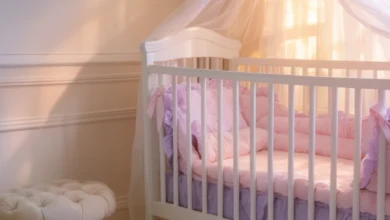

Small bedrooms are having a moment on Pinterest, and it has less to do with square footage than with what people now ask of the room. American homes have shrunk in the bedroom while the demands on that space have grown — sleep, storage, a desk, sometimes two adults and a dog. The looks saving fastest are the ones that solve something: beds that swallow a season’s worth of bedding, wardrobes that read as walls, lighting warm enough to make a ten-by-ten feel deliberate. What follows is twenty ideas worth copying, each with the reasoning behind it and the details that make it hold up in a real room.
1. Storage Beds With Deep Drawers
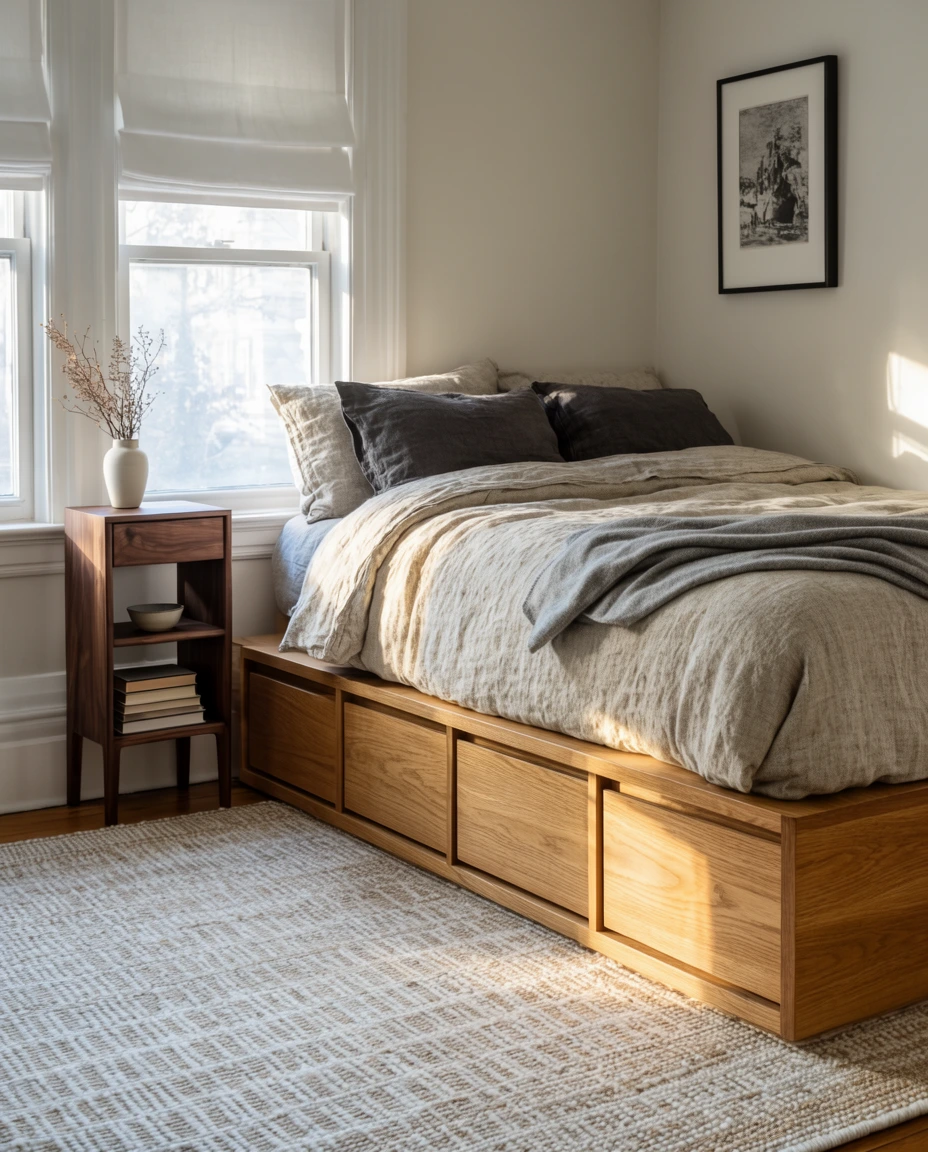
A bed frame with drawers built into its base does the work of a dresser without asking for another square foot of floor. This is the quietest of the space saving solutions for a room under 120 square feet, and it turns under bed territory into real, usable closet space. Bulky sweaters, spare bedding, off-season shoes — all of it slides out of sight. Among the storage hacks that actually last, this one holds up because nothing about it looks like a workaround.
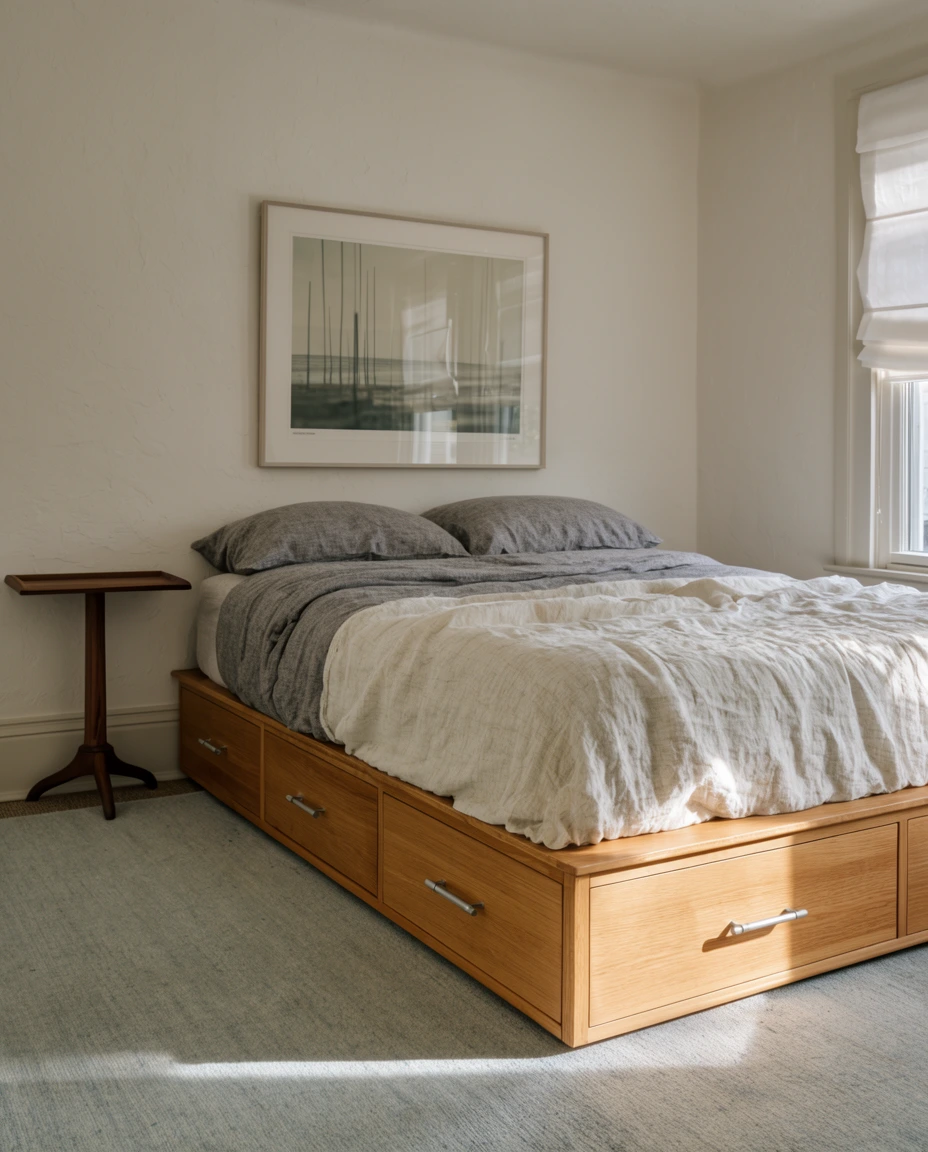
Prices run wide. A basic four-drawer queen frame sits around $400 to $600 at most big-box retailers, while a solid-wood version with soft-close hardware climbs past $1,500. The middle ground is usually the smart buy, and the detail worth paying for is drawers on both long sides rather than one, since a bed pushed into a corner loses half its access overnight. Pair it with a low headboard and the whole footprint reads lighter than the storage it hides.
2. The Corner Wardrobe Wall
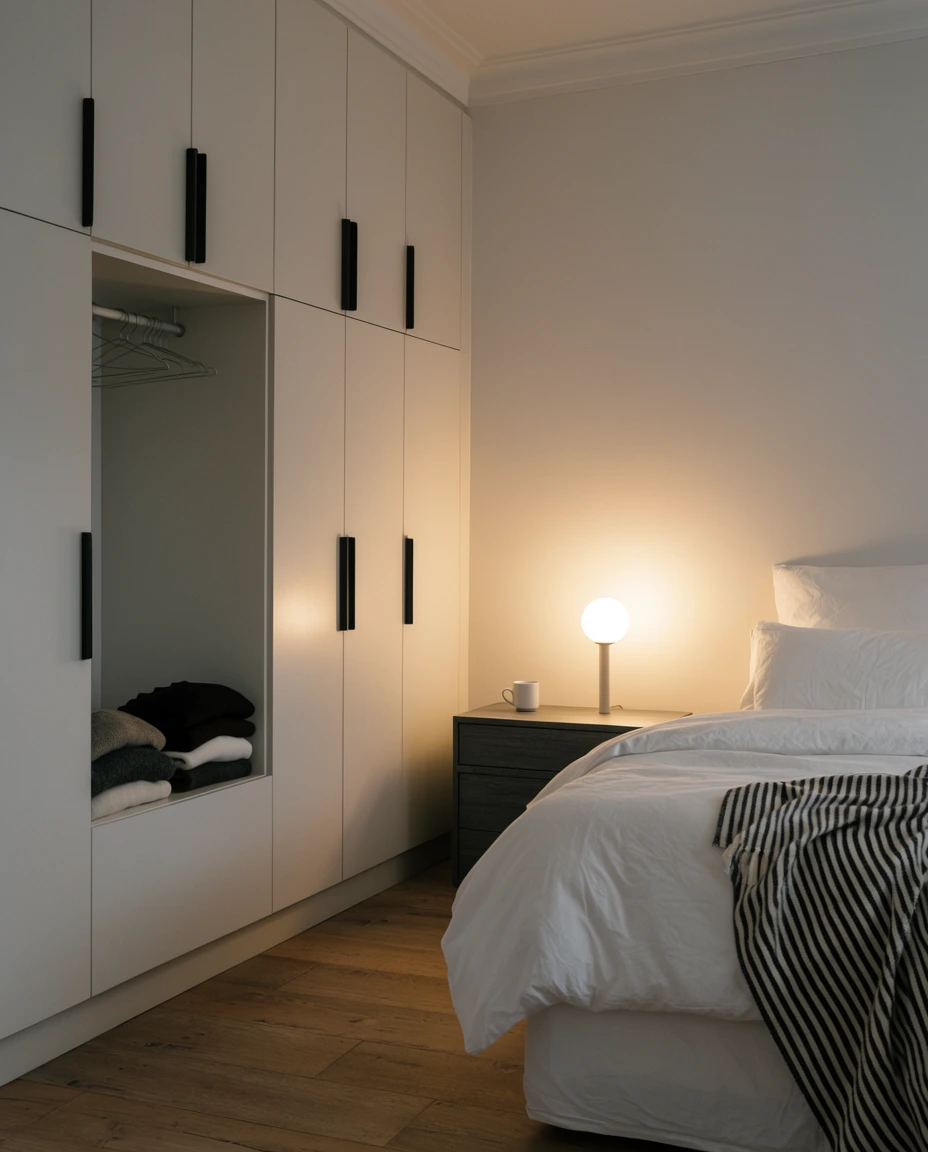
Push a floor-to-ceiling wardrobe into the corner and let it run the full height of the wall, and a small bedroom gains an entire storage system without losing walking room. Custom built ins are the tailored version, but flat-pack units set side by side and trimmed with molding read almost identically once painted. The point is to maximize the vertical space that otherwise sits empty above eye level and collects nothing but dust.
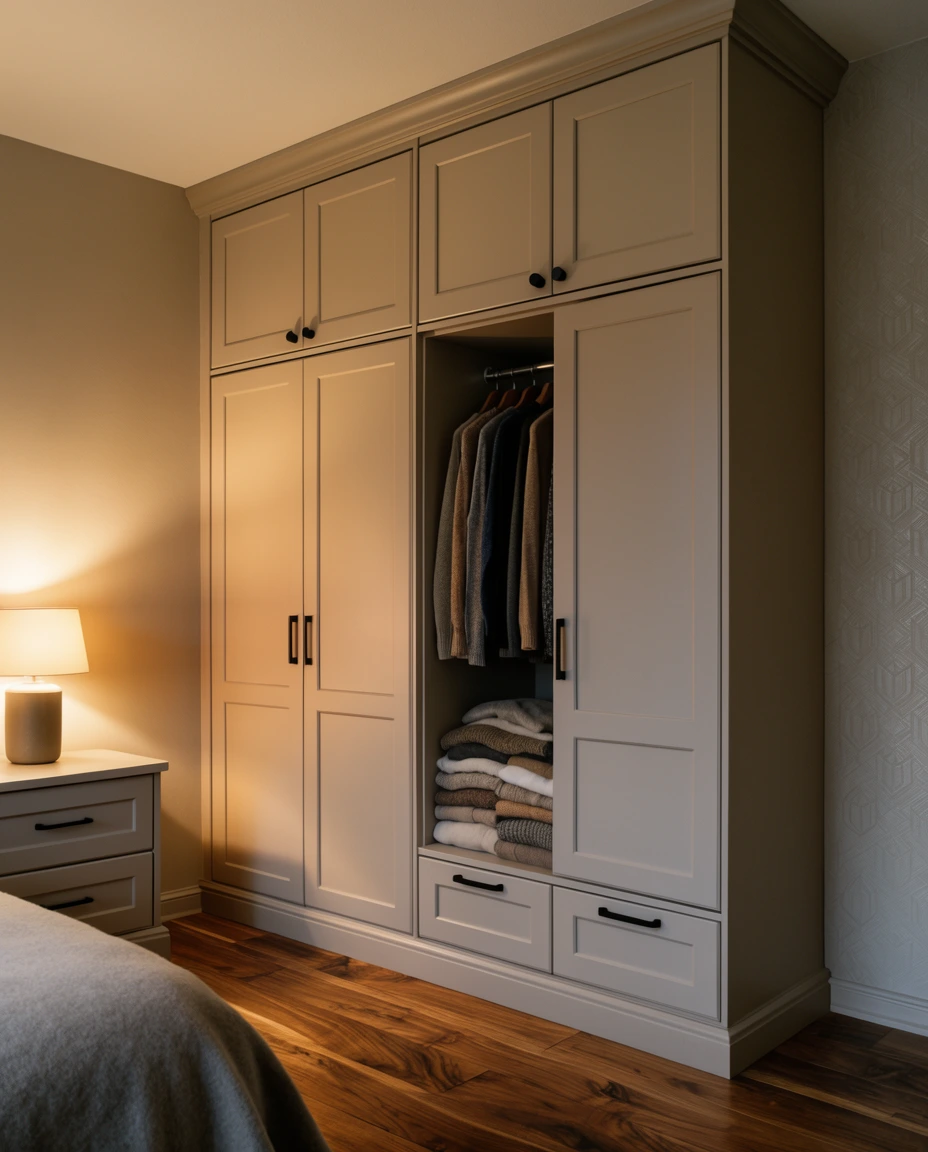
Designers tend to give the same advice here: paint the doors and the surrounding wall in one shade so the mass disappears. A contrasting wardrobe front chops a small room into pieces, while a matched finish lets the eye travel straight past it. Hardware matters just as much — recessed pulls or a push-latch keep the plane flat, and a flat plane is what makes eight linear feet of storage read as architecture instead of furniture.
3. Pale Pink and Warm Wood
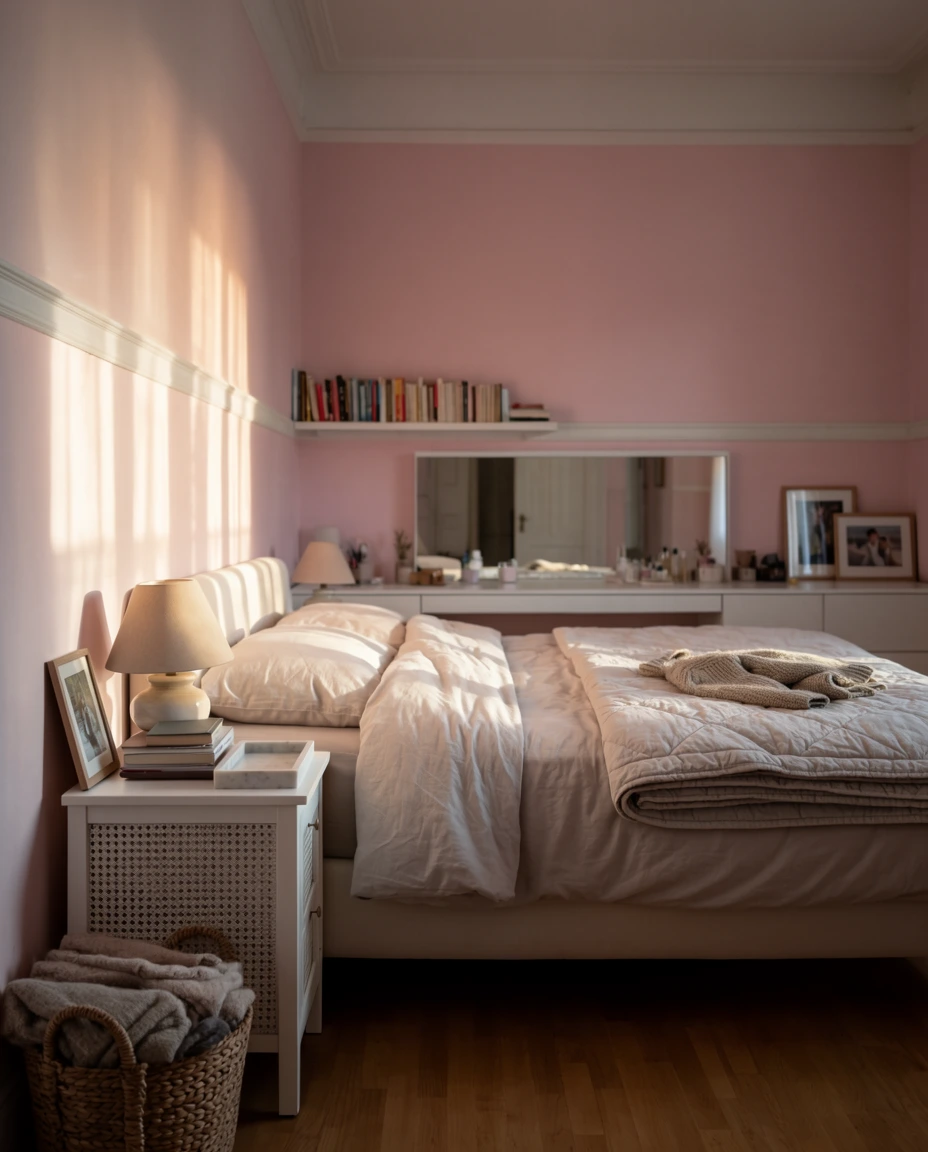
Pink has grown up. The version showing up in small bedrooms now is dusty and warm, closer to clay than candy, and it sits beautifully against oak, cane, and unbleached linen. Painted across all four walls and the ceiling, it wraps a tight room in soft color instead of pointing out where the corners are. For a girl who has outgrown pastel bedding but still wants warmth, this is the cozy aesthetic that carries her through the next decade.
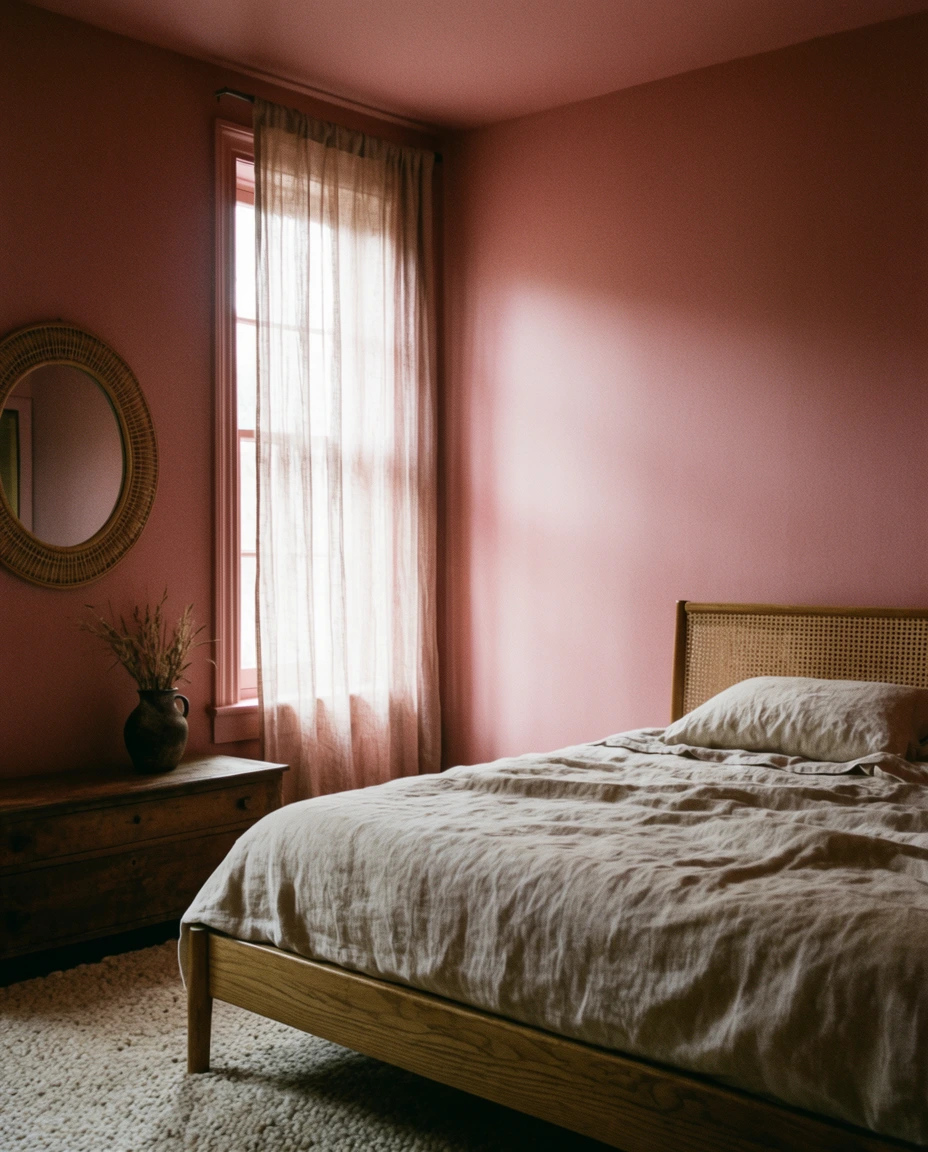
Rooms with a single north-facing window are where this palette earns its keep, since cool daylight turns crisp white flat and gray while a warm pink pushes back against it. It also suits older homes with plaster walls and dark trim, where the color softens the contrast at the edges. In a bright south-facing room, go a shade or two deeper — full sun washes out anything too pale by mid-afternoon.
4. Bunk Beds for Two Sisters
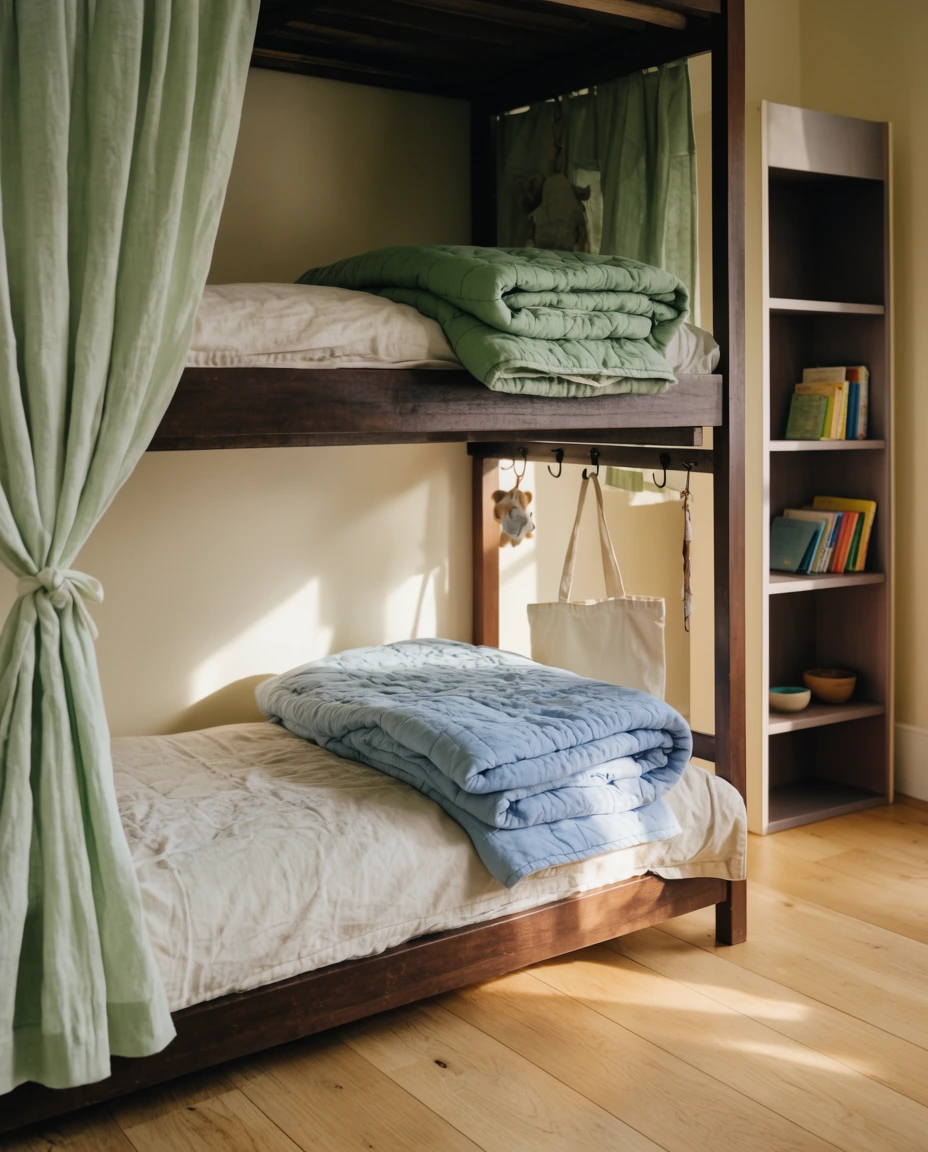
A shared room stops feeling like a compromise the moment the beds go vertical. A built-in bunk with a solid rail, its own sconce, and a ledge deep enough for a book gives each child a defined corner of her own. For 2 sisters in a room barely wide enough for two twins side by side, stacking frees the entire floor for a rug, a small table, and the sprawling projects kids actually want space for.
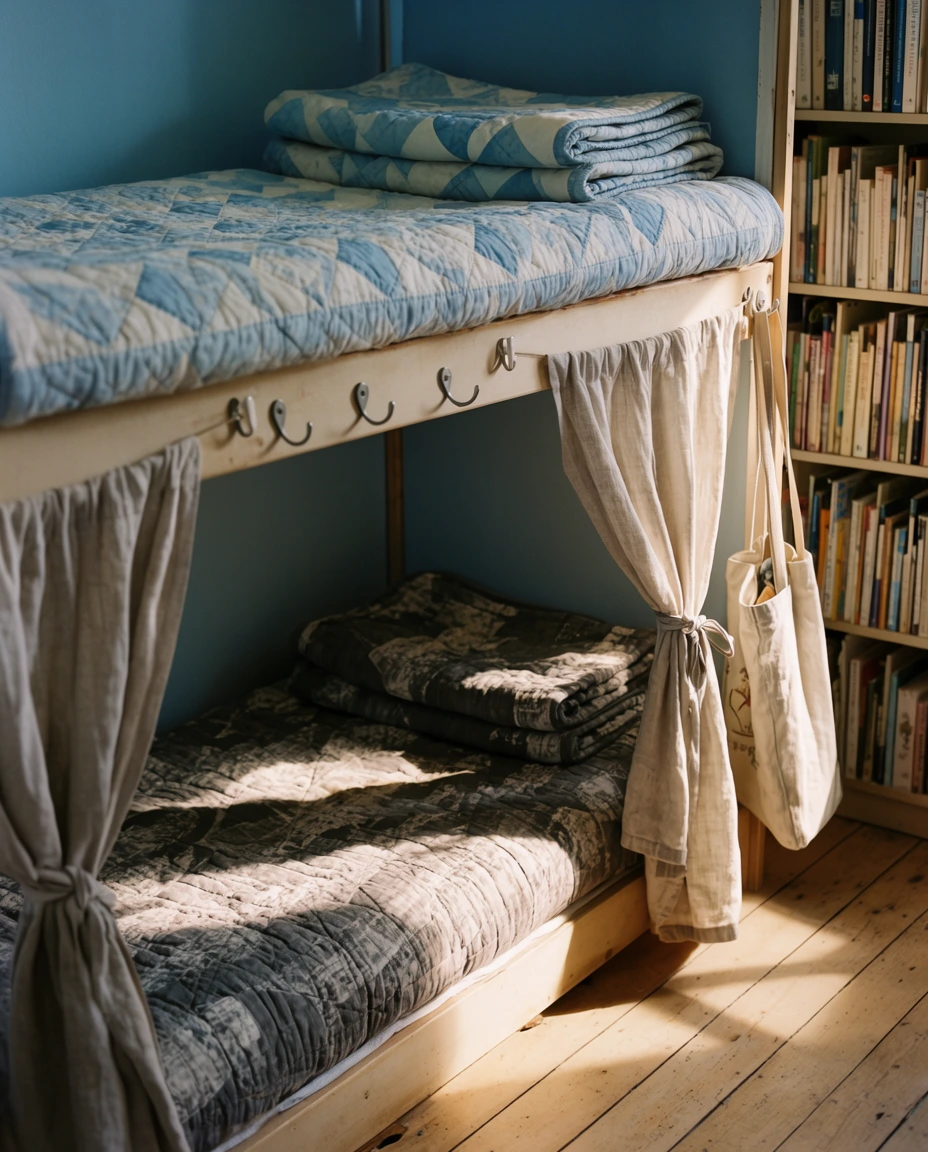
Parents almost always report the same thing after the switch: the floor stays clearer, and bedtime arguments shift from territory to who gets the top. Most families add curtains along the lower bunk within the first year, usually because the younger child asks for them. Small hooks at each level fill up fast with headphones, water bottles, and stuffed animals, so plan for roughly twice as many as you think the room needs.
5. Floating Nightstands and Wall Sconces

Lift the nightstands off the floor and a small bedroom breathes. Wall-mounted shelves beside the bed, paired with swing-arm sconces, clear away both the surface clutter and the table legs that visually crowd a tight room. It is a modern move with minimalist discipline, and it leaves the floor uninterrupted from wall to wall. The decor payoff is immediate: fewer objects, better shadows, and a bedside that looks composed even with a book and a glass sitting on it.
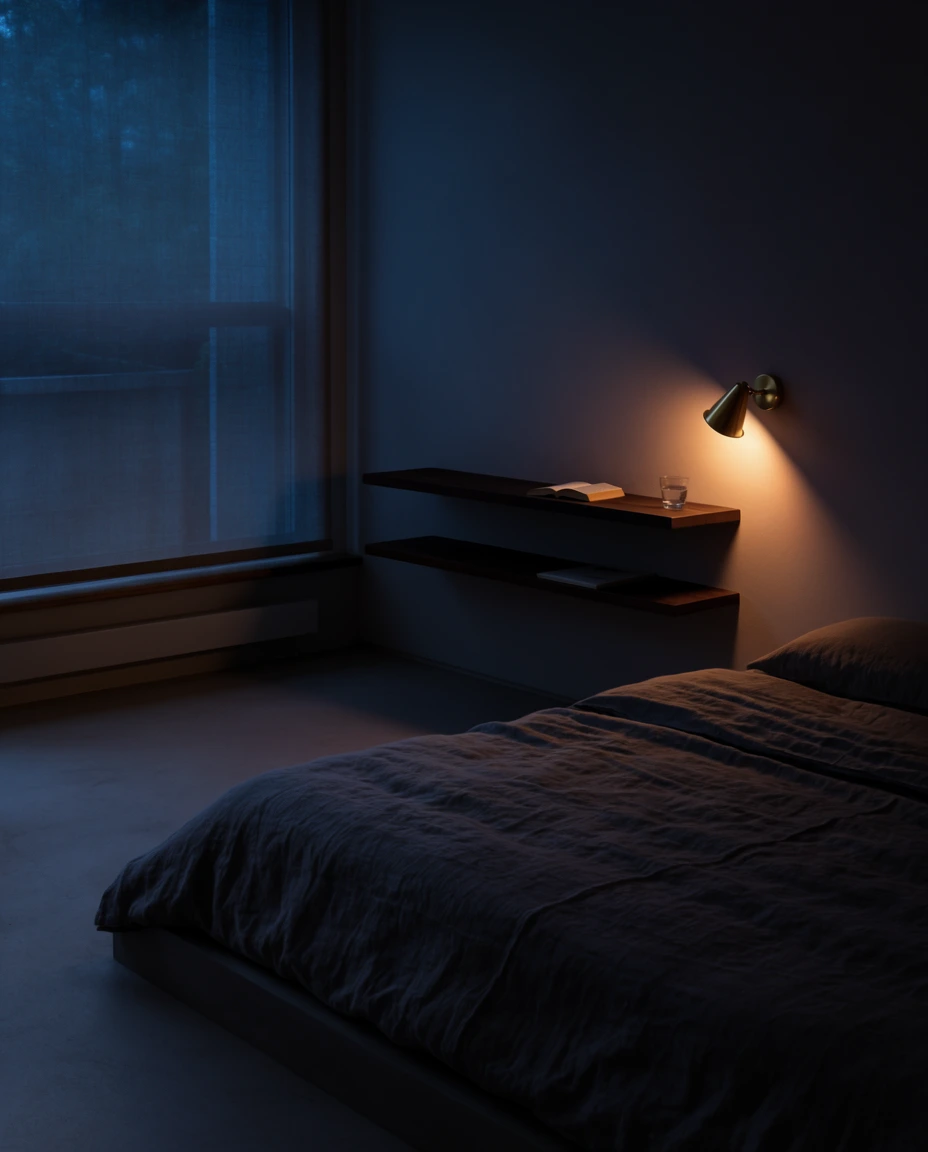
Mount the shelf about six inches above the mattress top and set the sconce roughly twenty inches higher, angled toward the pillow rather than the ceiling. Run wiring inside the wall if it is already open; if not, plug-in sconces with a fabric cord and a slim cord cover look entirely intentional. Keep the shelf shallow, around eight inches, so it holds a phone and a lamp without slowly becoming a shelf that collects.
6. Loft Bed Over a Desk
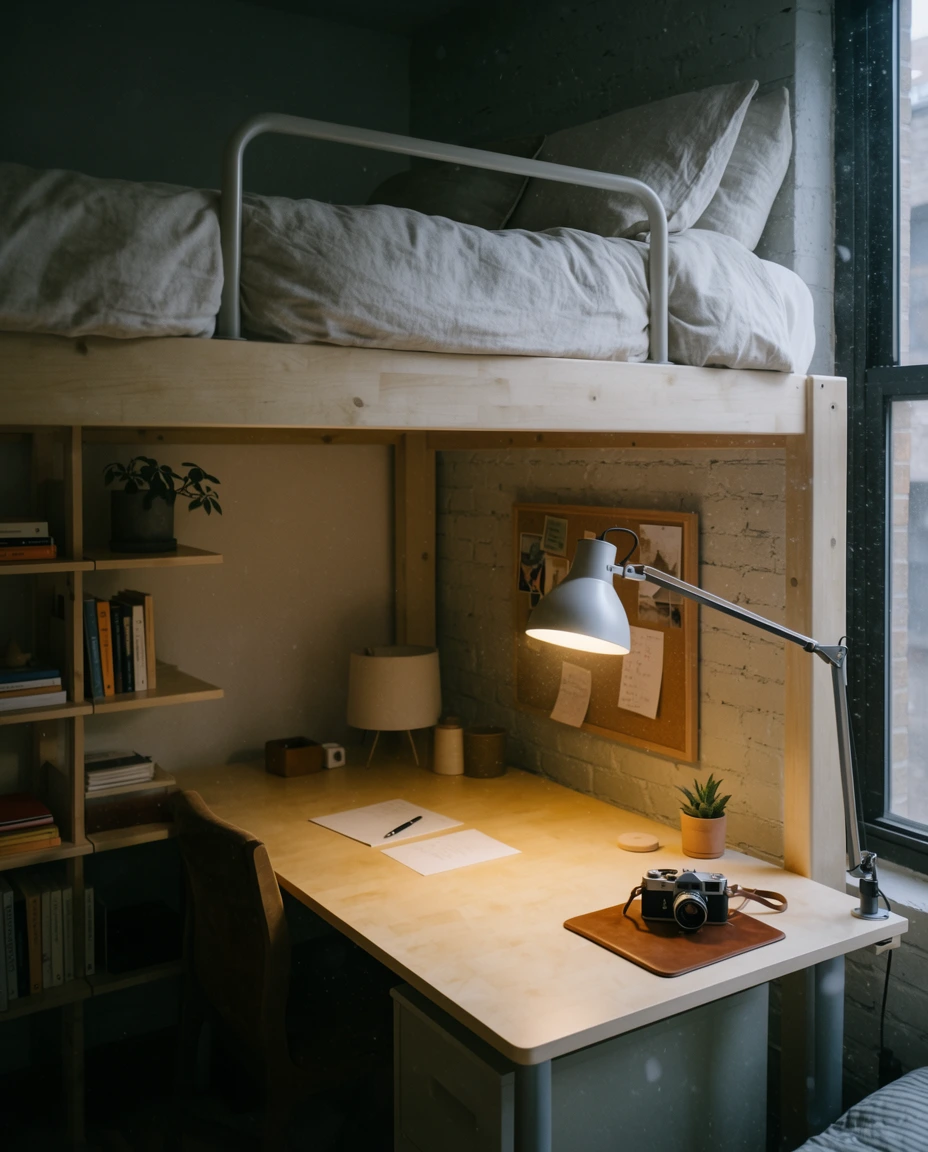
Raising the mattress to shoulder height and putting a work surface underneath is the single biggest square-footage win available in a small room. A loft bed with a proper ladder, a guardrail, and a fixed desk below gives teens somewhere to sleep, study, and keep their own things without the room becoming one giant bed. Add a clip lamp, a pinboard, and a chair that tucks fully under, and the setup holds for years.
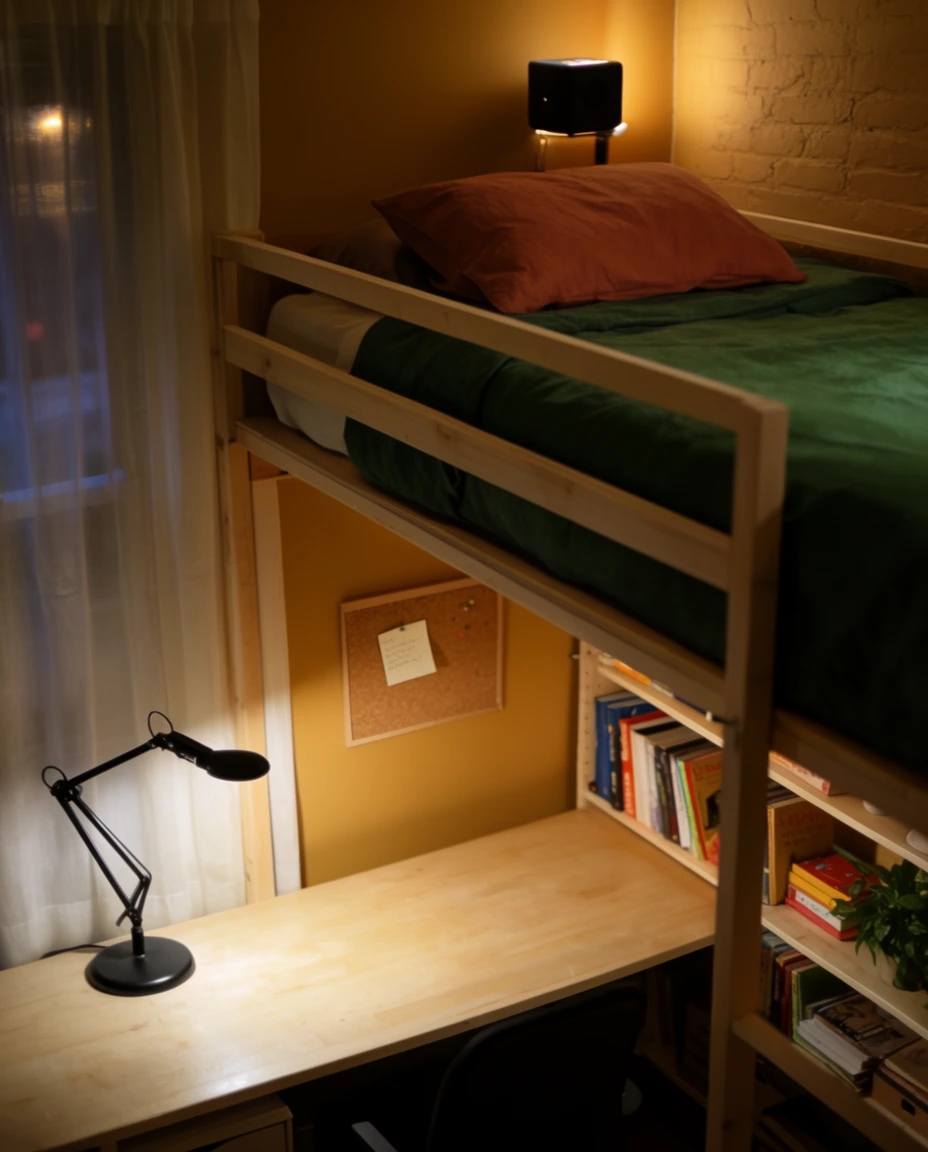
In older East Coast apartments with nine-foot ceilings, a full-height loft leaves generous room overhead and still feels open. In newer Sun Belt builds, where ceilings often stop at eight feet, a mid-height frame is the better call — enough clearance to sit and work comfortably below without the mattress pressing toward the ceiling. Measure from the finished floor before ordering, since teenage growth spurts arrive faster than furniture returns.
7. The Minimalist Platform Layout
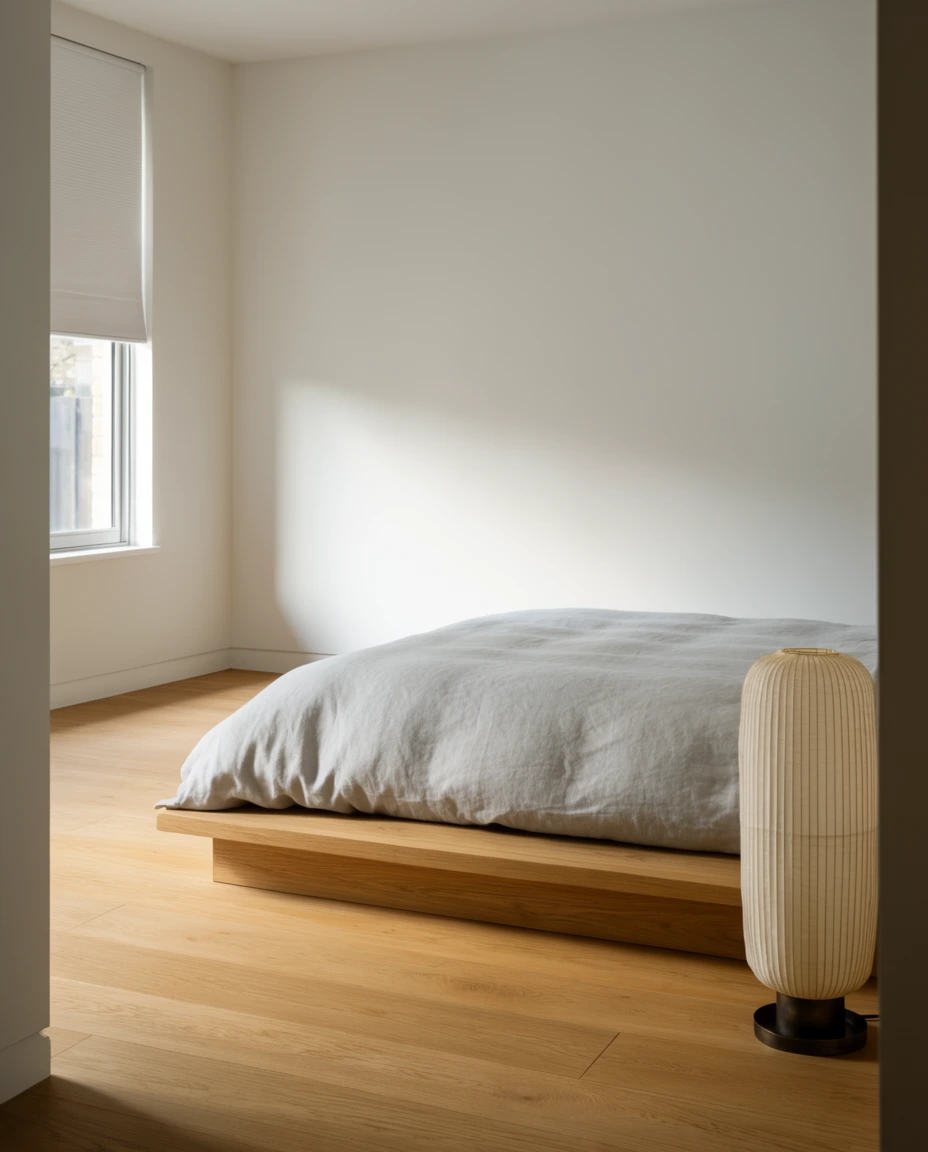
Strip a small bedroom down to a low platform, one lamp, and a single piece of art, and something unexpected happens: the room reads larger than it measures. This layout keeps everything below waist height so the upper half of the walls stays wide open. The rule is simple — one bed, one light, one surface, nothing loose on the floor. It looks super restrained in photographs and feels calm in person, which is the harder half to pull off.
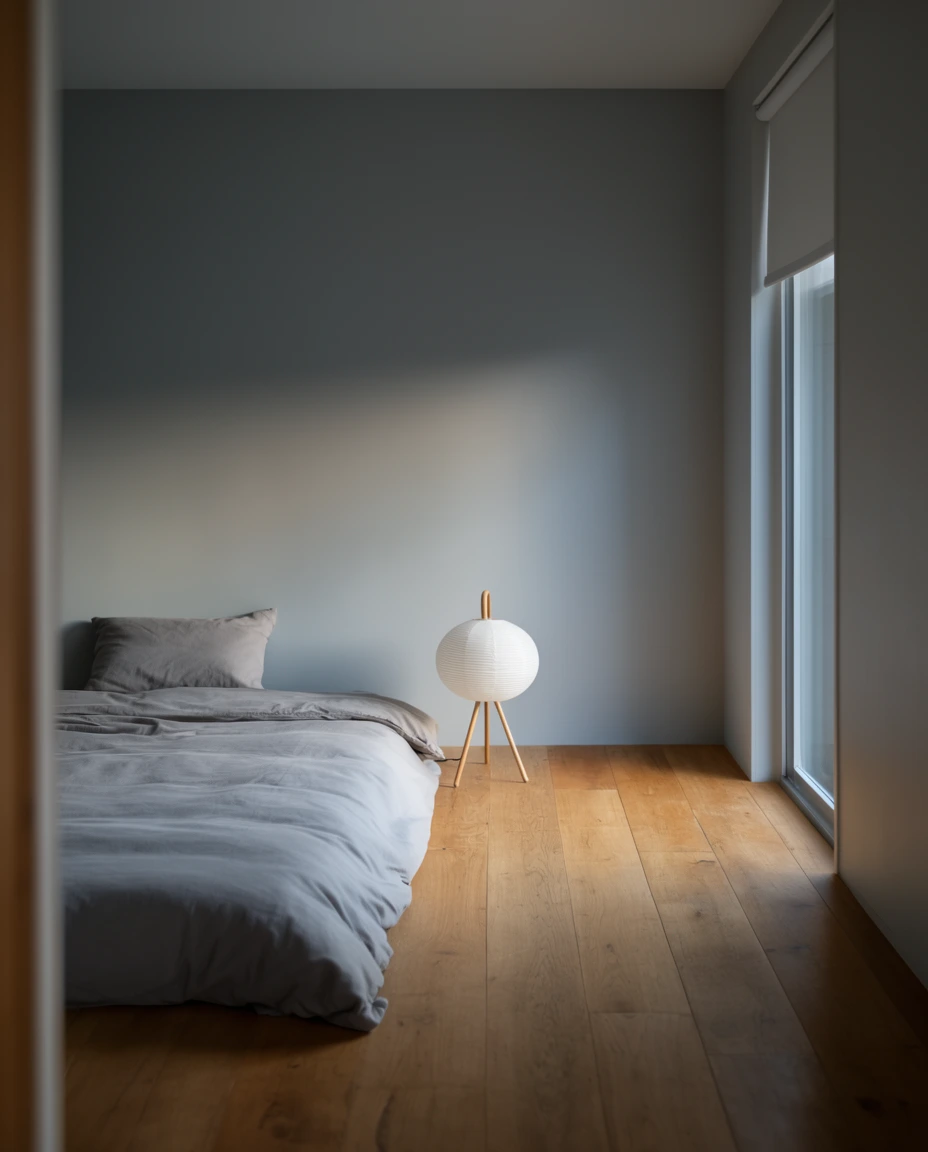
A friend in Chicago pared her 10-by-10 bedroom down to a mattress on a walnut platform and one ceramic lamp, fully expecting to miss the dresser she gave away. Six months on she still has not replaced it; the clothes moved to the closet, and the room stayed quiet. That is the trade — you commit to editing what you own, and the room gives back a sense of space no amount of rearranging could produce.
8. Sheer Curtain Wardrobe Fronts
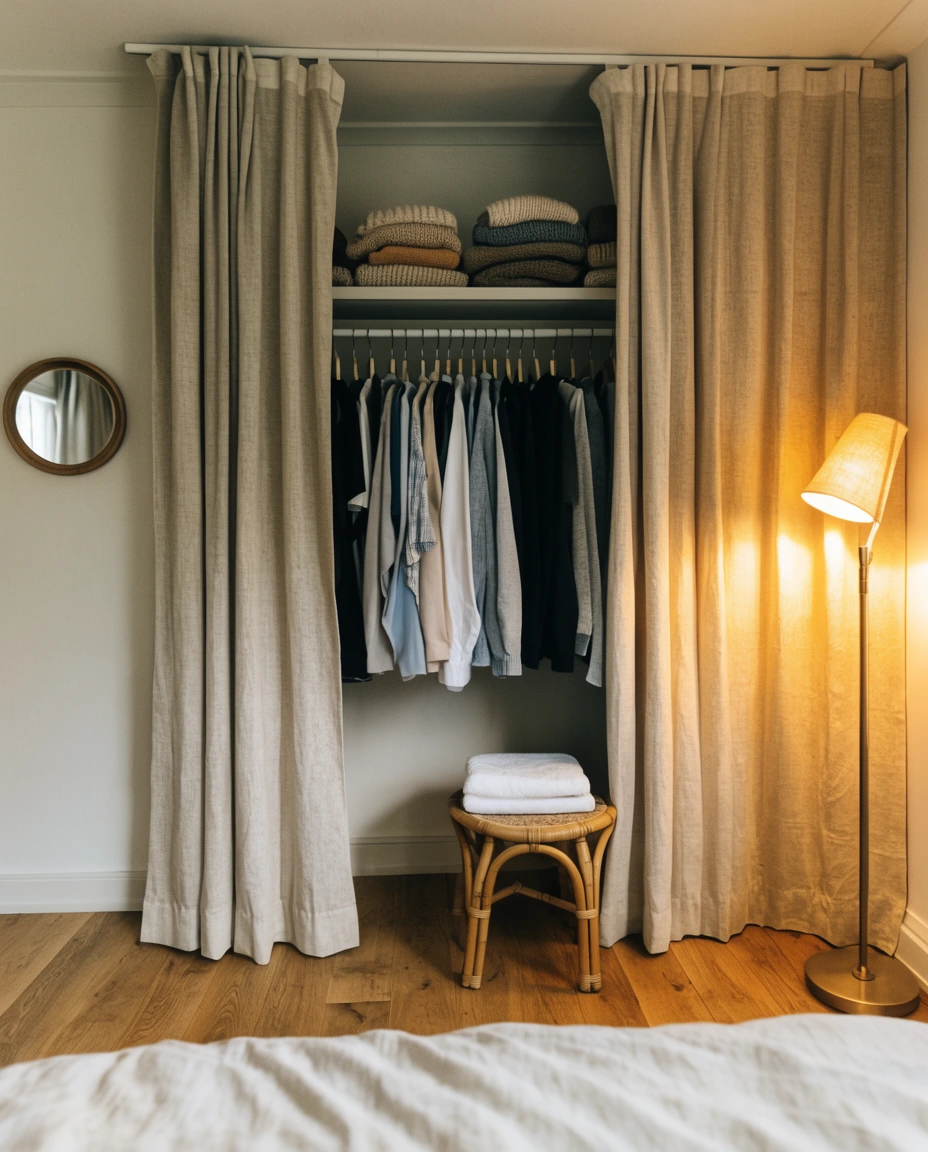
Swapping closet doors for a floor-to-ceiling curtain is one of the friendliest changes a renter can make. In a small apartment where a swinging door claims three feet of floor, a linen panel on a slim track opens the wall and softens it at once. Hang the rod at ceiling height rather than at the frame and the room gains extra visual height for free. An Ikea track system and a pair of unlined panels cover most standard openings.
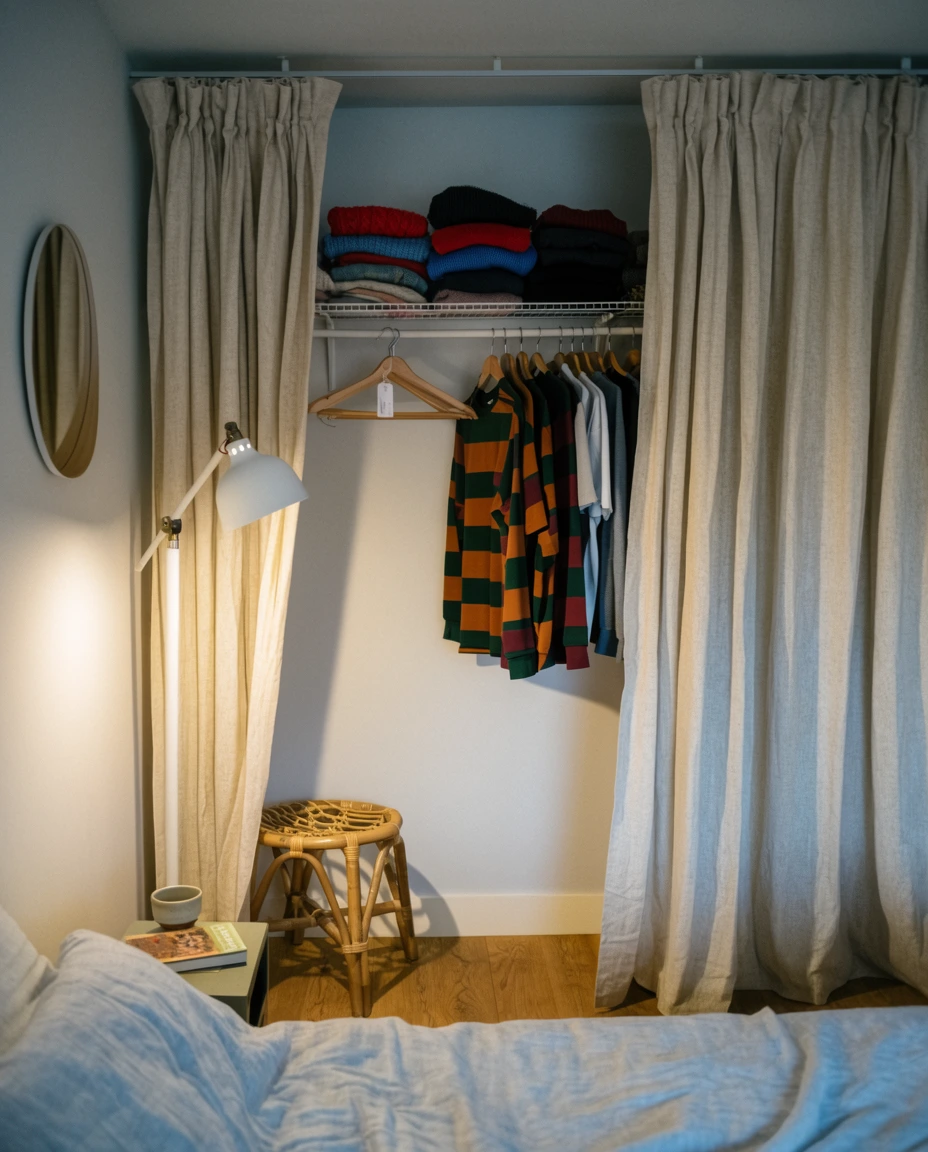
Figure roughly $30 to $50 for the track, another $40 to $90 for panels depending on width, and an afternoon with a drill. Even at the top of that range it lands well under the price of new bifolds, and nothing about it is permanent — the original doors go back on before you hand over the keys. Buy panels a few inches longer than the drop and let them break gently on the floor, because the fullness is what sells it.
9. Warm Lighting Without the Overhead
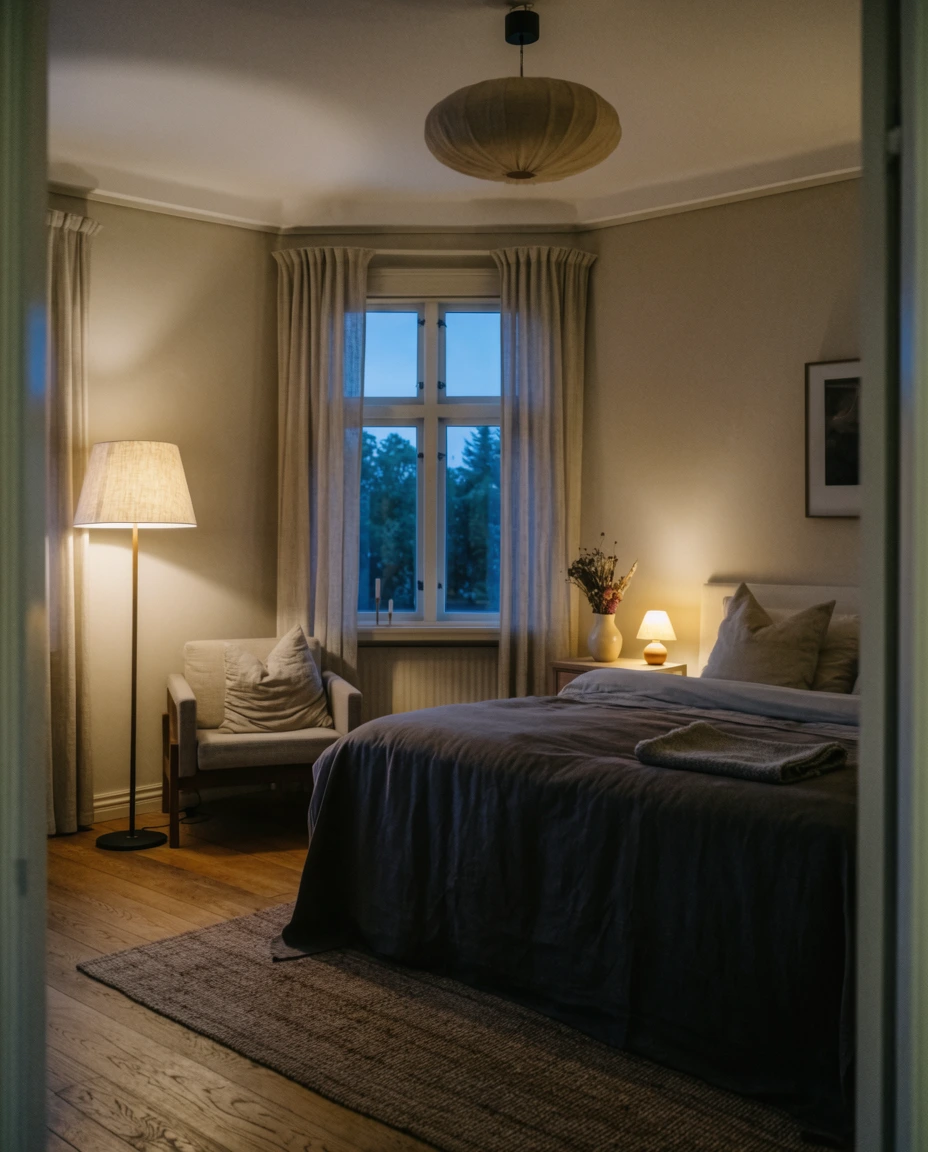
Switch off the ceiling fixture and a small bedroom changes character entirely. Lamps layered at three heights — a sconce beside the bed, a low table lamp, a warm strip behind the headboard — give a cosy wash of light that flatters the room instead of flattening it. That is the difference between a space you sleep in and one that feels cozy relaxing at nine at night. The aesthetic payoff shows up the second you photograph it.
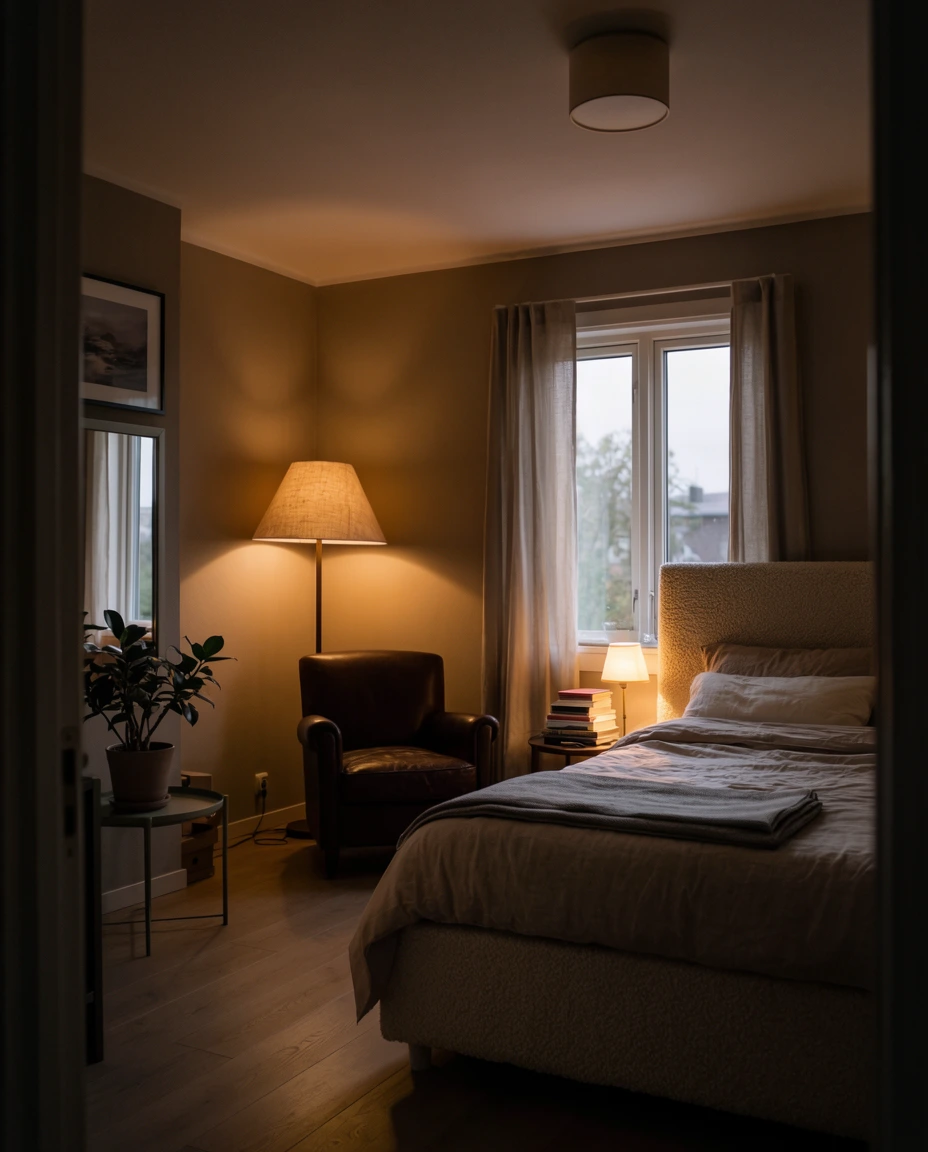
Look for bulbs in the 2400K to 2700K range and put every fixture on a dimmer, plug-in lamps included — inline dimmers run about fifteen dollars and screw-in dimmer sockets even less. Keep the brightest source behind your shoulder when reading and the softest near floor level, so nothing shines straight into your eyes from across the room. Three modest lamps beat one bright ceiling fixture almost every time in a space this size.
10. Queen Bed in a Rectangle Room
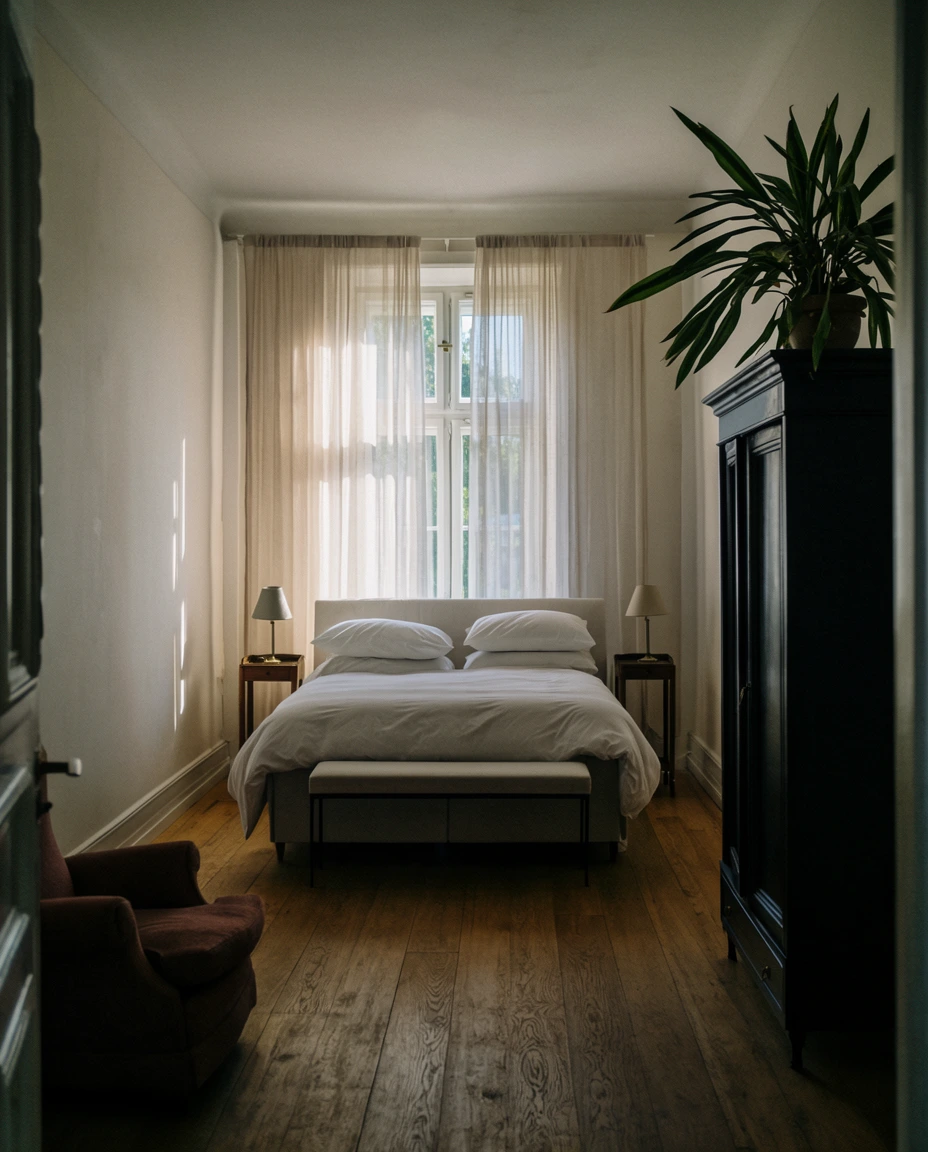
A long, narrow rectangle is the most common small-bedroom shape in American housing, and it has a right answer. Center the queen bed on the short wall, leave equal clearance on both sides, and push storage to the far end. Furniture placement here is less about fitting more in than about protecting the walking path down each side. Arrange it this way and the room finally reads as a bedroom rather than a hallway with a mattress in it.
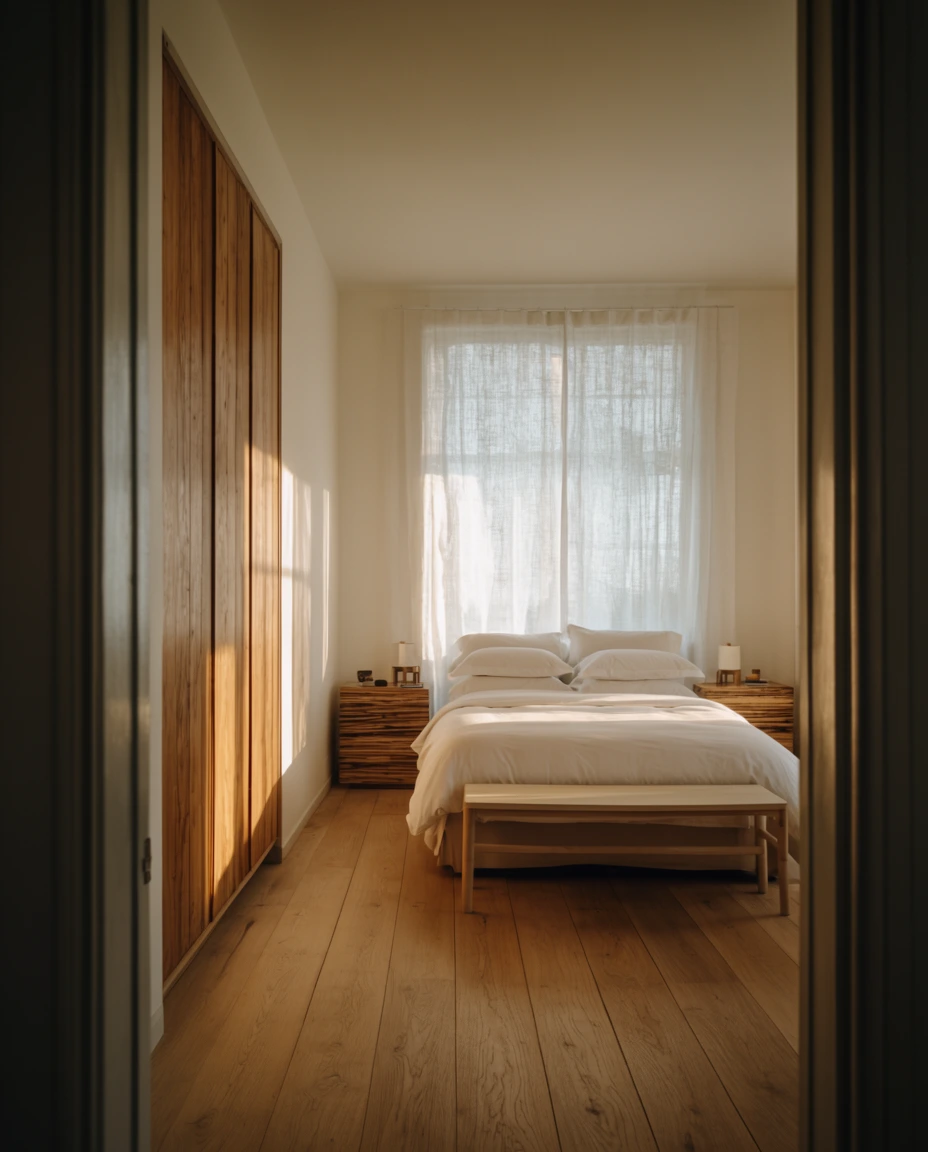
The usual misstep is shoving the bed lengthwise against a side wall to open up the middle. It looks roomier on paper, but it kills access on one side, and whoever sleeps there ends up climbing out over their partner every morning. Hold at least 24 inches of clearance on each side and 30 at the foot where the room allows. If the space is too narrow for that, a smaller frame is the fix, not a tighter squeeze.
11. A Headboard With Built-In Shelves
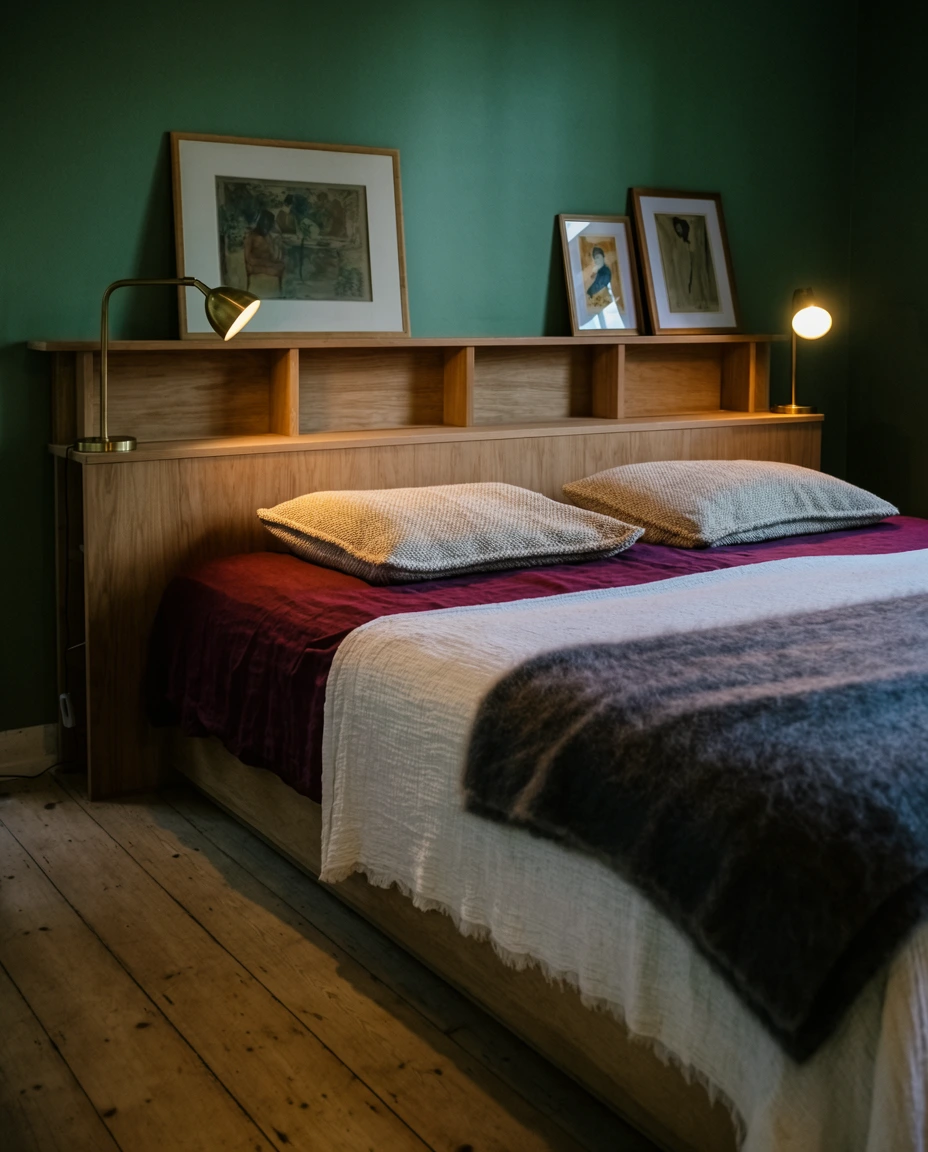
A headboard that doubles as a shallow bookcase removes the need for nightstands altogether. Built to the width of the bed and about ten inches deep, it carries books, a lamp, and a glass of water while the floor stays completely clear. For a king size bed squeezed into a modest room, it is often the only way to keep a bedside surface at all. The upholstered version reads luxury, and it is quietly practical for couples who both read at night.
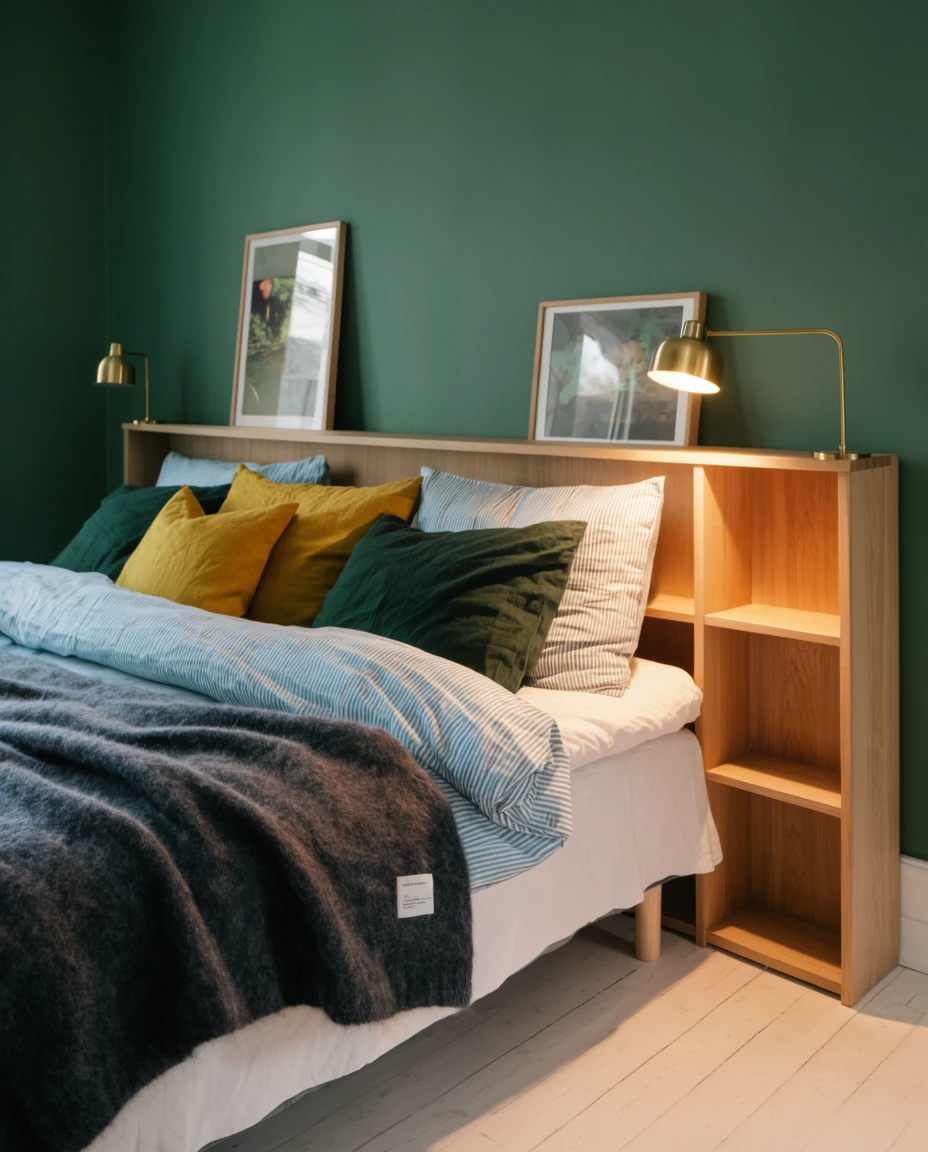
This does its best work in rooms where the bed faces the door, since the headboard becomes the first thing you see and hands the room a proper focal point. It also solves the awkward case of a bed centered under a window, where a solid back panel blocks the draft. Rooms under nine feet wide are the exception — at that width, the extra ten inches of depth costs more than the shelves give back.
12. Mirrors for Instant Depth
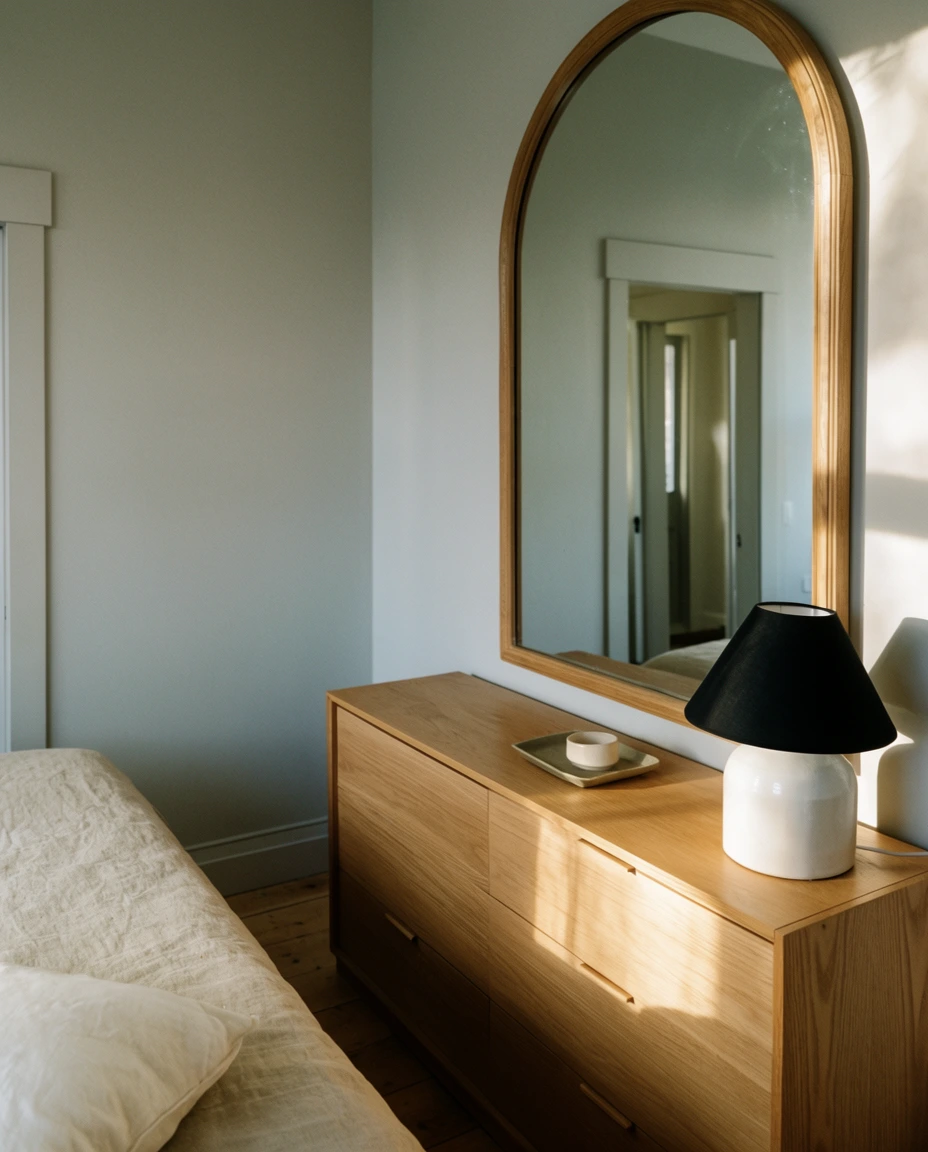
A tall mirror leaned against the wall or mounted opposite a window does more for a tight room than any single piece of furniture. It borrows daylight, doubles the view, and makes an extremely narrow space feel like it carries on past the wall. The trick is placement rather than size — a super plain full-length panel in a thin frame outperforms an ornate one every time. Working on a budget, this is the highest-return purchase in the entire room.
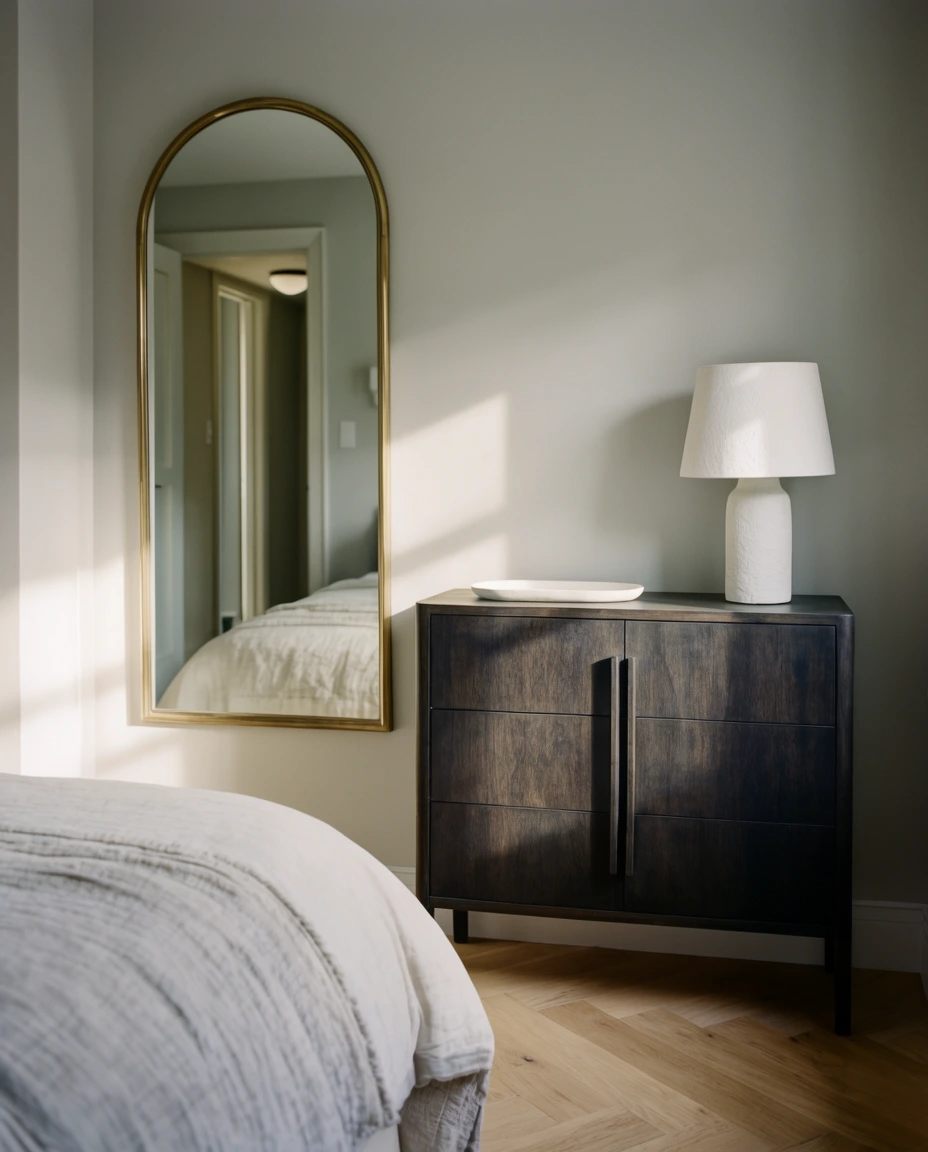
The stylists’ rule is to reflect something worth seeing. A mirror facing a blank wall gives you twice the blank wall; the same mirror turned toward a window or a doorway pulls light and distance into the room. Set it slightly off-center rather than dead across from the bed, which most people find unsettling at night, and lean it with the top tipped back a degree or two so it catches the ceiling line.
13. The L-Shaped Corner Nook
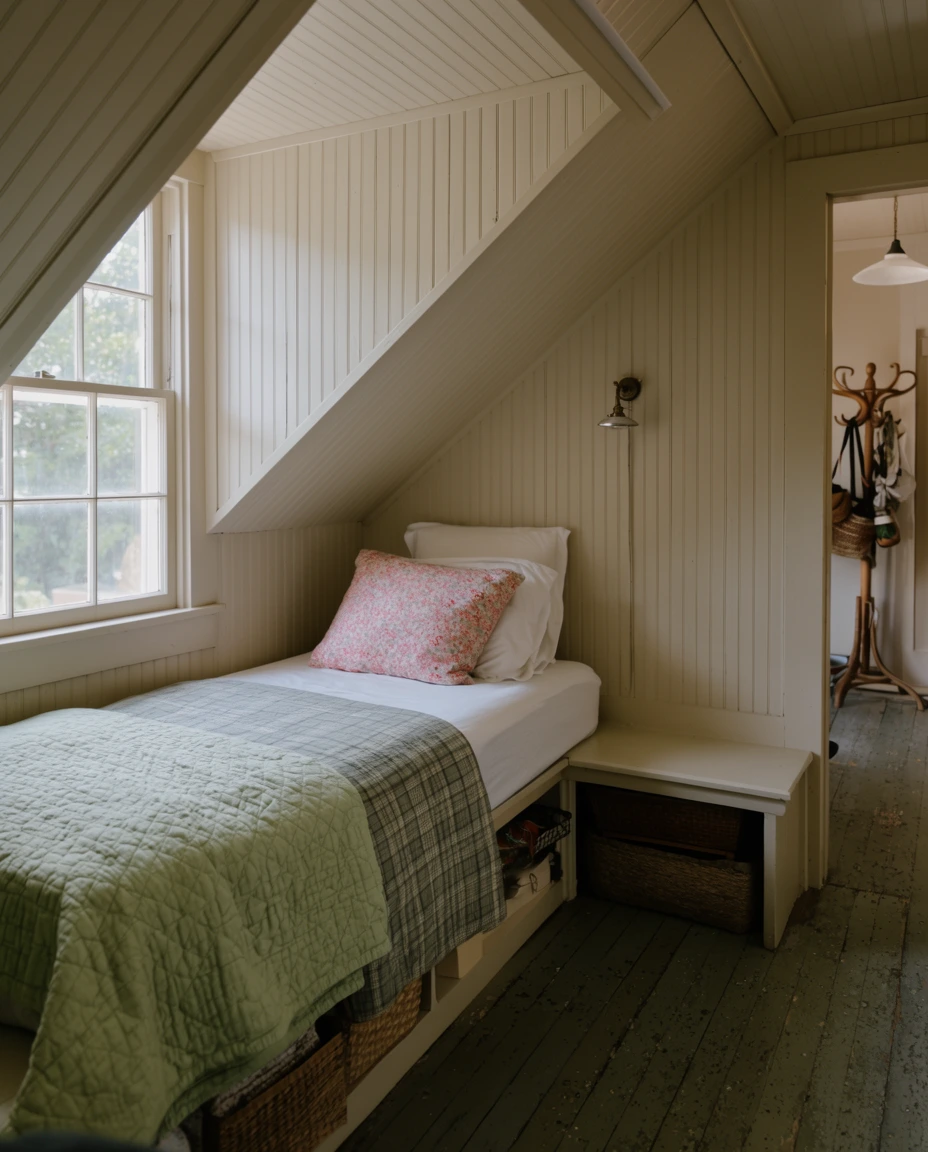
Tucking a single bed into a corner and running a bench or low storage along the adjoining wall turns dead space into a daybed nook. The resulting l shape frees the center of the room completely, which matters more than any square footage gained elsewhere. Add bolsters along the back and the bed works as seating by day. This kind of furniture placement suits guest rooms, home offices, and any room asked to do two jobs at once.

In Pacific Northwest bungalows and Midwestern attic bedrooms, where a sloping ceiling eats into one wall, the corner is often the only place a bed fits at full height anyway. Southern houses with wide window trim get a bonus, since the bench can run right beneath the sill and double as a window seat. Measure from the outside edge of the trim rather than the wall, because that is where the mattress actually stops.
14. Under-Bed Baskets and Rolling Bins
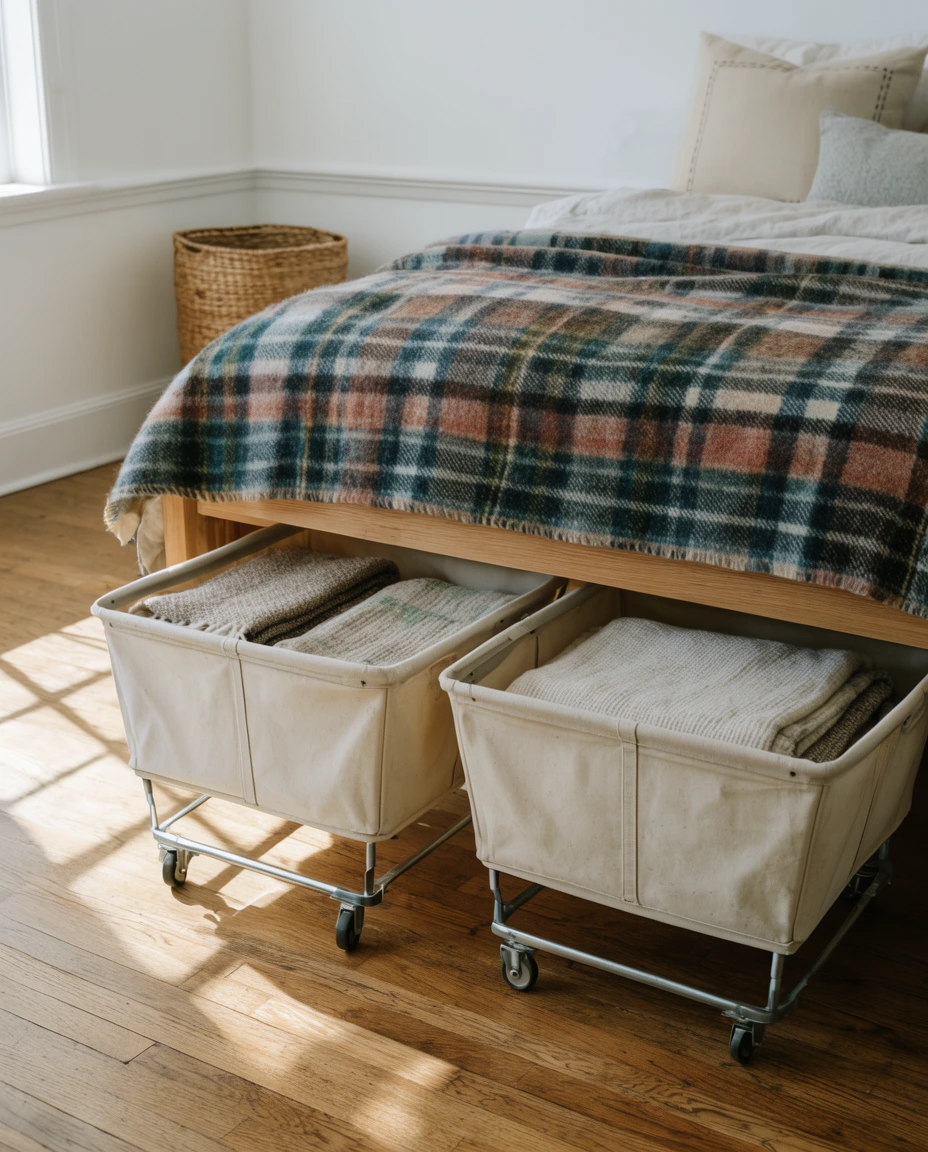
Not every bed needs built-in drawers to earn its keep. Flat woven baskets and low rolling bins slide beneath a standard double bed and hold everything a small room has no closet for. Lift the frame on risers and the under bed zone grows another four inches without changing how the room looks. Of the storage hacks that cost close to nothing, this is the most forgiving, since a bin can be added or pulled out in under a minute.

Measure the clearance from floor to the underside of the rails before buying anything, then subtract an inch for the rug. Lidded bins on casters beat open baskets for anything you touch twice a year, since dust settles fast down there. Label the short end rather than the top, because the end is the only part you will ever see. A bed skirt or low platform frame hides the whole system without adding visual weight.
15. A Reading Corner in Warm Light
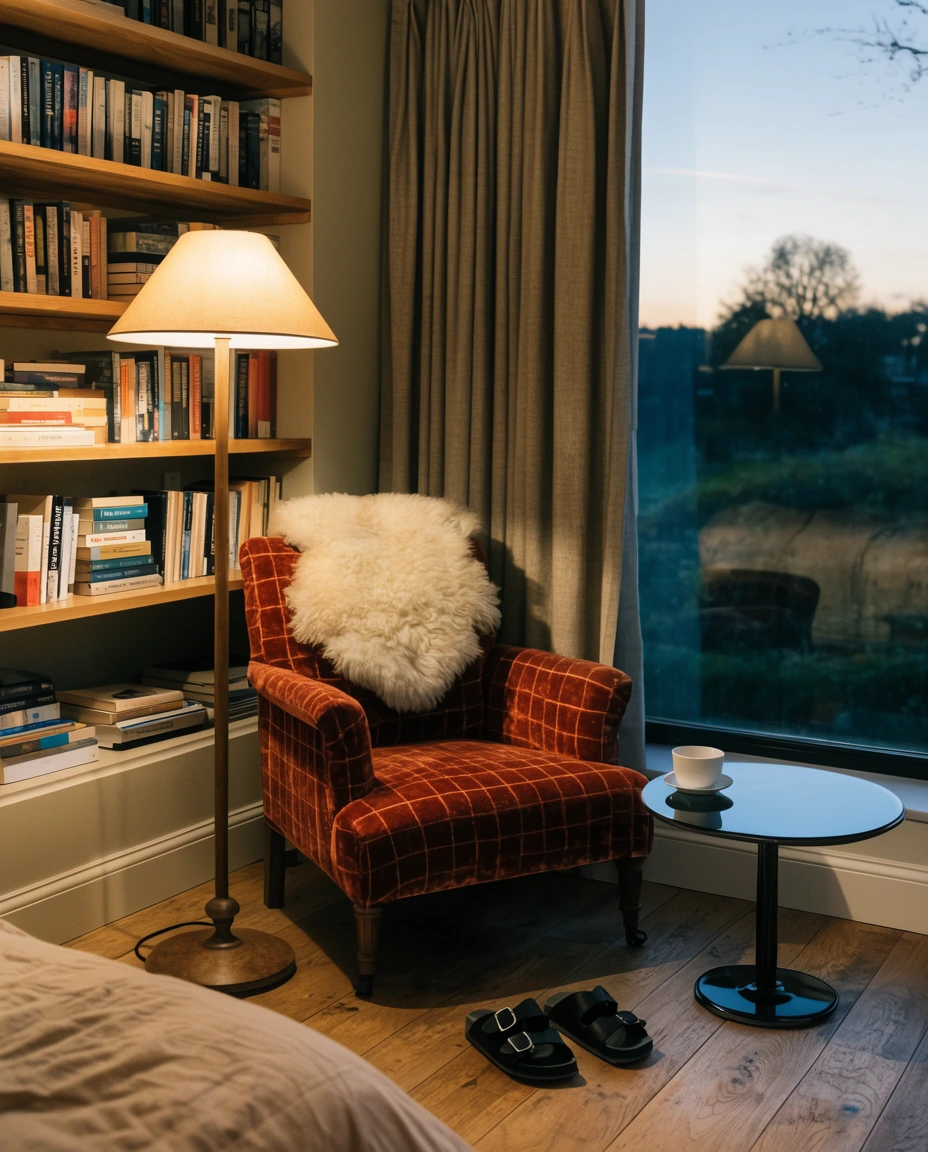
Even a small bedroom can hold a chair, provided the chair is the right size. A slim armchair angled into the corner, a floor lamp behind it, and a small side table make a cozy spot that pulls double duty as a place to sit and a piece of decor. Rooms styled for women who read late often begin right here, because a corner claimed for something other than sleep changes how the whole space feels.

A reader in Austin described wedging a 26-inch-wide chair into the last open corner of her bedroom, half expecting to move it back out within a month. It became the spot she uses every evening, and the bed stopped doubling as a sofa. Measure the widest point of any chair with the arms included, and leave a few inches of air on each side, since a chair touching both walls always looks wedged in.
16. Twin Beds With Matching Canopies

Two twin frames under matching fabric canopies give a shared room symmetry and hand each sleeper a sense of enclosure. The canopy can be a simple ceiling-mounted ring with a sheer panel, or a slim four-poster frame in painted metal. In a teenage bedroom, this reads far more grown-up than bunk beds while keeping the same floor plan. Hang both at identical heights and the pair looks deliberate rather than improvised.
Families who try this usually find the canopies get used as much for privacy as for looks — panels get pulled closed during phone calls and homework. The other thing that happens is decorating drift: within a season each side picks up its own lights, photos, and colors, and the symmetry survives anyway because the frames match. Choose washable fabric, and check that the ceiling anchors land in a joist rather than drywall alone.
17. Moody Walls for Deep Rest
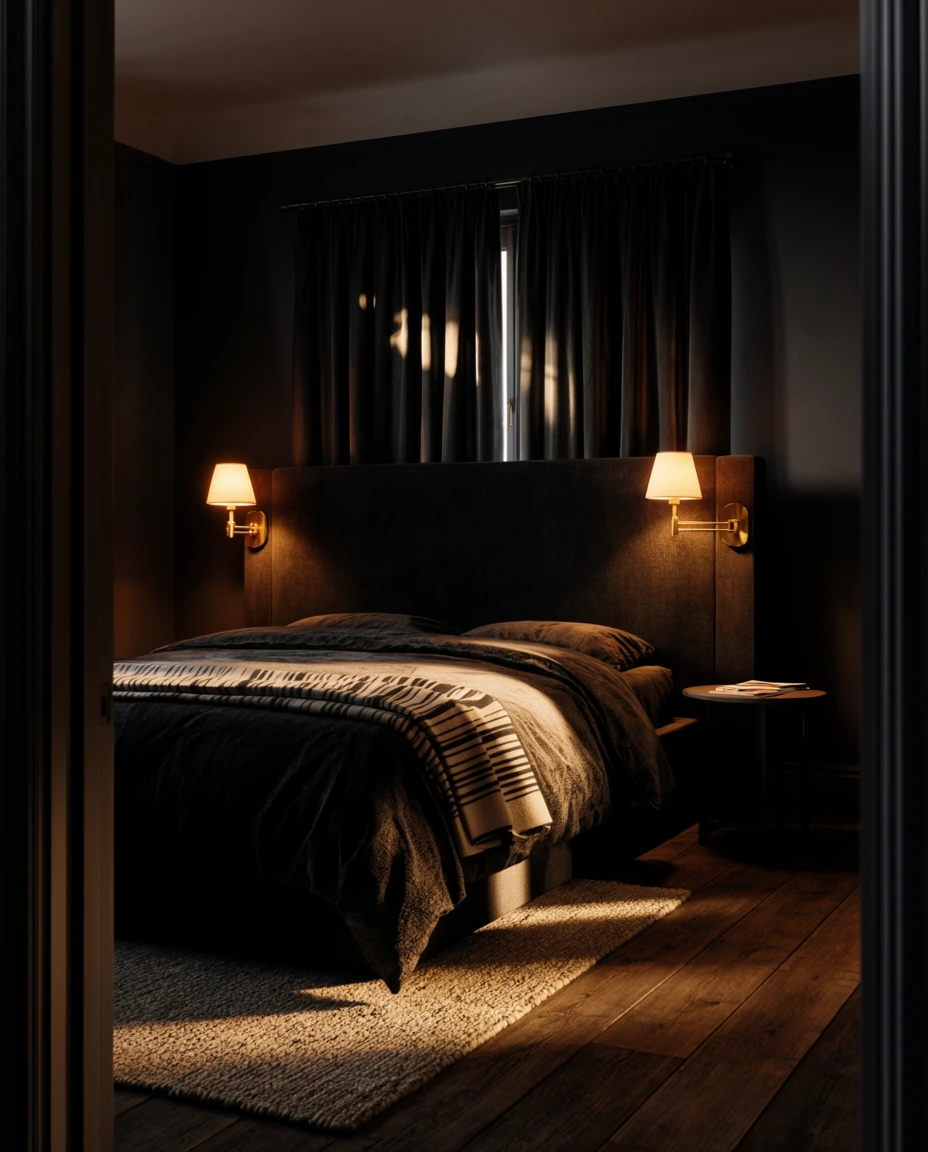
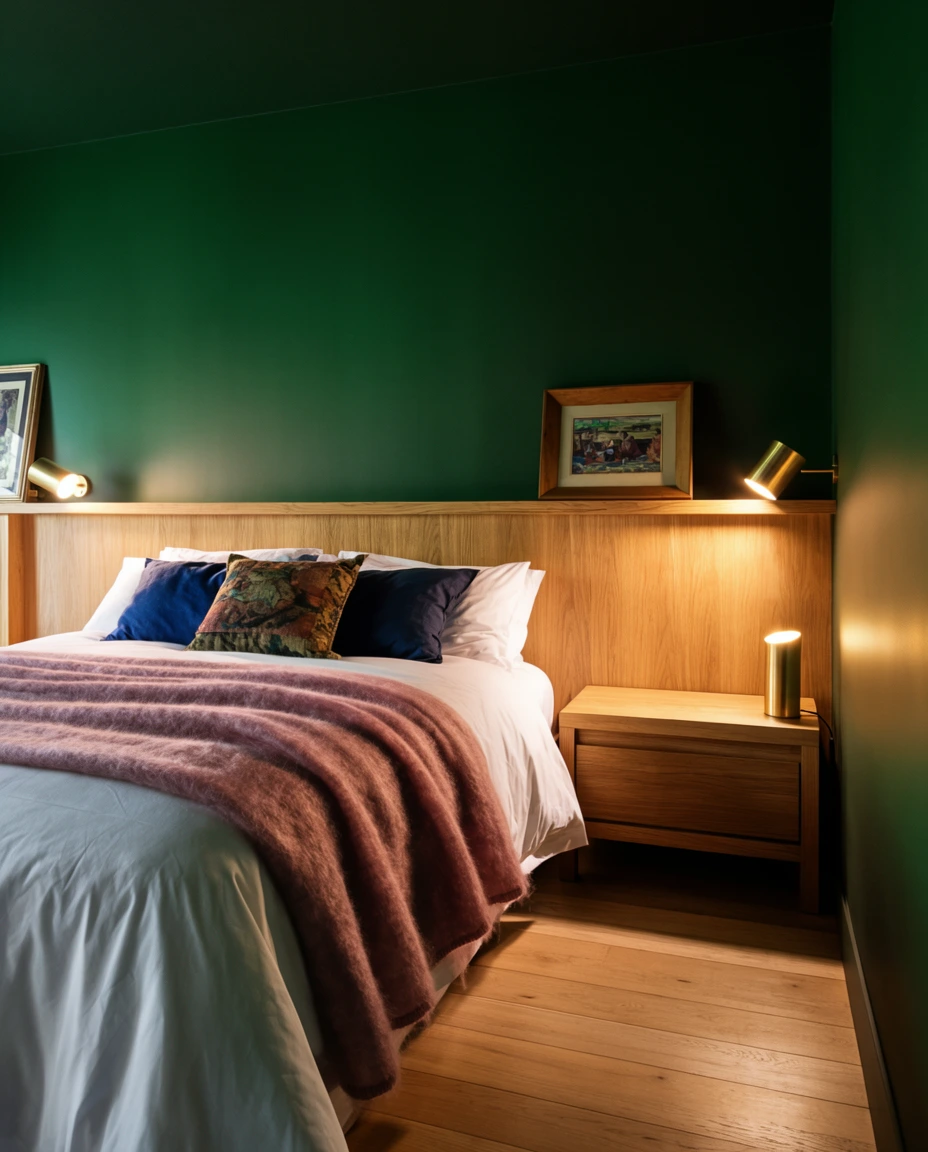
Dark walls in a small bedroom sound risky and almost always work. A deep olive, charcoal, or oxblood absorbs the corners so the walls stop announcing where the room ends, and the effect after dark is enveloping. For couples sharing a modest room, this is the couples cozy direction worth trying long before knocking anything down. The aesthetic holds up in daylight too, as long as the trim and ceiling go the same color as the walls.
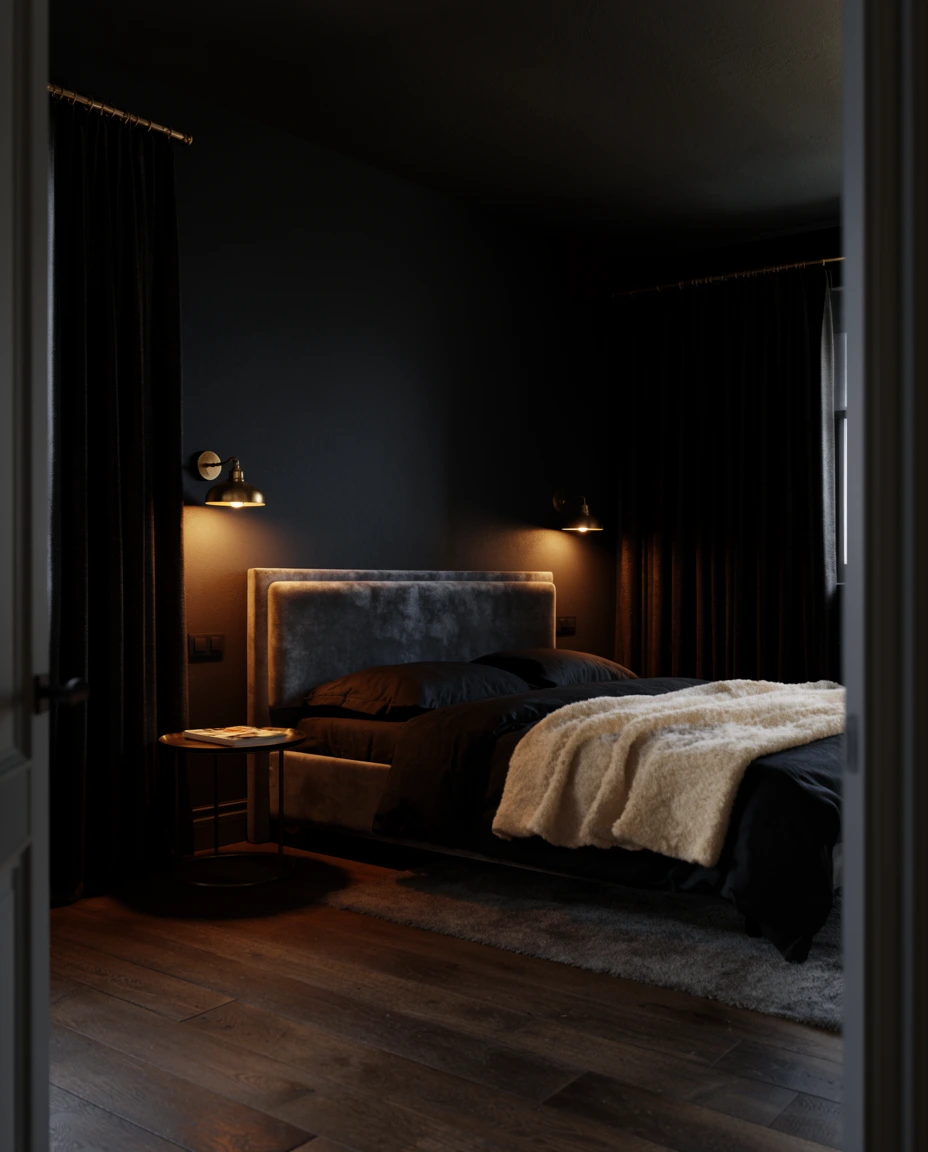
Basement bedrooms and garden-level apartments with small windows gain the most, since a dark room stops apologizing for its lack of light and simply owns it. Rooms with strong afternoon sun handle the deepest shades well, because the light travels across the surface all day and keeps it alive. Reach for eggshell or matte rather than satin — the lower the sheen, the softer the color reads on a wall you sleep beside.
18. The Vertical Gallery Wall

Stack art in a narrow vertical column instead of spreading it wide, and a low-ceilinged room gains height. Two or three frames set above one another beside the bed or over a dresser pull the eye upward and hold it there. It is a simple move with an outsized effect, and it costs whatever you decide it should. A wall built for teens can mix prints, photos, and postcards, while a matched set of frames keeps the decor calm.
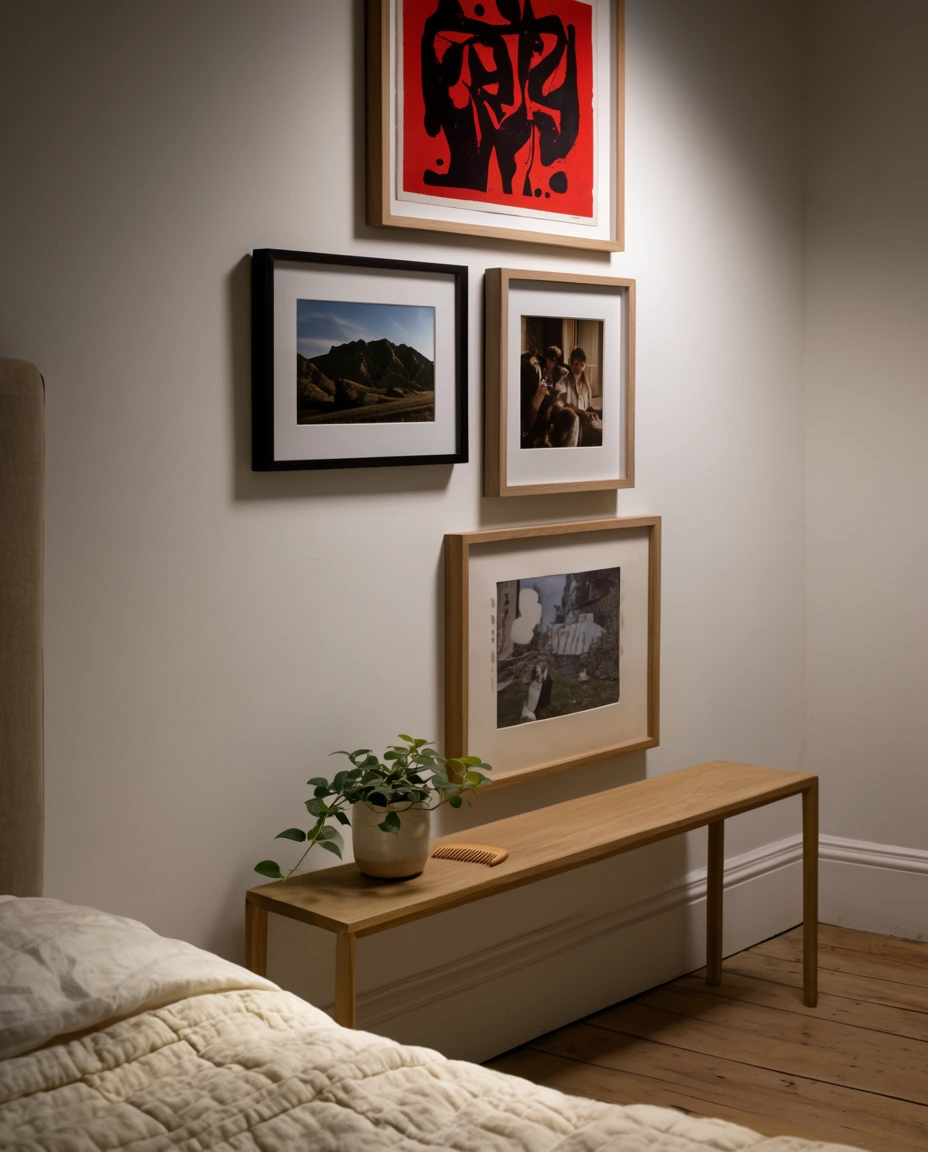
In Southwestern homes with thick plaster walls, adhesive strips rarely hold for long, so a small anchor and a picture hook are worth the patching later. Older Northeastern houses with original picture rails have it easiest — hang from cord and adjust the column height without touching the wall at all. Keep two to three inches between frames and align the left edges, so the stack reads as one piece from across the room.
19. Sliding Doors and Slim Frames

Replacing a swinging bedroom or closet door with a slider gives back the entire arc it once needed. In a modern studio or one-bedroom apartment where every wall is spoken for, that recovered floor usually becomes the spot for a chair or a narrow dresser. Barn-style hardware suits older homes, while a flush pocket door disappears completely. As space saving changes go, this one alters the plan of the room rather than just the furniture inside it.

The frequent misjudgment is picking hardware before checking the wall. A surface-mounted slider needs a clear run as wide as the door itself, and an outlet, a switch, or window trim sitting in that run will stop the project cold. Measure the full travel path first, then the header height above the opening. Soft-close hardware is worth the upgrade, since a heavy door slamming into its stop wakes the house and loosens the track over time.
20. A Weekend Bedroom Makeover
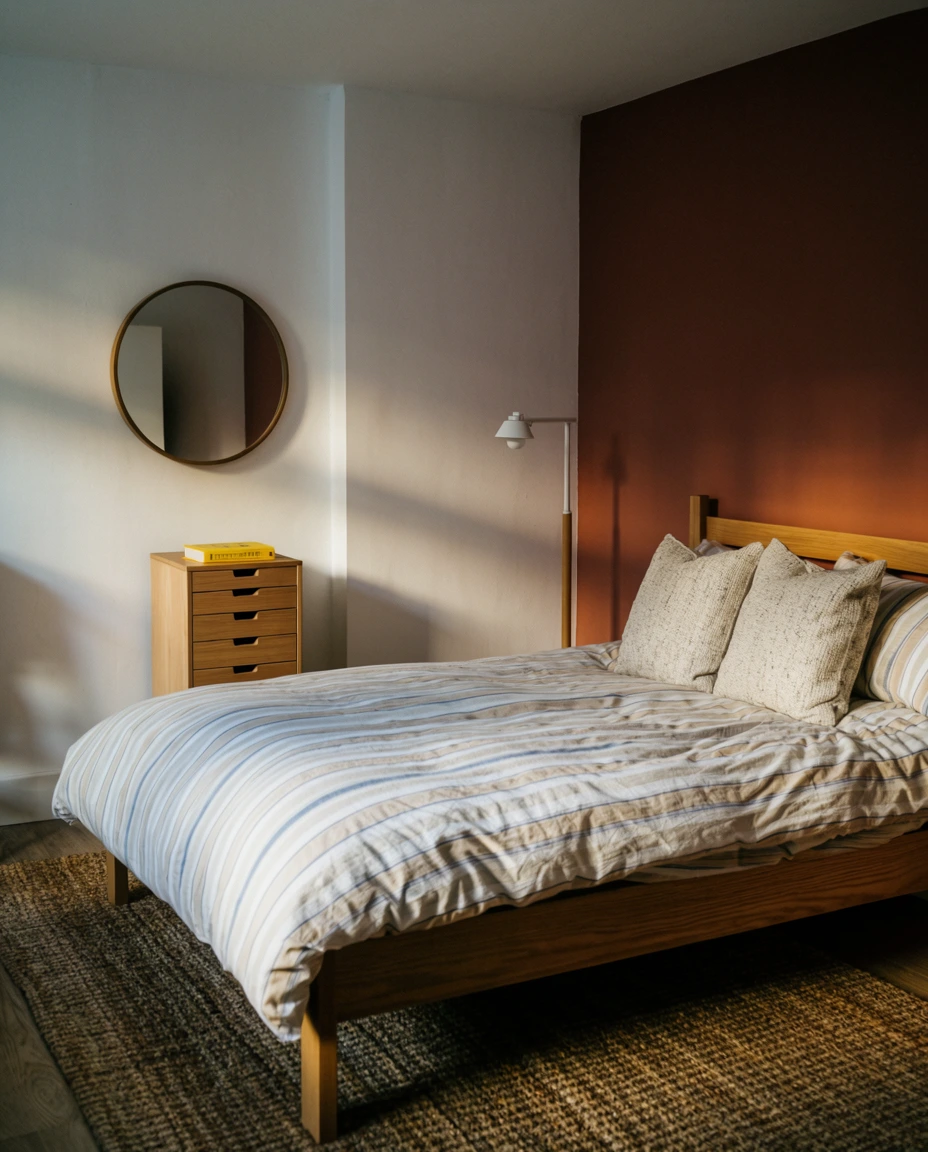
Two days, a drop cloth, and a paint tray can carry a room a long way. A weekend makeover usually comes down to one wall color, new bedding, and a single furniture swap — a slim dresser, a proper lamp, a rug wide enough to run well past the bed. Done on a budget, most of the money goes to the rug and the paint. An Ikea frame or shelf fills the gaps, and nobody can tell once the room is pulled together.
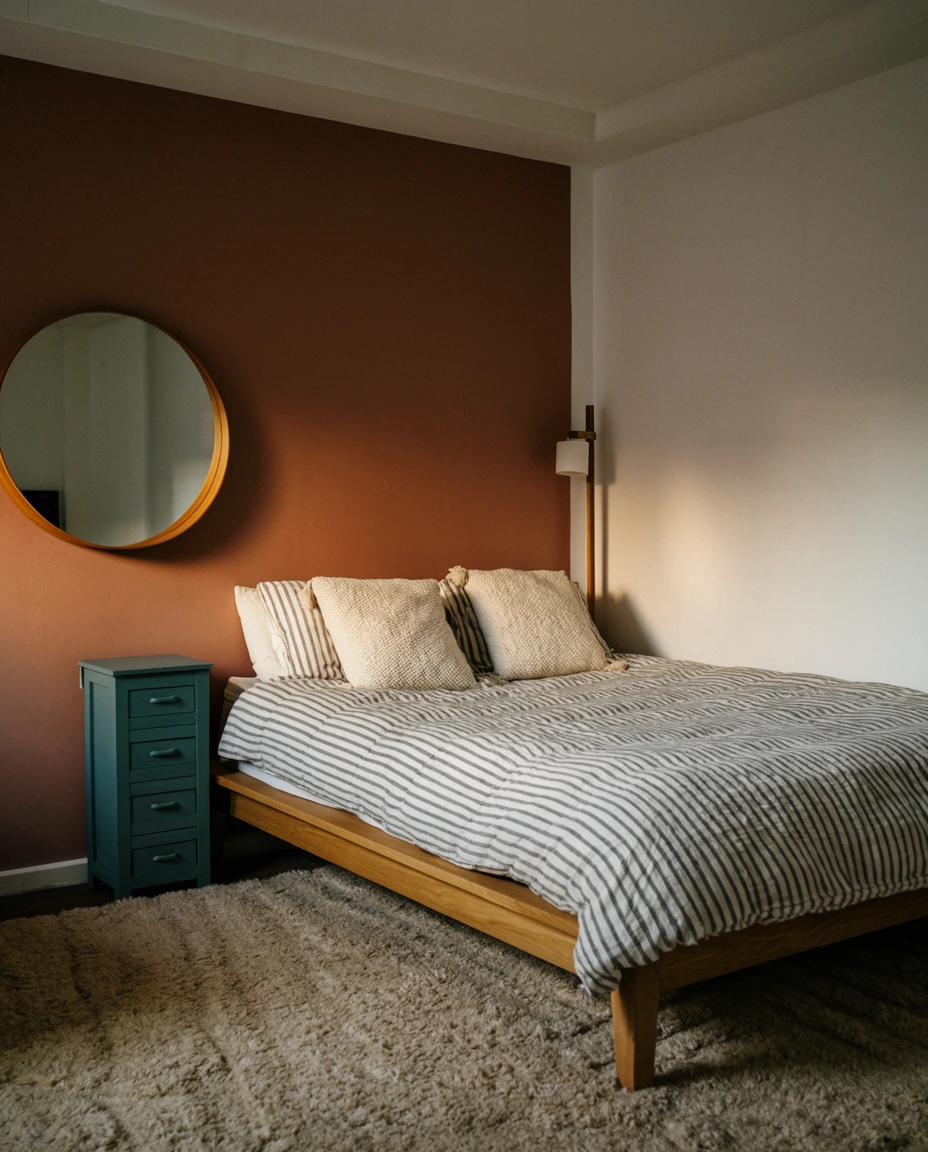
A realistic tally for a 10-by-11 room runs about $60 for two gallons of quality paint, $150 to $300 for an 8-by-10 rug, $80 for bedding that actually looks good, and roughly $120 for a lamp and shade. That lands near $500 all in, and the rug is the piece not to cut corners on — a thin one curls at the corners within a month and quietly undoes the rest.
Every one of these looks can be scaled down, mixed together, or stretched to suit the room you already have. If you have pulled off a small-bedroom setup you love, or you are stuck on one tricky corner, leave it in the comments below. Other readers plan their own rooms from exactly those notes.