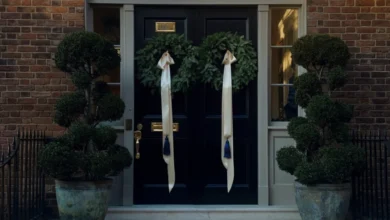

Christmas lights have quietly become the biggest exterior design decision most American homeowners make all year, and 2026 is shaping up to be the season of restraint — cleaner lines, warmer bulbs, and fewer competing colors on one facade. Pinterest boards fill up every October with photos of glowing rooflines and wrapped tree trunks because those images answer a real question: what will my house actually look like from the street? The gap between a display that reads as charming and one that reads as chaotic usually comes down to spacing, color temperature, and knowing where to stop. Below are 22 looks worth copying, each one photographed the way you’d want your own yard to look on a cold, clear evening.
1. Classic Warm White Rooflines
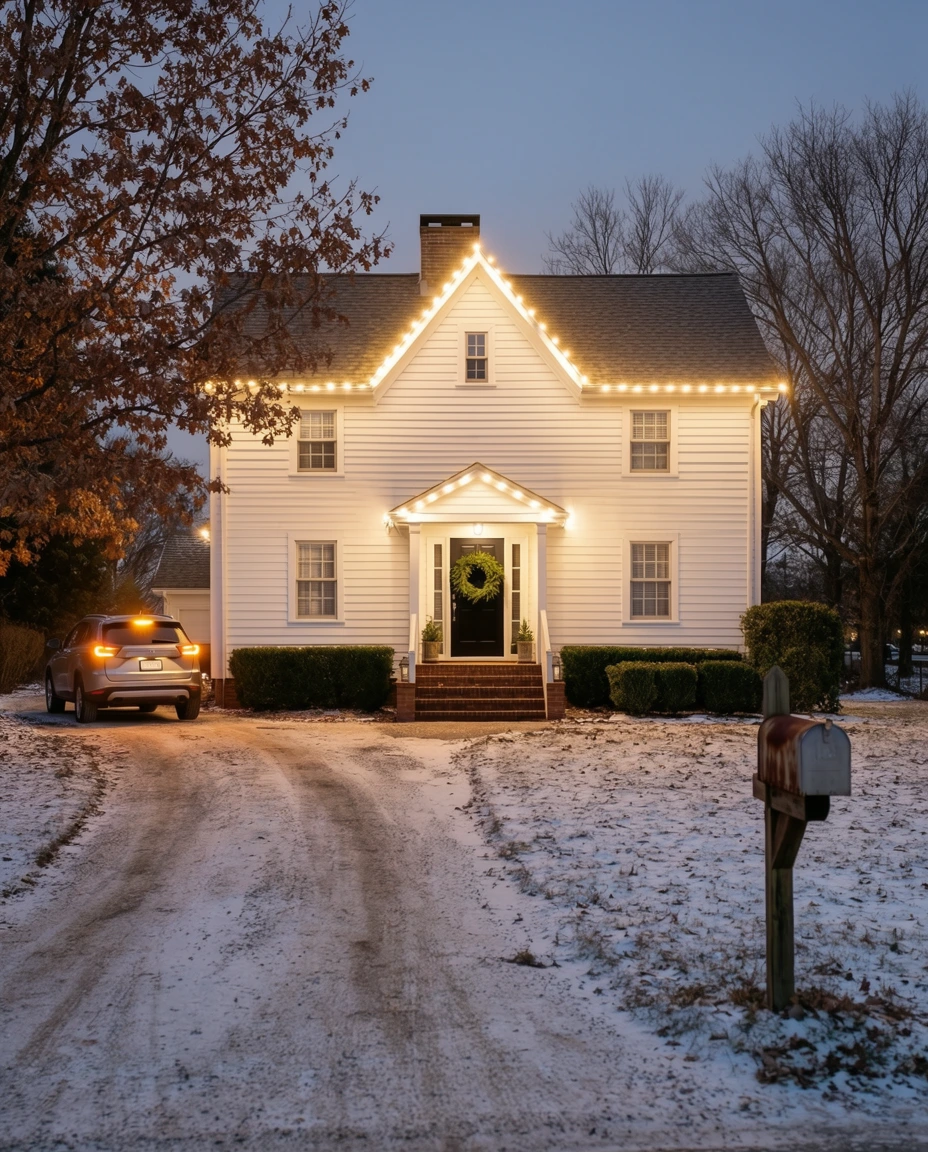
Nothing reads more like December than one clean line of light tracing the eaves. A run of warm white bulbs on house rooflines delivers that classic American picture you see on every quiet suburban street after dark — steady, golden, and never fussy. The line follows the architecture instead of arguing with it, so a ranch, a colonial, or a story-and-a-half Cape all look taller and better proportioned. It is the one idea that works on literally any style of home.

Spacing matters far more than quantity here. Bulbs set roughly twelve inches apart read as a continuous ribbon from the curb, while wider gaps turn into a dotted line the second you back down the driveway. Commercial-grade clips that grip the shingle edge keep the run dead straight through wind and freezing rain, and a single outdoor timer means the whole front comes on at dusk without anyone thinking about it again. Straight lines and consistent spacing are the entire trick.
2. Red and Green Porch Columns
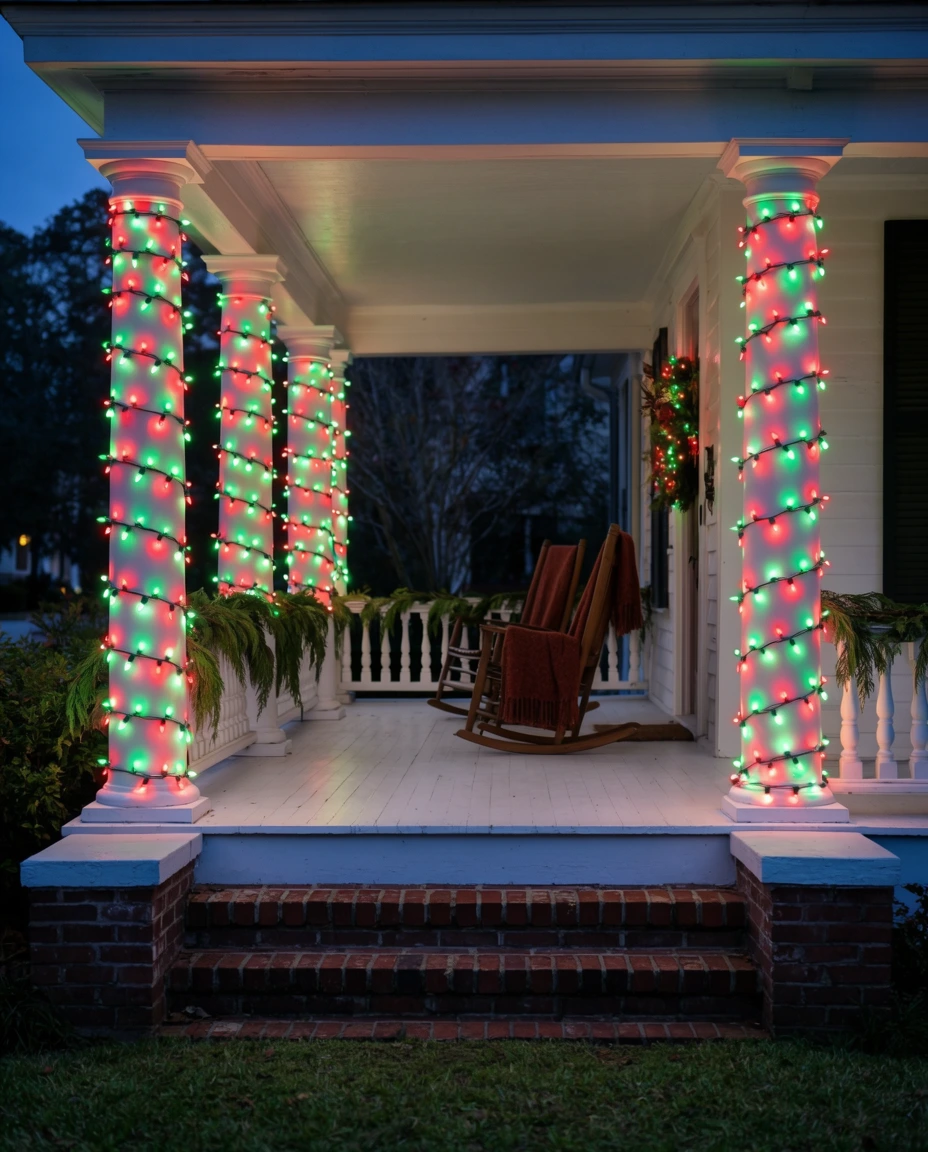
Wrapping a pair of porch columns in red and green is one of those traditional moves that never goes stale. Spiral the strands evenly from base to capital, keep the wraps tight and consistent, and the two colors stay crisp from the sidewalk instead of blurring into brown. Paired with simple fresh pine decorations at the door, lit columns frame the entry the way a mat frames a photograph, which lets the rest of the facade stay quiet.
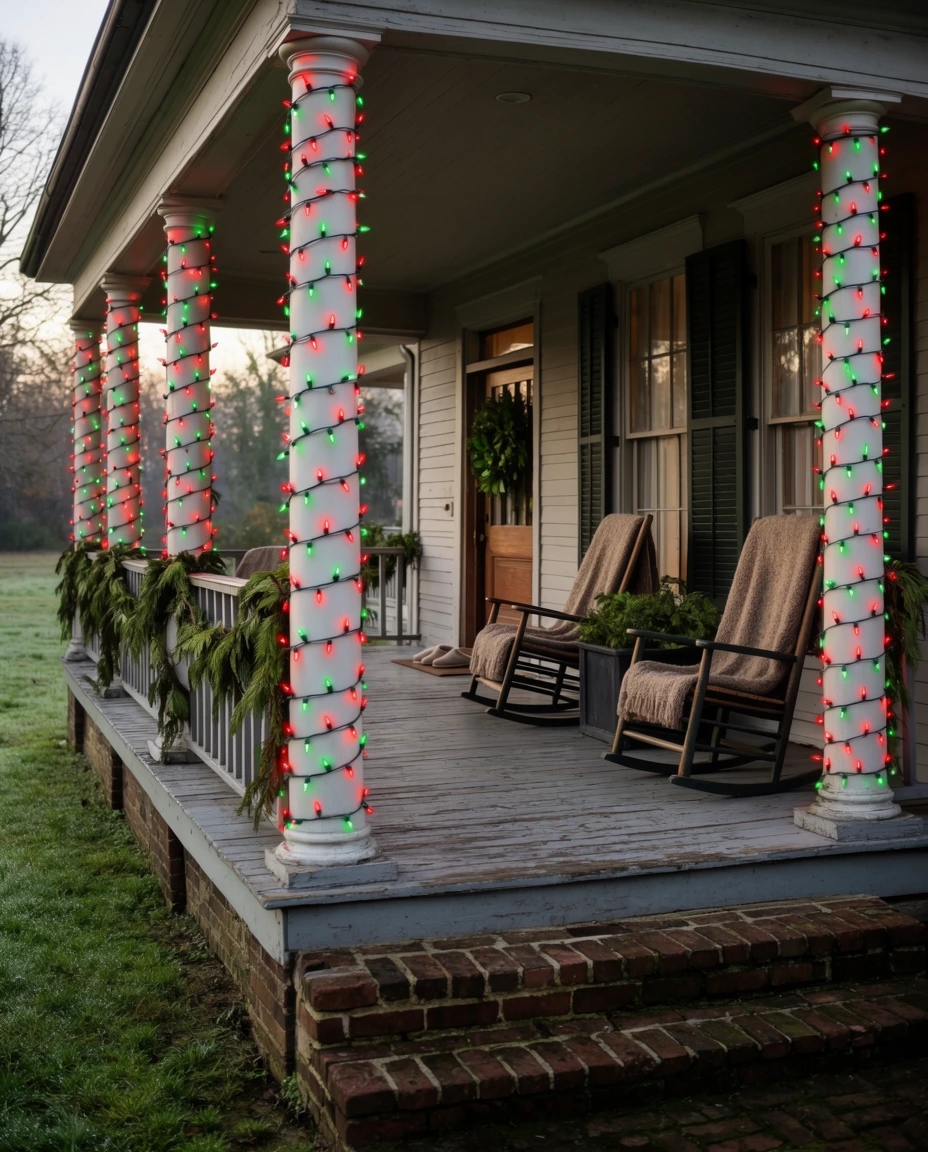
This look carries especially well on the deep front porches common across the Midwest and the South, where columns are already the strongest feature of the house. In Georgia or Tennessee, where the lawn stays green into January and snow never arrives to bounce light around, that jolt of saturated color does the work winter does farther north. Older neighborhoods with brick piers and painted railings get the most out of it, since the wraps echo the porch’s existing rhythm.
3. Net Lights Over the Hedges
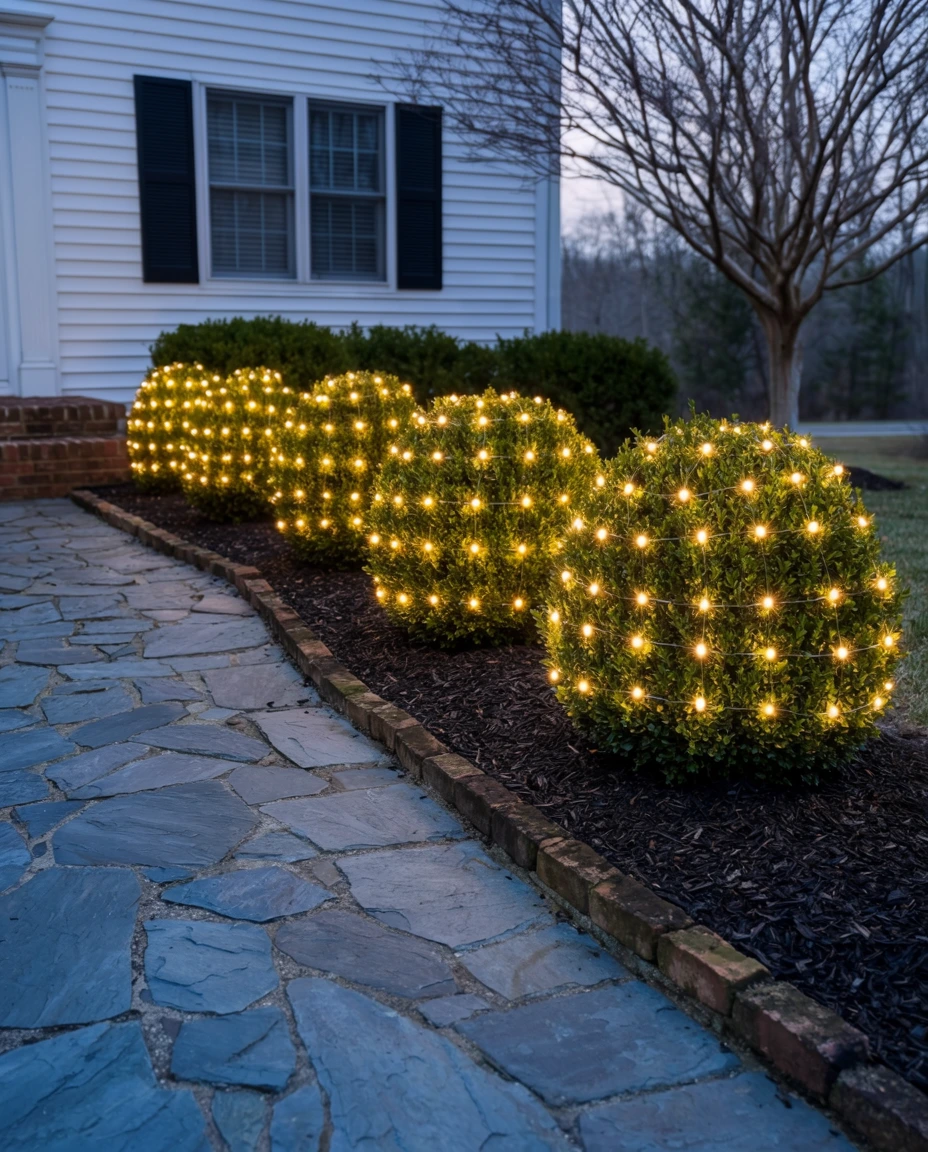
Foundation shrubs are the fastest win in the whole yard, and net lights are the simple answer. They are genuinely easy to hang — you unfold the mesh, drape it over the boxwood or the yew, tuck the corners into the branches, and the shape of the plant does the styling for you. Two people can cover an entire front bed in twenty minutes, and the even grid keeps the glow smooth rather than clumping in one bright spot.
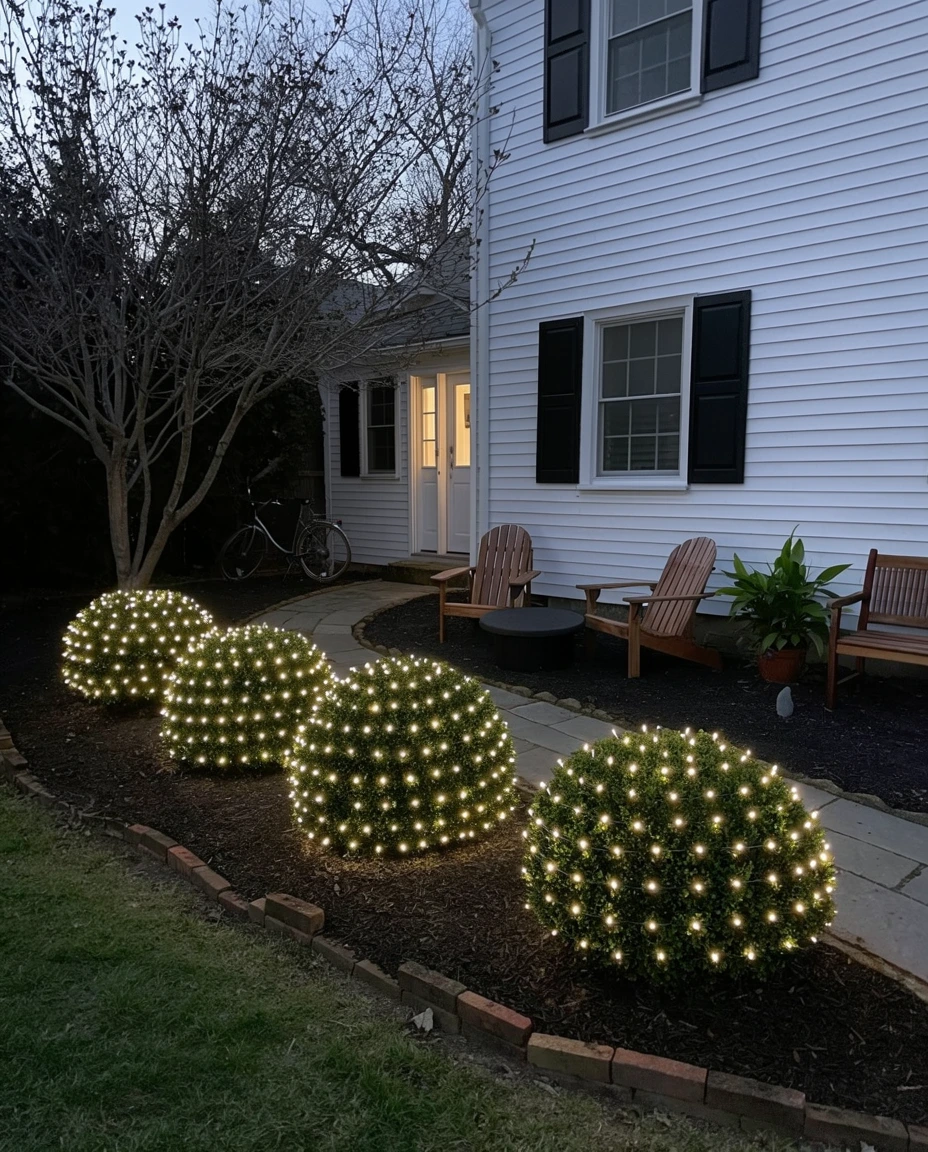
Cost-wise this is the best value on the list. A 4-by-6-foot net typically runs eight to fifteen dollars, so a standard front bed with four shrubs lands well under sixty dollars total, and LED versions add only a few dollars to a December electric bill. Buying all the nets in one order matters more than the brand, because bulb tone drifts noticeably between production runs and mismatched whites are obvious the moment they are side by side.
4. Wrapped Trunks in the Front Yard
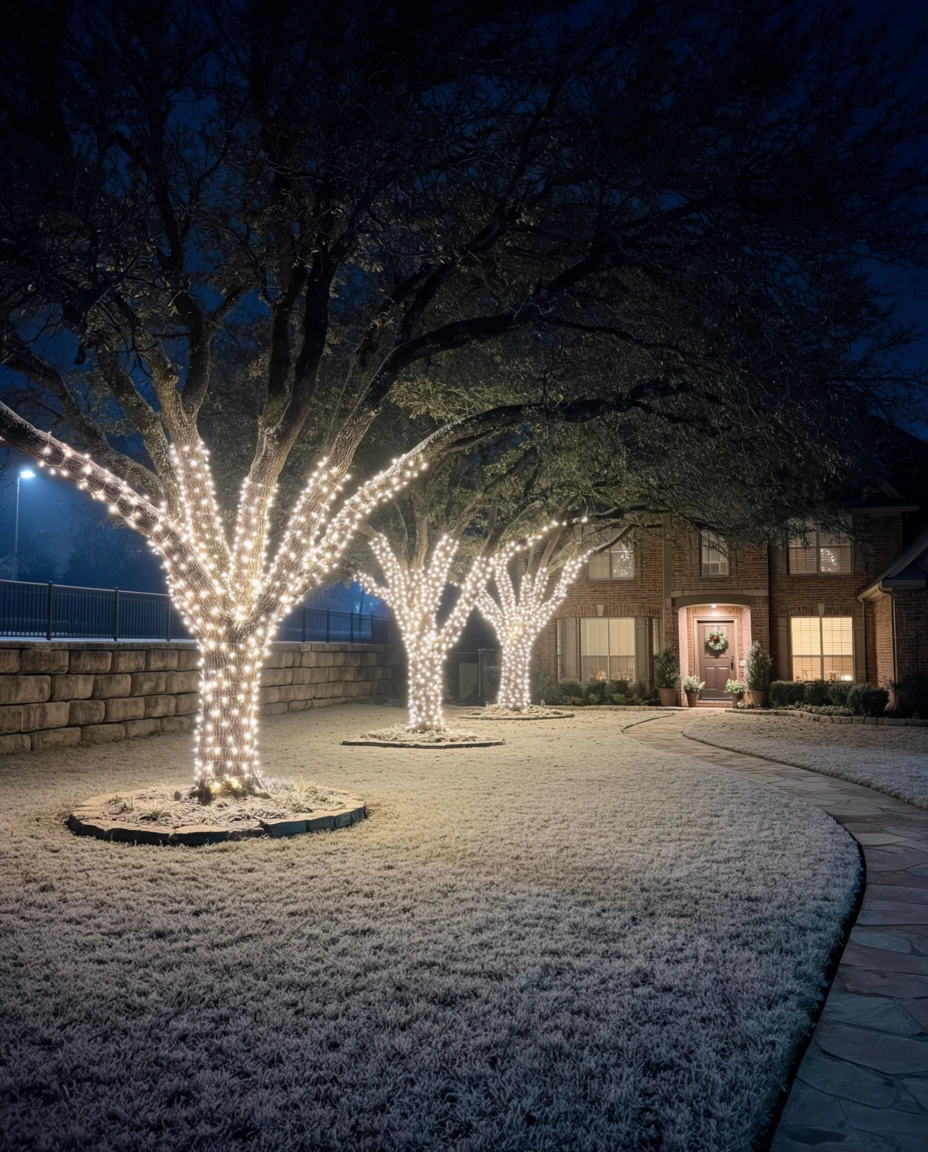
Lights on trees change a yard more than anything on the house itself. Wrapping a mature trunk from the ground up through the first heavy branches gives you height, depth, and a real silhouette after dark, and a single bare tree handled well beats a dozen scattered inflatables. Among the display ideas circulating this year, this is the one that photographs beautifully at every hour, from that blue half-light at 4:45 to full night.
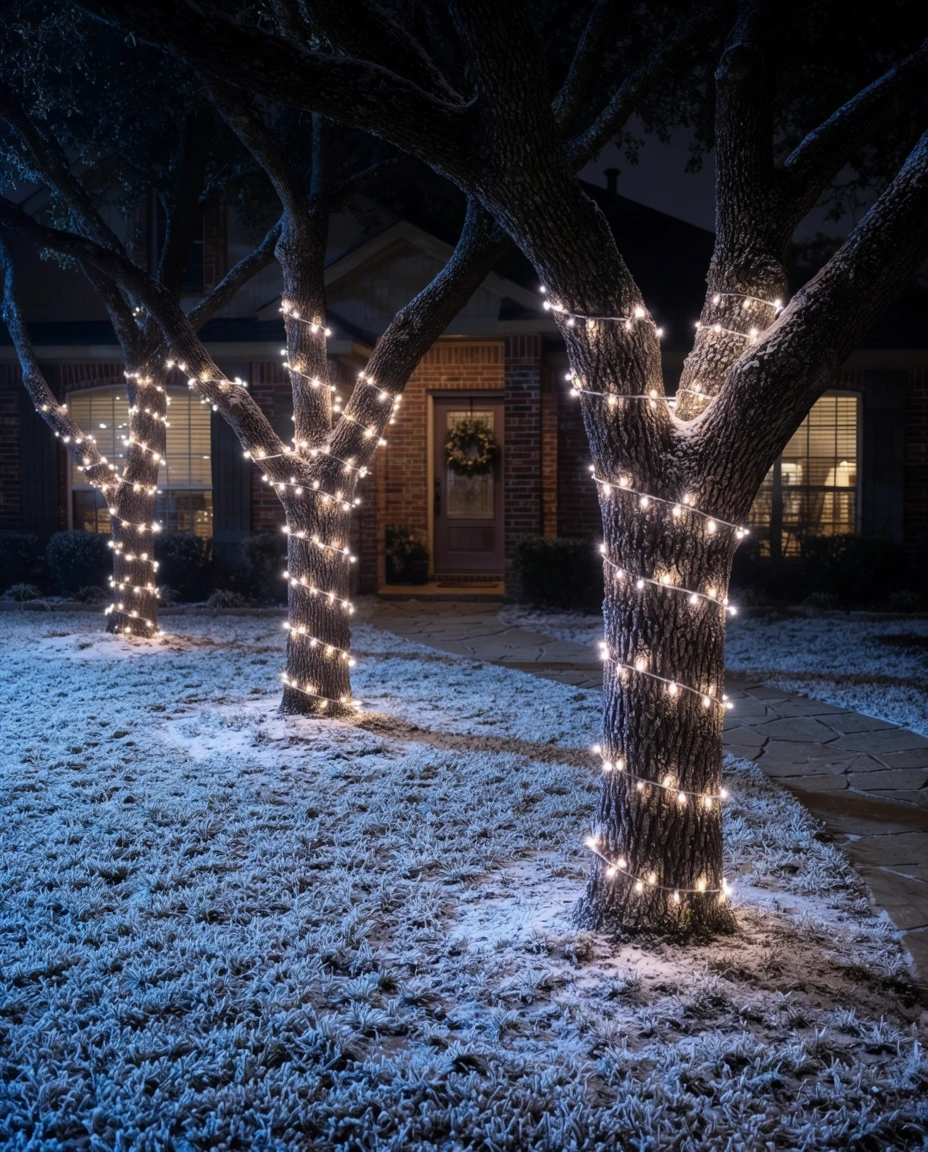
The effect lands hardest on yards with two or three trees at different distances from the street, because the layered depth is what your eye reads as glamour. Corner lots benefit too, since the wrapped trunks are visible from both approaches. Skip it if your only tree sits directly against the house — the trunk lights and roofline lights end up stacked in the same sightline and neither one gets to breathe.
5. Vintage C9 Bulbs for Brick

The fat, teardrop C9 bulb is the shape most of us actually picture when we think of Christmas, and its vintage character sits perfectly against brick. On a red or painted-brick house, the wide spacing between big bulbs lets the mortar lines and texture show through instead of being washed flat. That restraint is the whole aesthetic — fewer, larger points of light, spaced generously, reading like a strand your grandparents would recognize.
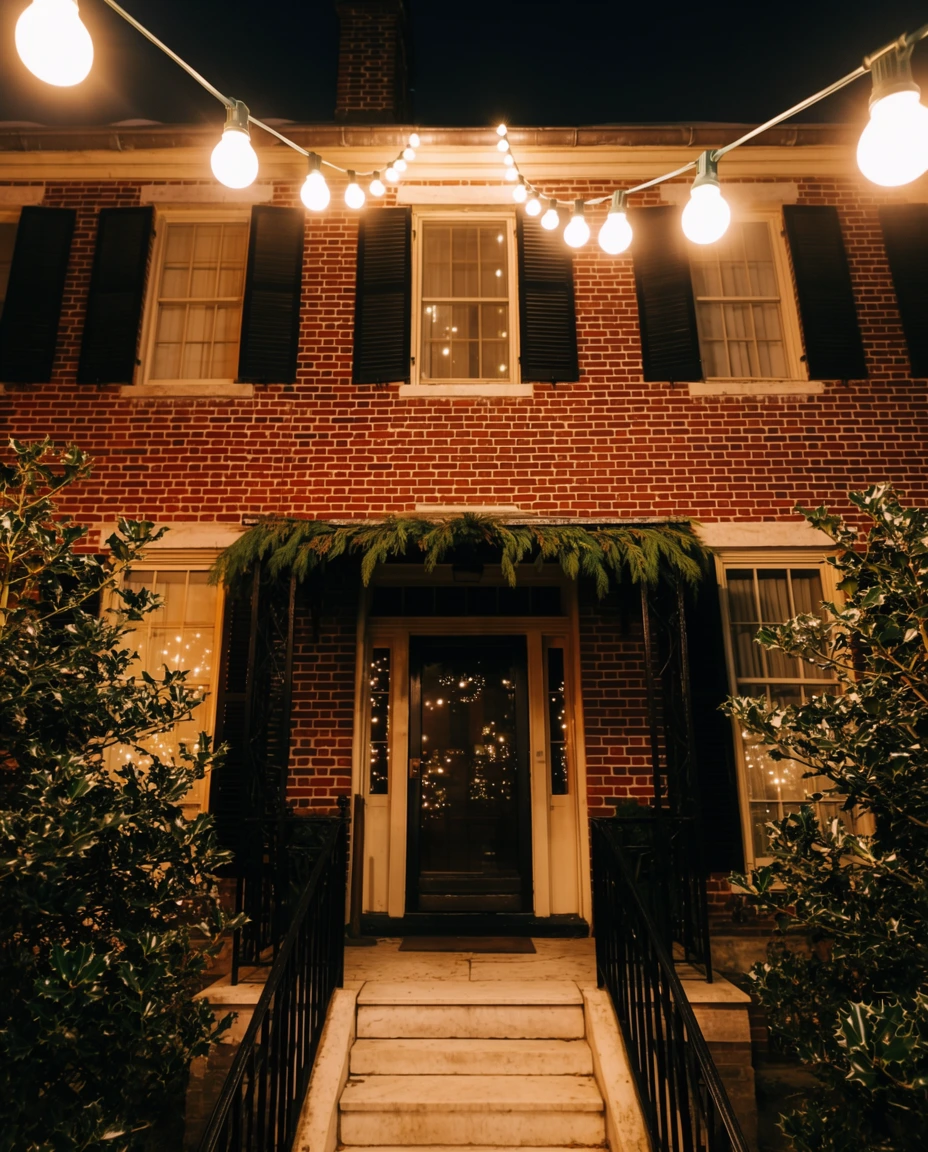
Lighting designers who work on historic districts tend to argue for ceramic-coated LED C9s over clear glass on masonry, because the frosted shell softens the point source and keeps the bulb from blowing out to a hot white dot on camera. They also favor the twelve-inch spacing over eight for older facades, since a denser run starts to look like commercial signage on a house that was built long before anyone strung a single light.
6. Icy Blue Winter Glow
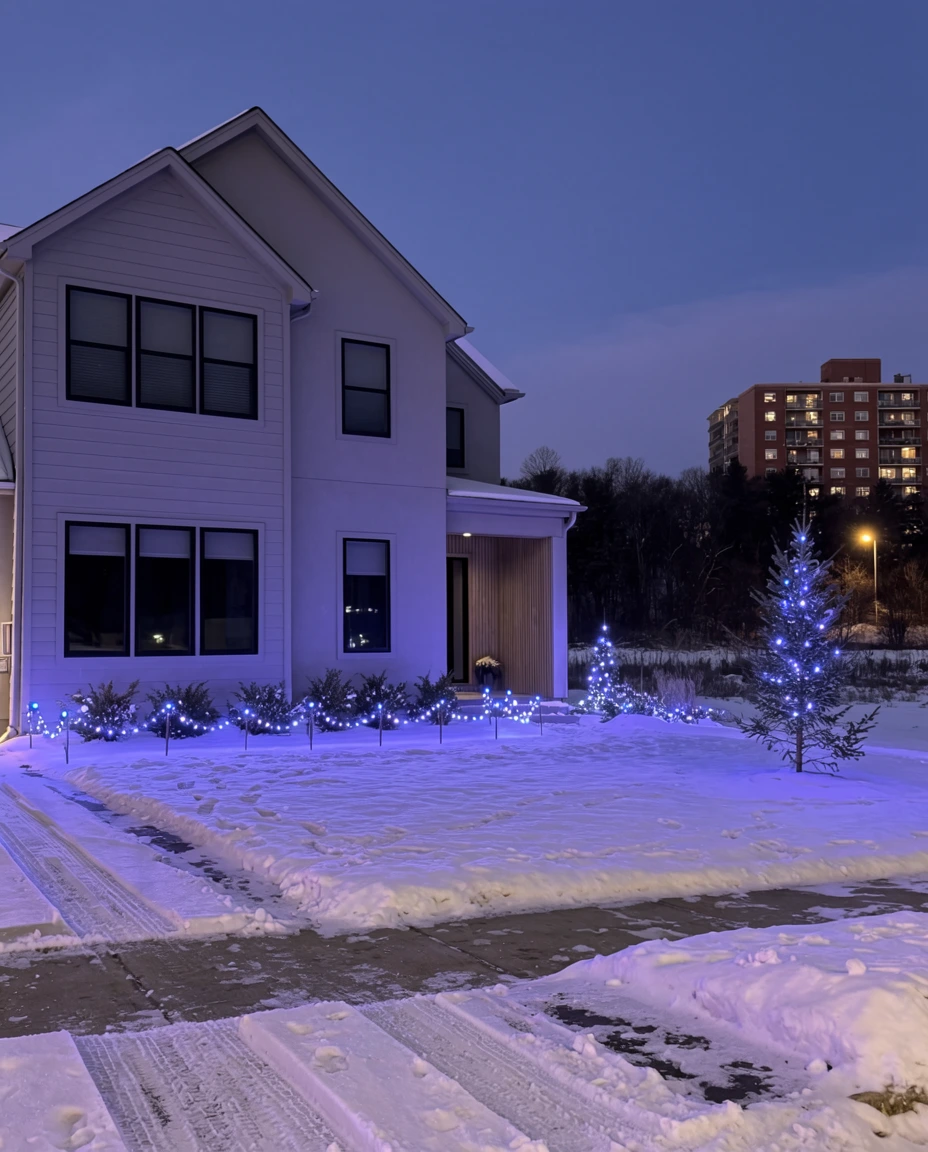
A cool blue scheme reads more Scandinavian winter than candy cane, and that restraint is exactly why it feels elegant. Blue behaves differently from every other bulb color outdoors: it holds its saturation at a distance and turns snow slightly violet, which makes it one of the most striking lighting ideas for houses with white or pale gray siding. Keep it to one or two surfaces — the shrubs and a single tree — and let the darkness carry the rest.
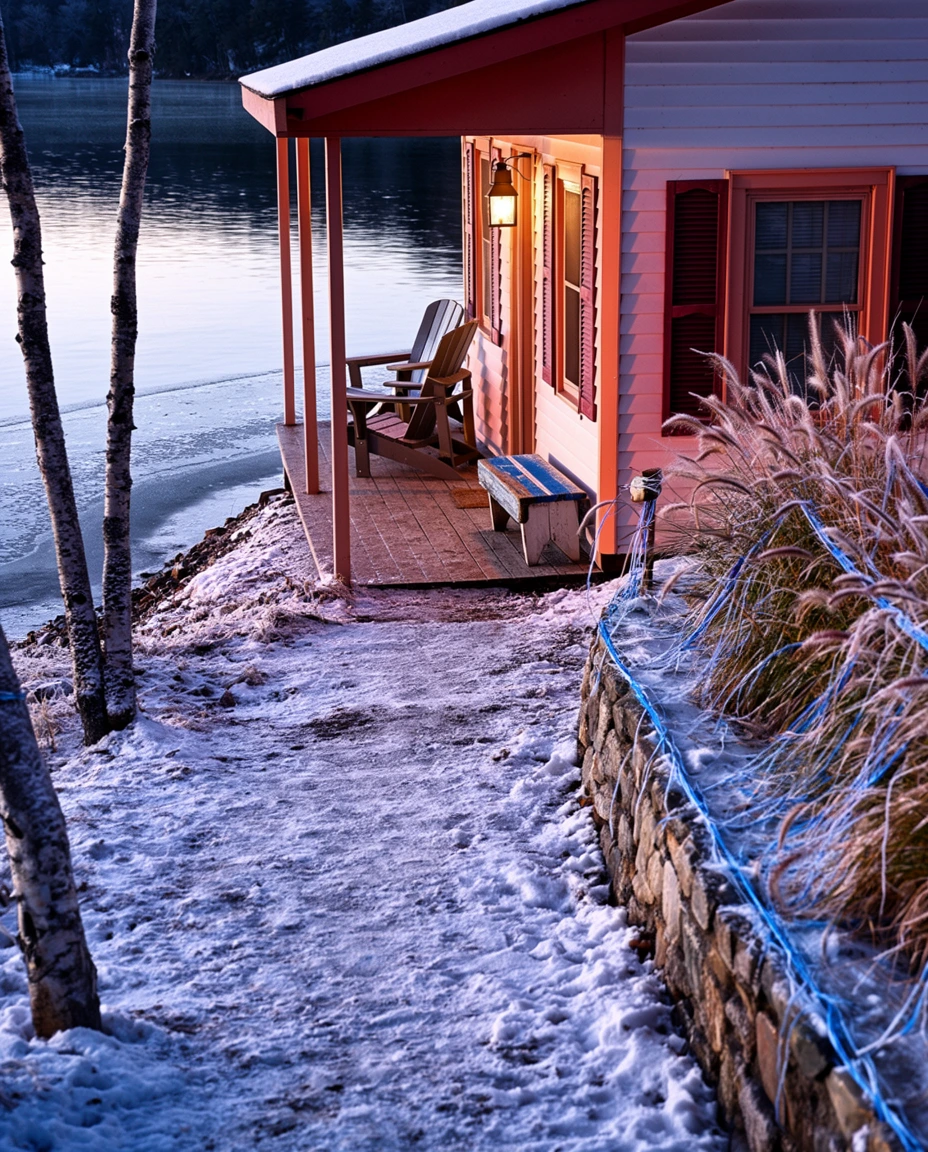
What usually happens is that people buy blue, install it next to their existing warm white porch fixture, and immediately hate the result. The fix is boring but reliable: swap the porch bulb for a cooler-temperature one, or turn that fixture off entirely for the season and let a lantern on the step handle the doorway. Once the warm and cool aren’t fighting each other in the same frame, the blue finally looks intentional.
7. A Simple Single-Color Statement
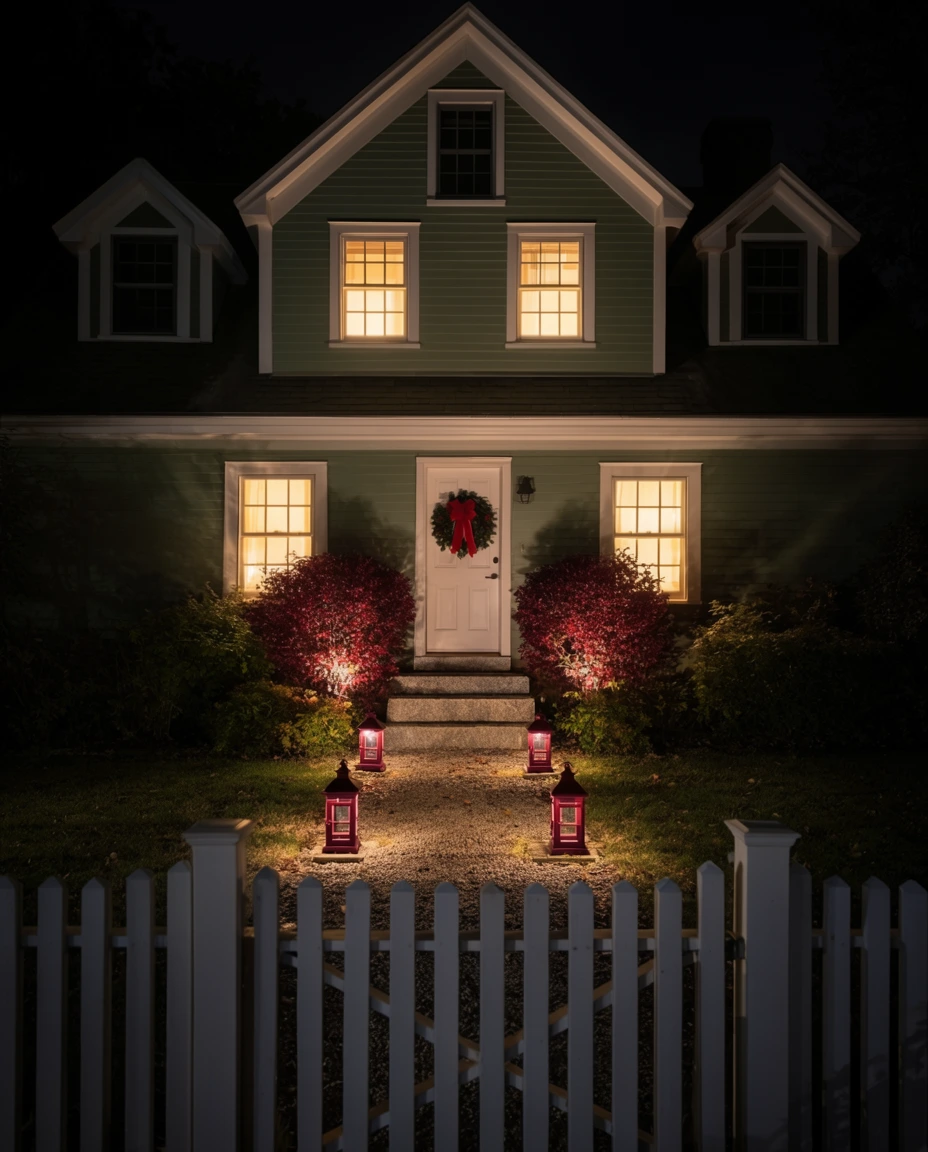
Choosing one color and committing to it is the quickest route to a classy exterior. Pure white across the roofline, the shrubs, and the walkway lanterns creates a single unified glow rather than four separate ideas competing for attention, and the surrounding decor — wreaths, urns, a pair of ribbon bows — can then carry whatever color you want. Designers lean on this approach constantly because it makes a modest house look considered rather than decorated.
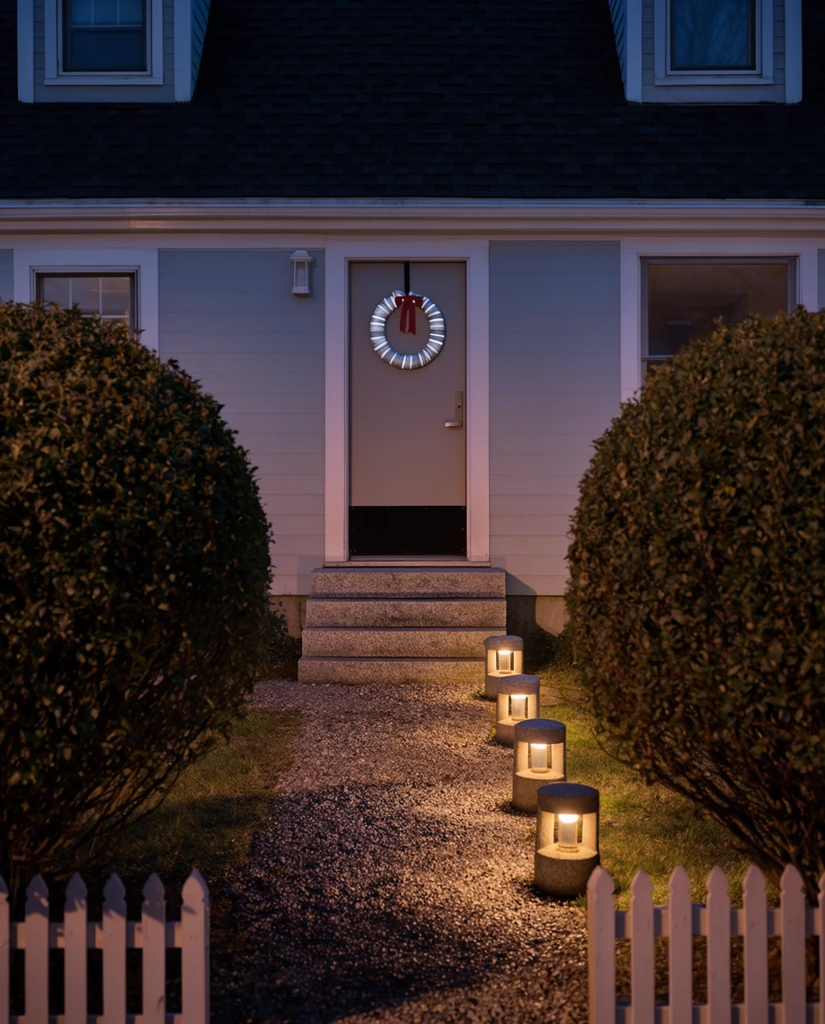
A neighbor of mine spent three seasons adding a new element every year — a projector, then colored spotlights, then a lit reindeer — before stripping it all back to one temperature of white and nothing else. Her house is now the one people slow down for on the street, and she spends about half the time putting it up. Subtraction turned out to be the upgrade she had been shopping for the entire time.
8. Multicolor Nostalgia for Ranch Homes
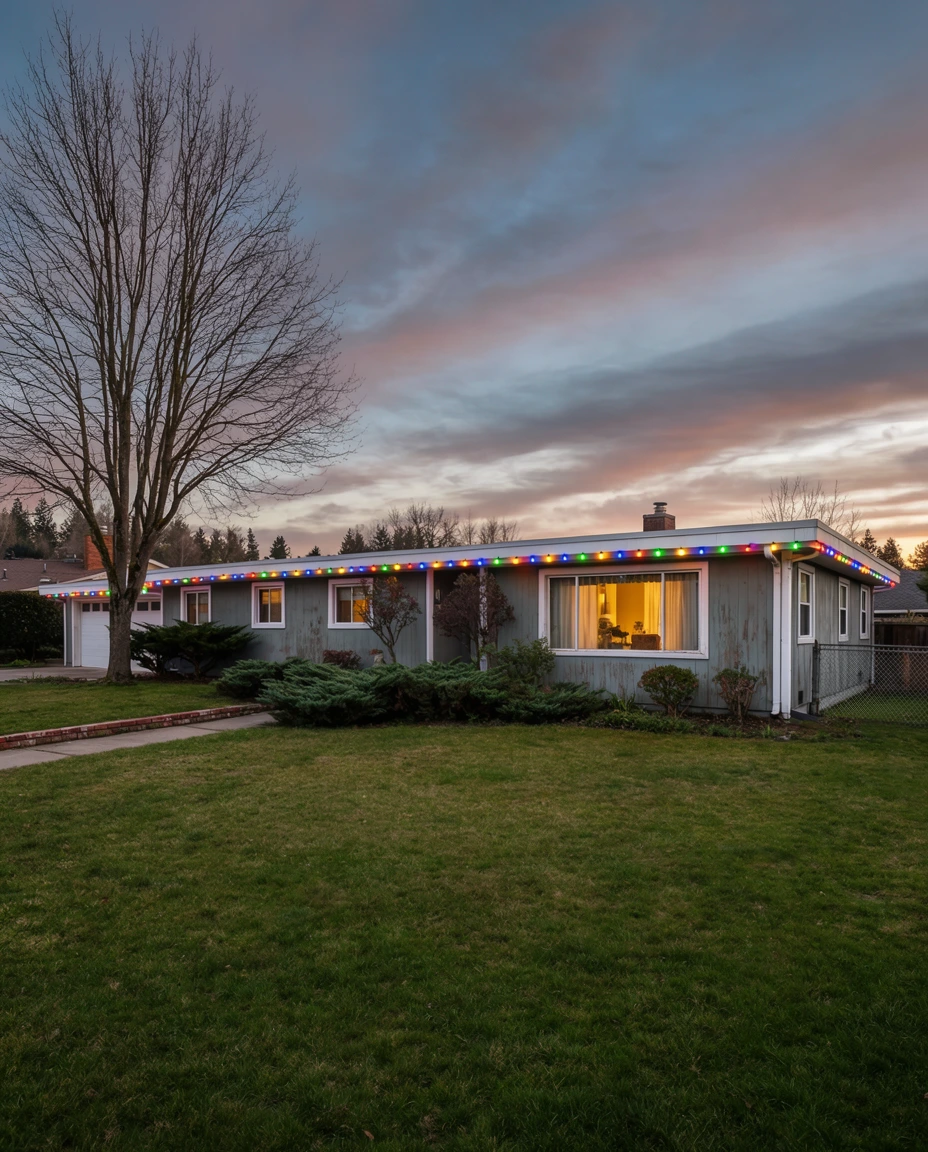
The long, low roofline of a ranch was practically built for multicolor bulbs. Because the eave runs unbroken for forty feet or more, a colorful strand gets room to establish a rhythm — red, green, blue, amber, repeat — that a busy two-story facade chops into fragments. Ranch displays like this feel like 1974 in the best possible way, and they photograph with a warmth that no all-white scheme quite matches.
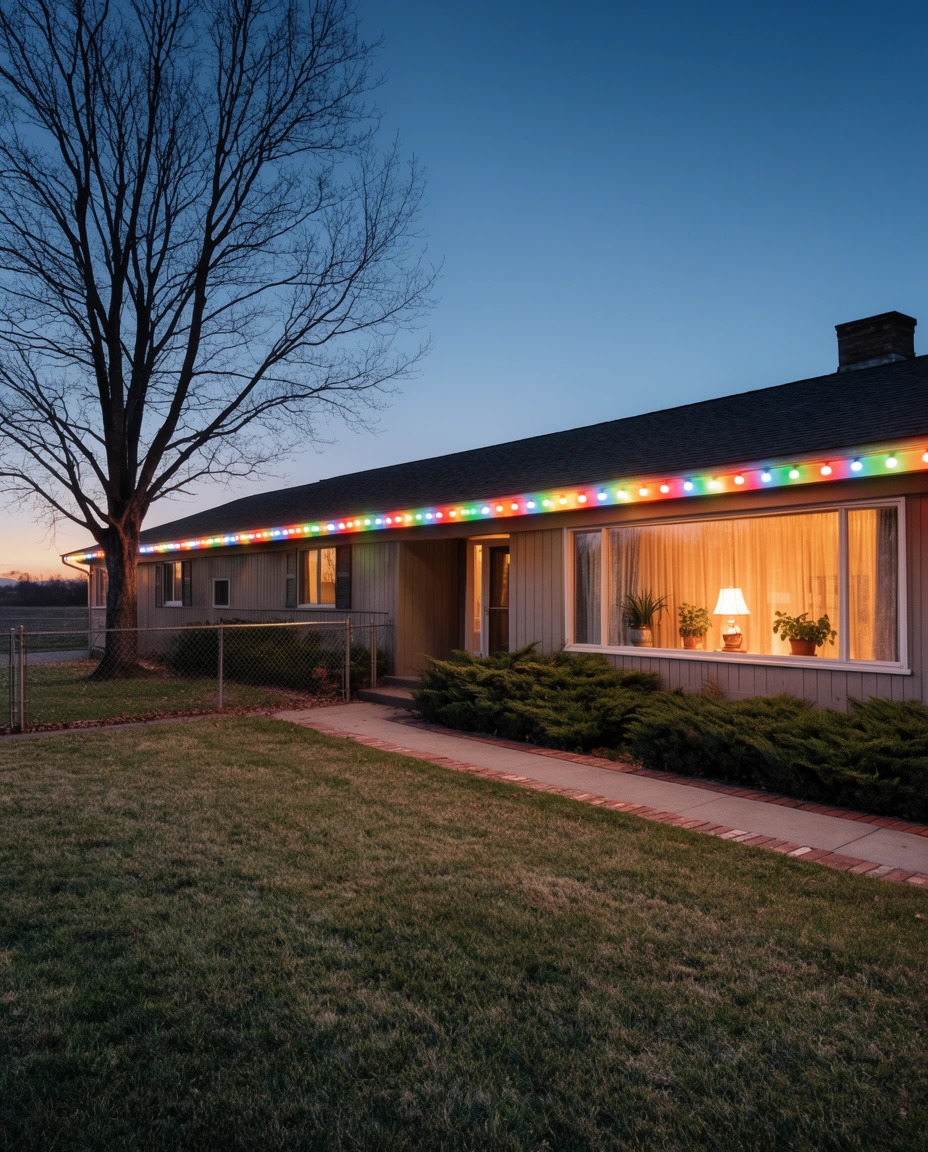
Whole neighborhoods in places like suburban Ohio, upstate New York, and the older sections of Phoenix have basically standardized on this look, and there’s a reason it stuck: postwar tract houses share an eave height and a lot width, so one lit roofline flows visually into the next. Drive those streets in mid-December and the block reads as a single continuous display rather than a series of individual efforts.
9. Lit Garland and Fresh Wreaths

Scroll through ideas houses boards for five minutes and you’ll notice how many of the most-saved images share one detail: real greenery with lights woven inside it. A cedar or fraser garland along the porch rail, a wreath on each front window, and a fine string of micro-LEDs buried in the needles gives the light something to live in. That texture is where the inspiration comes from — the glow reads soft and dimensional instead of pinned flat to the wall.

Fresh greenery holds up outdoors for about four to six weeks in cold climates, which is why installing after Thanksgiving rather than in early November is worth the wait. Anti-desiccant spray, sold at most garden centers, roughly doubles that window by slowing moisture loss from the needles. Battery packs tucked behind the garland save you from running an extension cord across the porch floor, and modern ones last most of a month on one set of cells.
10. Candy Cane Walkway Markers
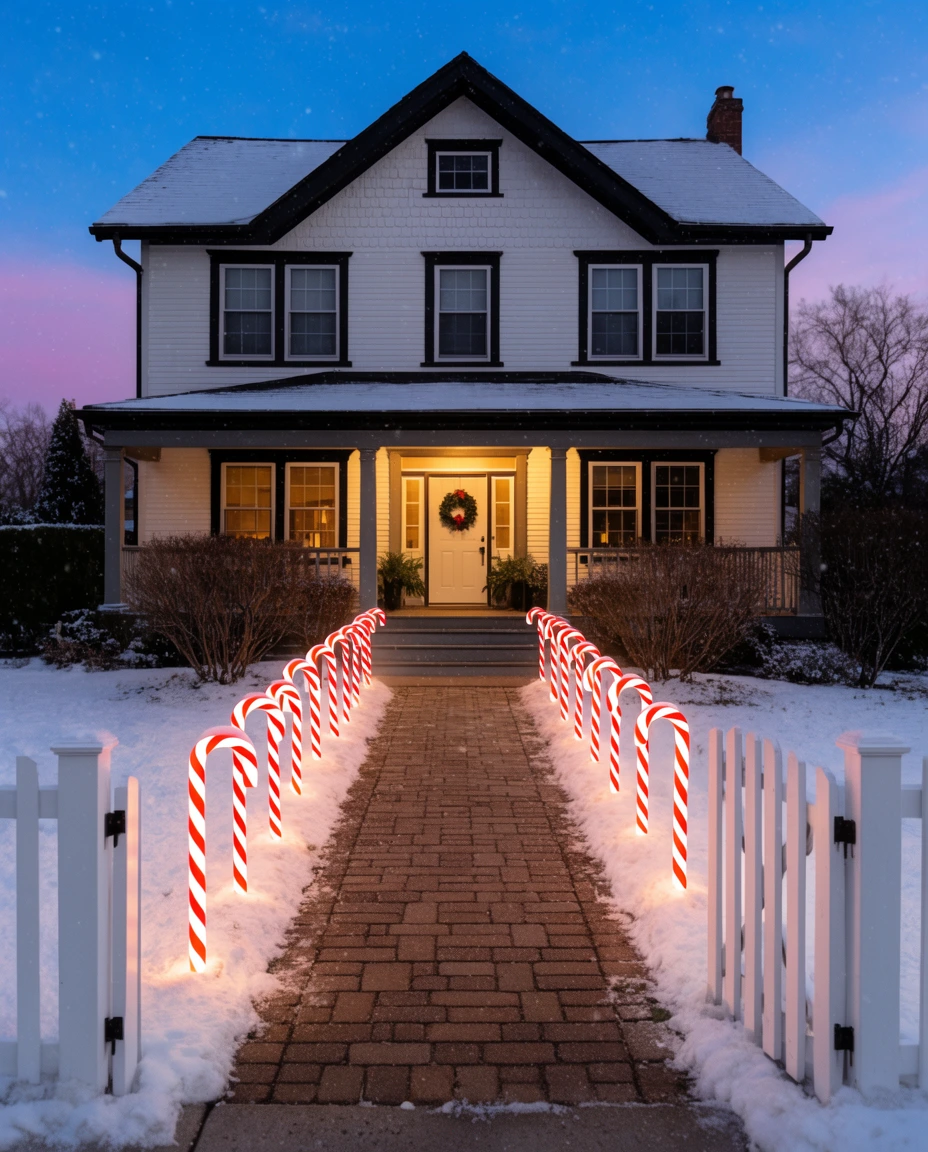
Lining the front path with lit candy canes is the definition of a satisfying diy afternoon — PVC pipe, a heat gun, outdoor tape, and rope light produce markers that look far better than the plastic versions sold in big-box aisles. This is the kind of project behind all those ideas houses holiday decorating easy searches that spike every November, because it costs almost nothing, stores flat, and gives the walkway a clear, cheerful rhythm from the curb to the door.
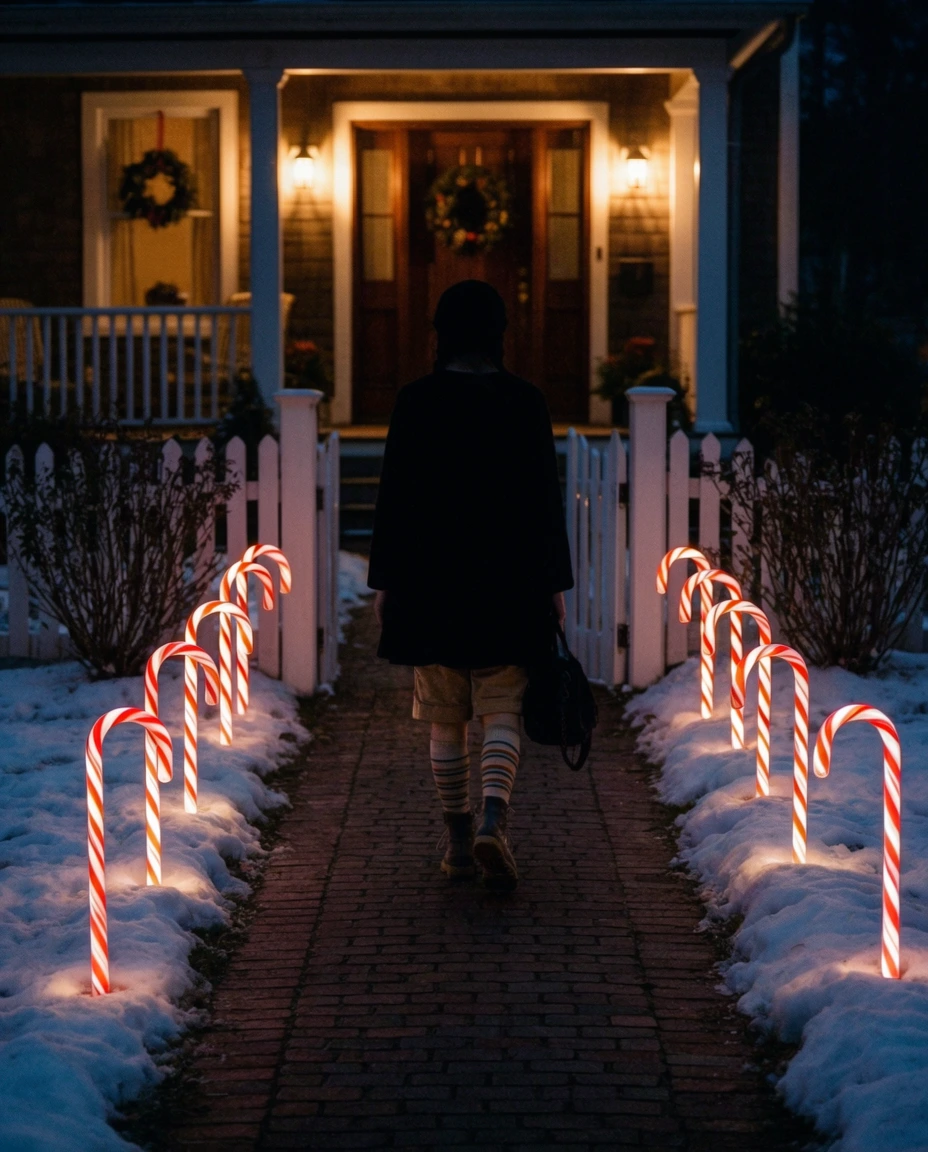
The failure people run into is spacing that drifts — start at the porch and work outward and the last three markers always end up crowded near the street. Measuring the path first and dividing by an even number solves it in two minutes. The other frequent slip is pushing stakes into soil that later freezes and heaves; setting them slightly deeper than feels necessary keeps every cane standing upright through the first hard freeze.
11. Curtain Lights Over the Porch

Curtain strands turn a covered porch into the warmest room in the house without a single piece of furniture changing. They are straightforward to hang along the header beam, and the vertical drops outfit the whole ceiling edge with a soft, even fall of light. The aesthetic lands somewhere between a wedding reception and a ski lodge, which is precisely why it keeps showing up in the most-saved exterior photos every season.

Deep porches with a solid roof are the natural home for this, since the overhead structure protects the strands and gives the drops something to read against. It also works beautifully along a pergola beam or across the top of a garage bay on a house with no porch at all. Where it struggles is on an open stoop with nothing above it, because the strands have no upper edge to define them and the effect scatters.
12. Red and White Peppermint Trim

Alternating red and white bulbs along the trim gives you the peppermint effect without a single plastic ornament in the yard. The trick is a strict repeat — two red, two white, all the way down — so the eye picks up a pattern rather than randomness. It’s a classic pairing that flatters white siding and black shutters especially well, and it feels traditional without sliding into anything sugary or overdone.
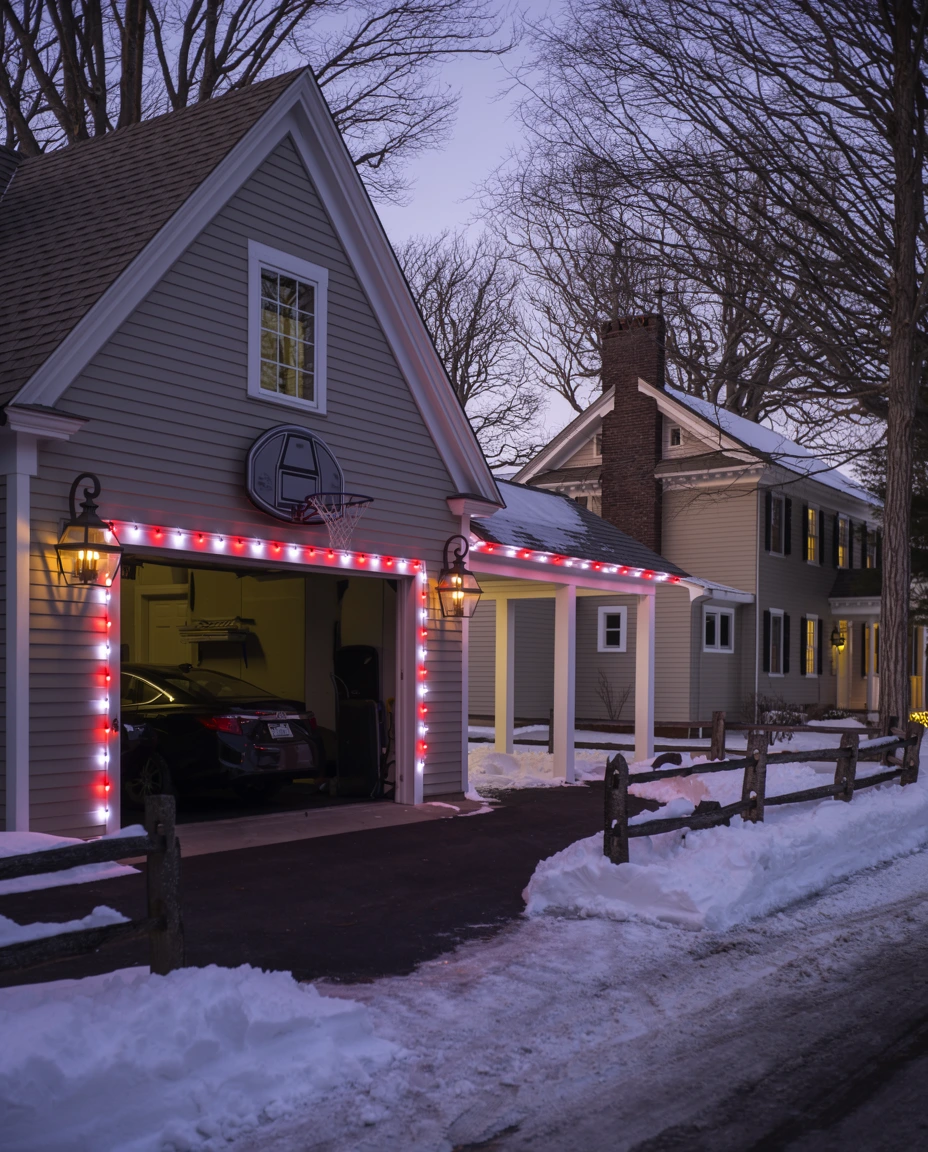
Buying two separate single-color strands and alternating them by hand costs a few dollars more than a pre-mixed set but gives you total control of the ratio, and a hundred-count strand in each color usually covers a typical front elevation for under fifty dollars. The pre-mixed alternatives tend to throw in a third color you didn’t want, which quietly ruins the whole effect and can’t be fixed without replacing the strand.
13. A Glowing Photoshoot Corner

Setting up one corner of the yard specifically as a photoshoot backdrop has become its own tradition, and it’s the source of half the inspiration circulating online right now. A dense wall of warm white lights behind a simple bench, a lit tree at the edge of frame, and a wide, uncluttered patch of ground in front give you a spot that flatters everyone from toddlers to grandparents in late-afternoon light.

Families tend to shoot these the first weekend the lights go up, when the novelty is high and the cards still need to go out. What most people learn by the second year is that the corner gets used constantly after that — a spot for hot chocolate on Friday nights, somewhere the dog ends up sleeping, a place to stand and look at the yard. The backdrop quietly turns into the most-used square footage outside.
14. Bistro Bulbs for Backyard Dining
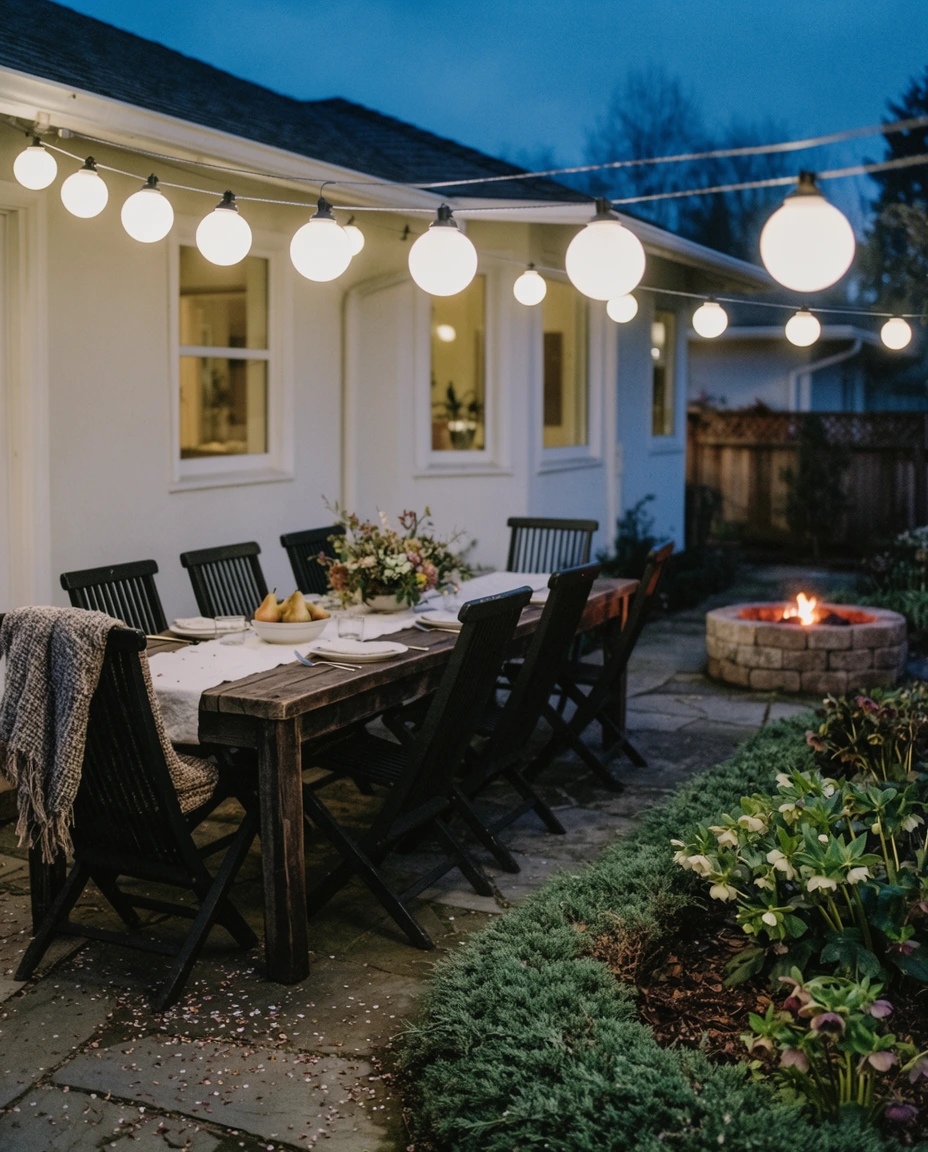
String bistro bulbs across the patio and the backyard stays in use straight through the cold months. Warm white globes strung on a taut cable read as year-round decor rather than holiday-only equipment, which makes them one of the easy upgrades you never take down in January. Over a dining table with a fire pit nearby, the light sits at the right height to feel like a room with the ceiling removed.
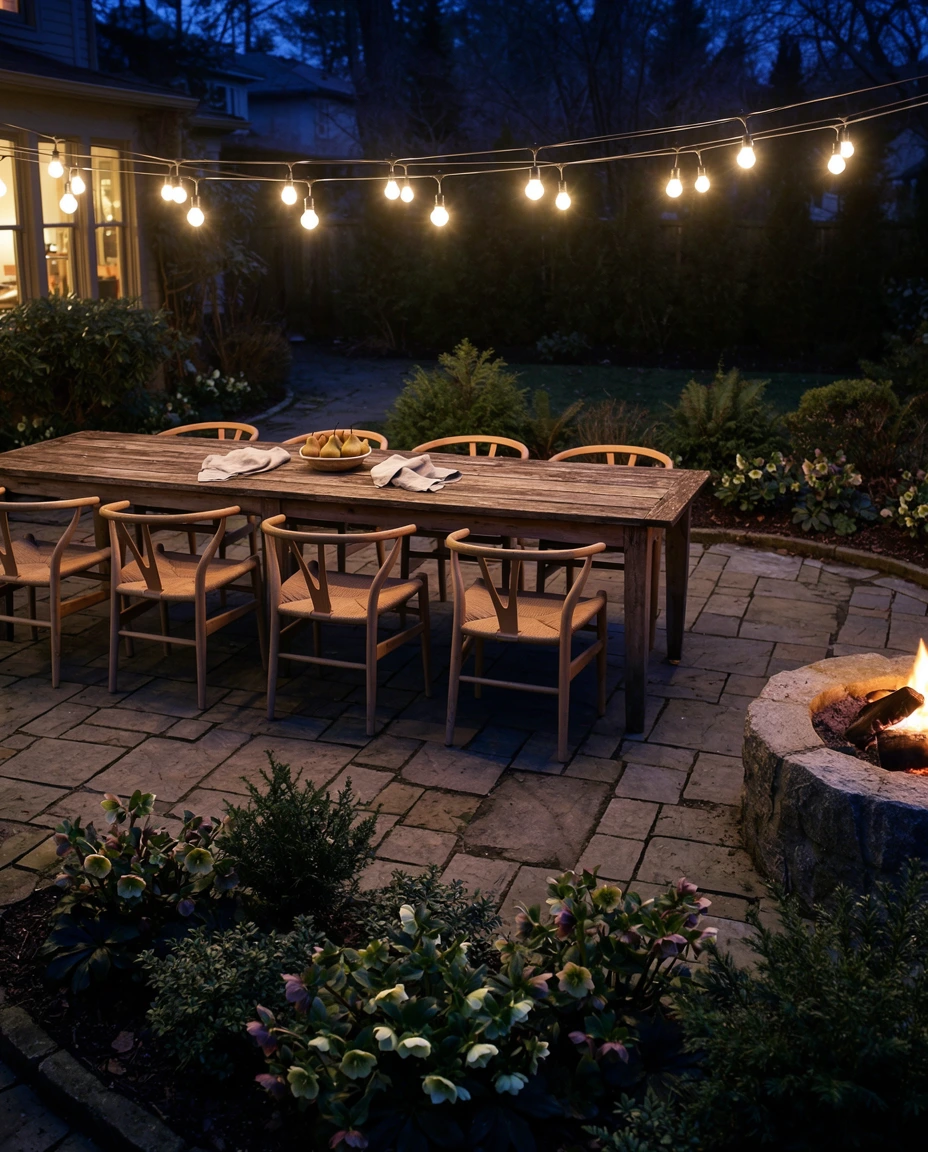
A friend in Denver installed hers as a summer project in June and assumed she’d unplug them by October. Three winters later they are still up, still on a timer, and she claims the patio gets more use in December than it does in August because the light makes forty degrees feel manageable. Guy wire and eye bolts anchored into the house and the fence posts have held through every storm since.
15. Big Impact Without the Ladder
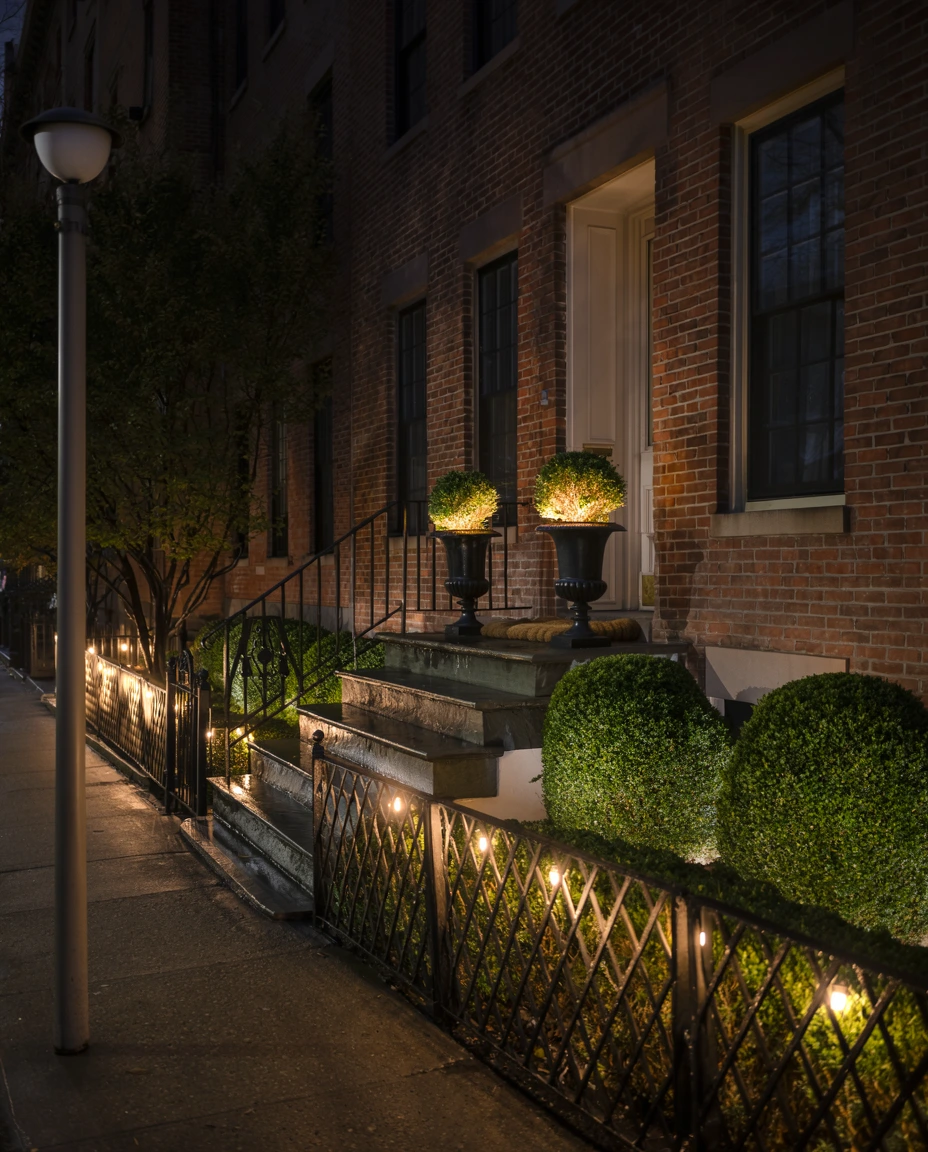
Plenty of gorgeous displays never go higher than six feet. Concentrating everything at ground level — shrubs, planters, railings, the walkway, a wrapped trunk or two — is the simple route to a full-looking yard when climbing isn’t in the plan. Every strand is to hang at arm’s reach, the whole thing is genuinely diy for one person in an afternoon, and takedown in January takes twenty minutes instead of a nervous morning on the roof.
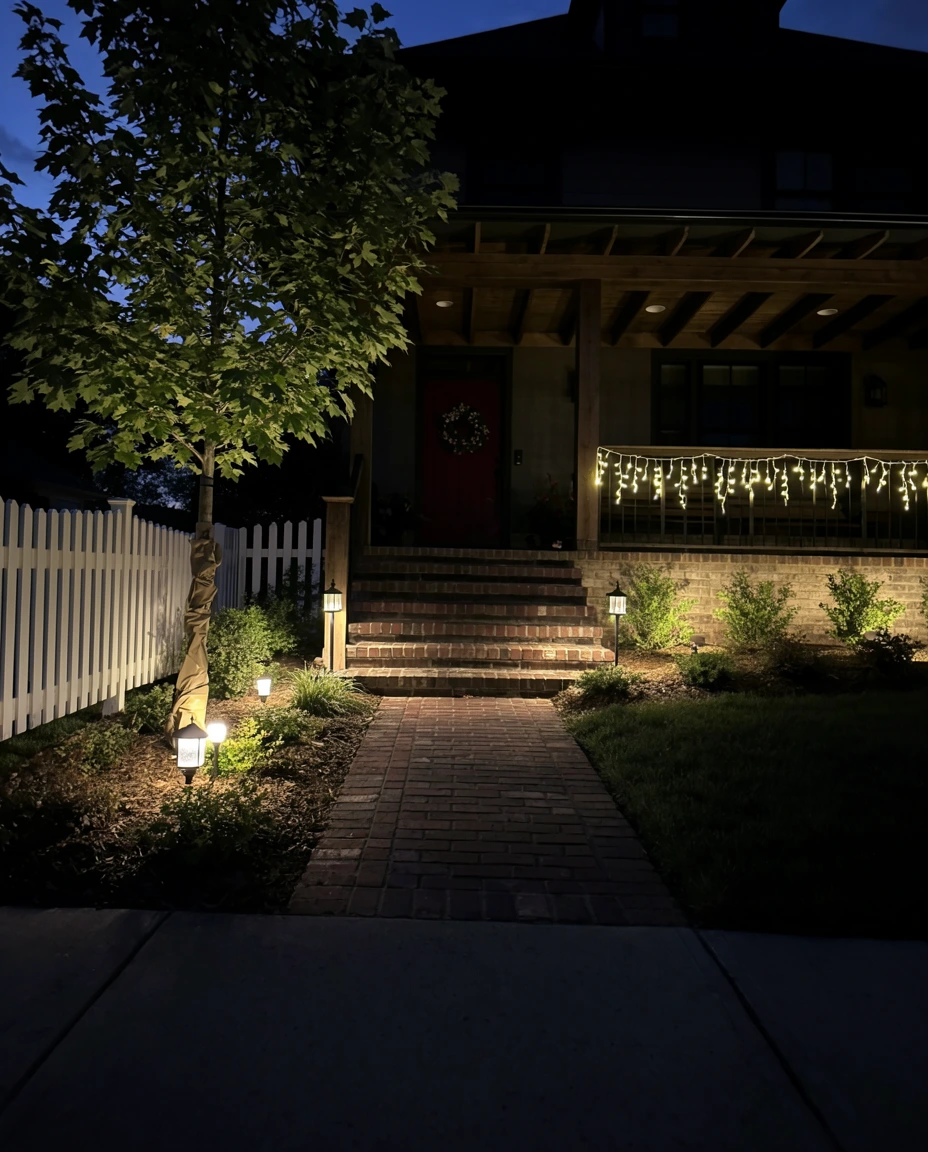
Low displays actually photograph better than high ones in most cases, because the camera sits at eye level and roofline light tends to fall outside the frame anyway. Aiming for three distinct heights within that six-foot band — ground-level lanterns, mid-height shrubs, then a railing or a small tree — creates the layering that makes a yard look designed. Uniform height is what makes a ground-level display read as flat.
16. Lantern Path in Deep Snow
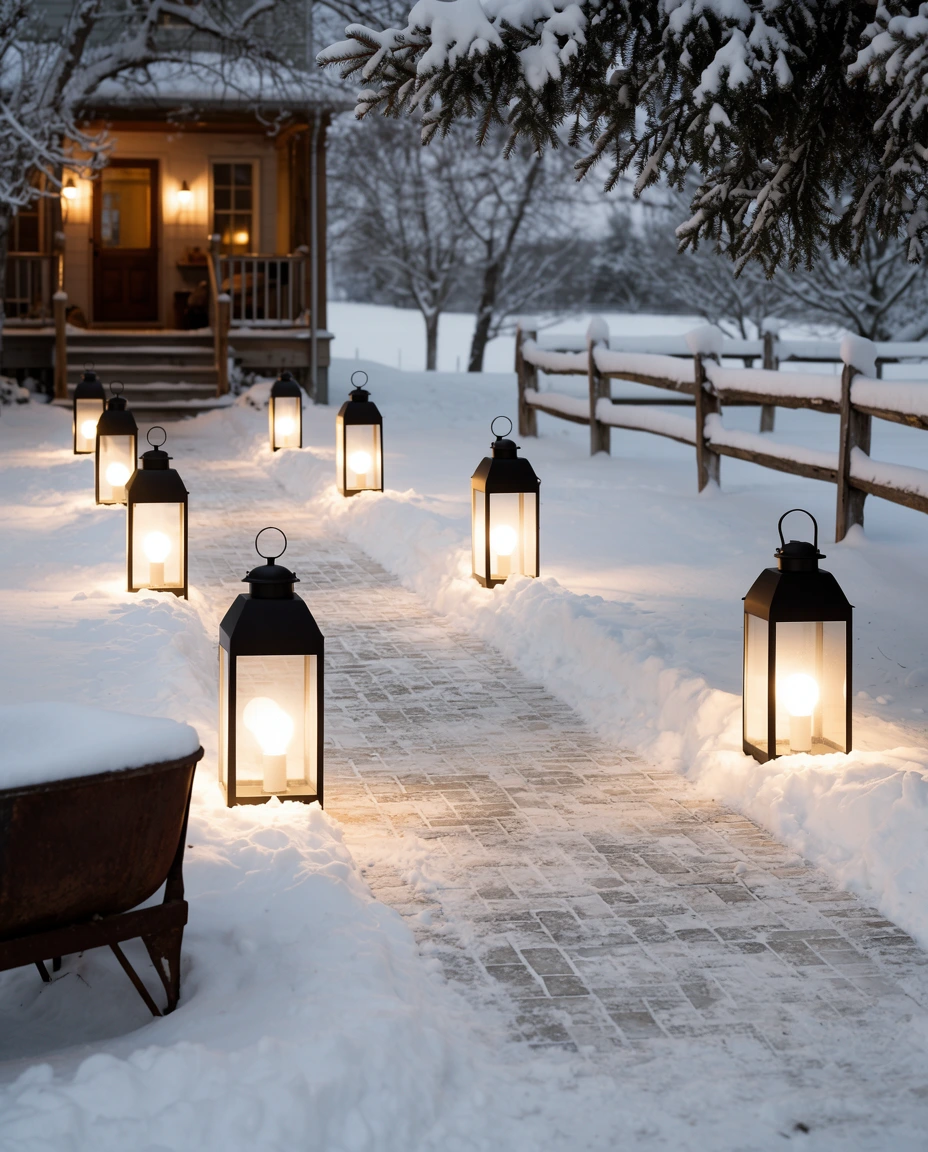
Oversized lanterns set along a shoveled walk are about as classy as outdoor lighting gets. Each one throws a pool of light onto the snow, and the reflection doubles everything — you get twice the glow from half the equipment. Unlike most decorations, lanterns stay handsome in daylight too, which is why they lead so many of the display ideas that get saved from northern homes each winter.
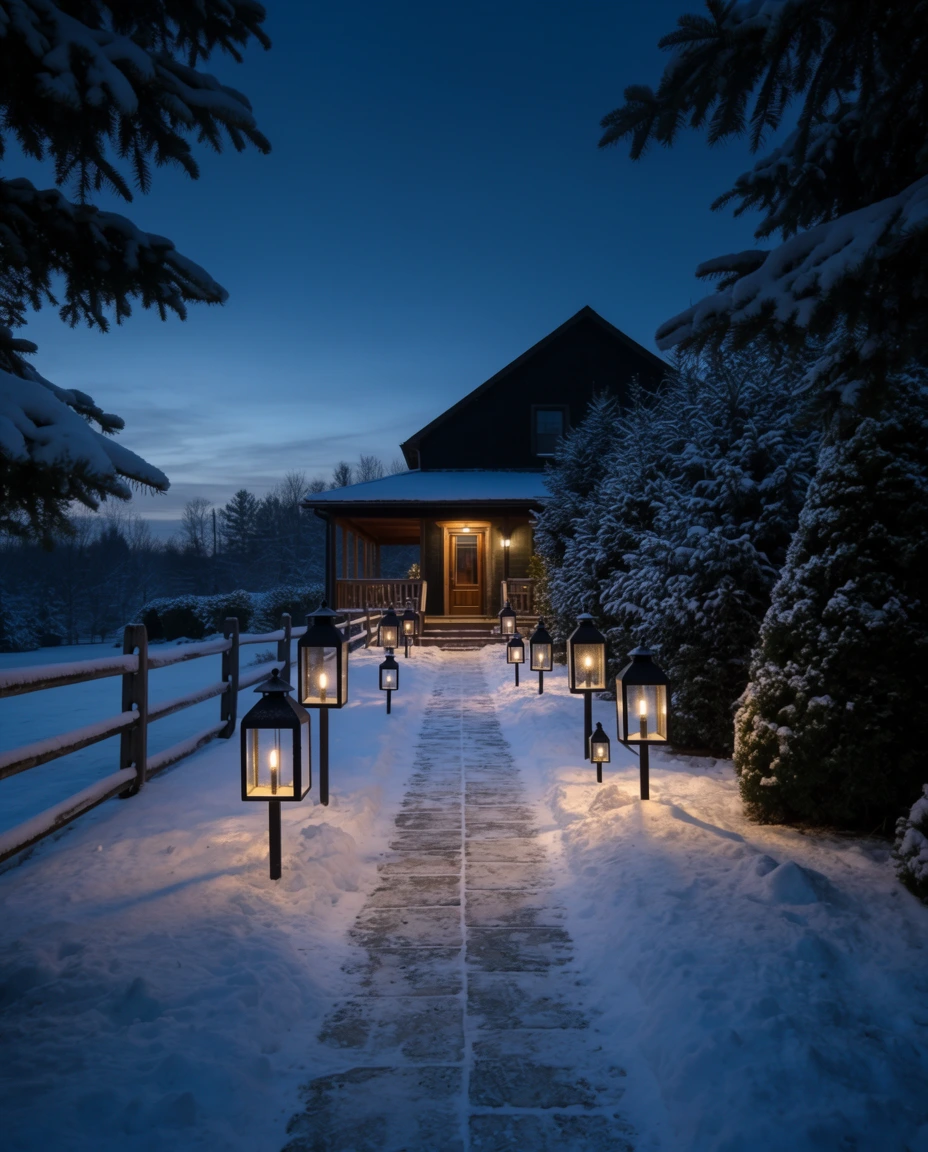
Landscape lighting professionals generally recommend staggering lanterns rather than lining them up in matched pairs across the path, since alternating sides guides the eye forward and avoids the runway effect. They also tend to specify at least two different lantern heights along a single walk. Anything under about eighteen inches disappears entirely once six inches of snow settles, so scale up more than instinct suggests.
17. Mixing Copper and Cool White

Pairing copper-wire fairy lights with a cooler white strand is one of the more elegant combinations to appear recently. The copper filaments produce a warm, almost amber sparkle at close range while the cool white handles the broader wash, and the contrast between the two temperatures is the entire aesthetic. As lighting ideas go it’s subtle, but the depth it creates is immediately obvious next to a yard using one bulb type everywhere.

Modern and mid-century houses take to this best, since the cool tone flatters flat rooflines, black window frames, and any facade with a lot of glass. It’s equally strong on a contemporary entry with concrete planters and a single sculptural evergreen. The one place to reconsider is a warm-toned brick or stucco house, where cool white turns the masonry slightly gray and drains the color the material is prized for.
18. Elegant Lit Window Frames

Outlining each front window turns the facade itself into the decoration. Clean white strands run around the casing give a symmetrical, almost European result that suits a colonial or Georgian house beautifully, and the repetition across four or six openings is what sells it. It’s a genuinely classic approach that requires no yard, no lawn stakes, and no additional objects — the architecture supplies the whole composition.

The usual misstep is outlining only some of the windows, which reads as unfinished no matter how carefully the lit ones are done. Commit to every opening on the front elevation or skip the idea entirely. The second thing worth avoiding is adhesive clips on painted trim in freezing weather — they release as temperatures drop and take paint with them. Small removable hooks rated for exterior use hold far better through a January cold snap.
19. DIY Twinkle Jars for Steps
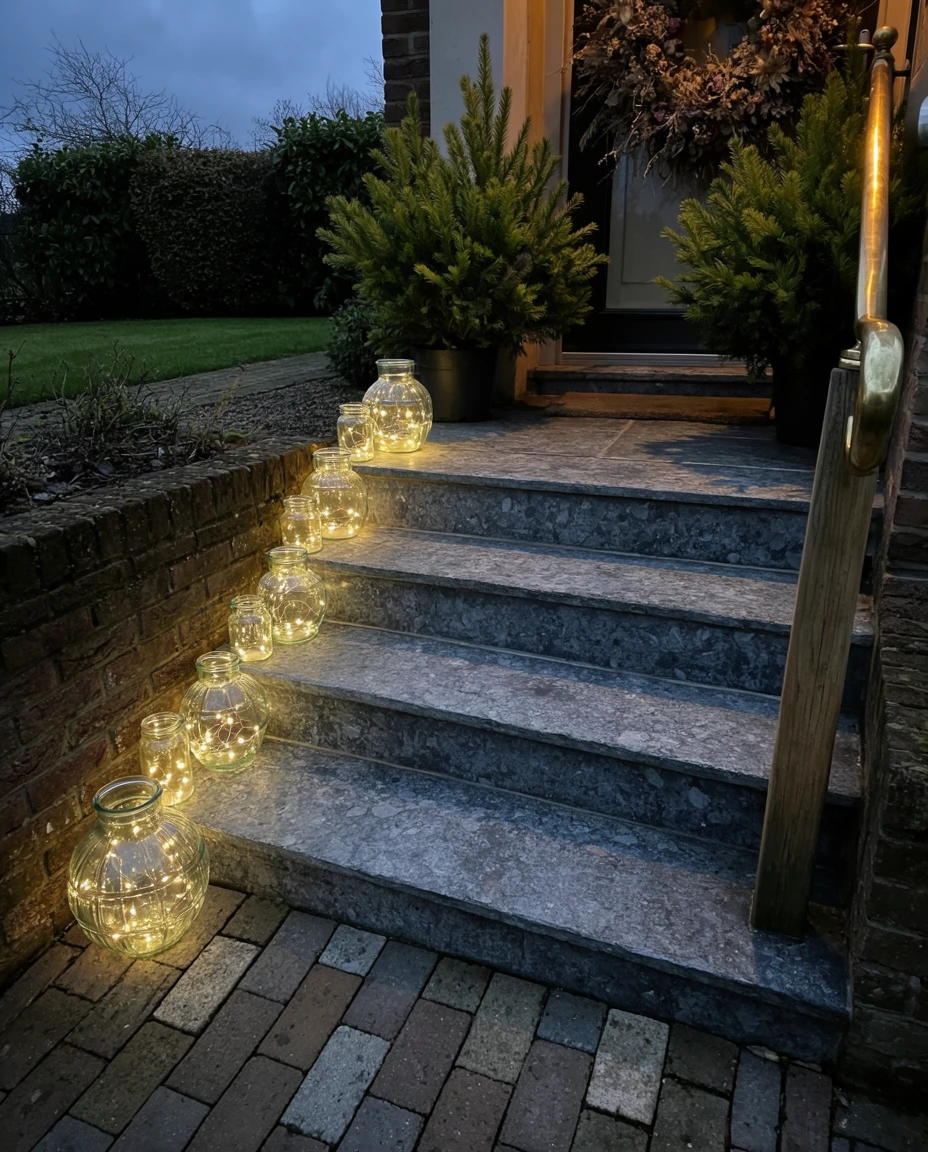
Glass jars filled with battery fairy lights and set along the edge of the front steps are the most charming diy on this list. They’re easy enough that kids can assemble a dozen at the kitchen table, and swapping in tinted bulbs or a few cranberries makes them as colorful as you want. Lined along one side of the treads, they give the entry a handmade warmth that store-bought pathway stakes never quite manage.
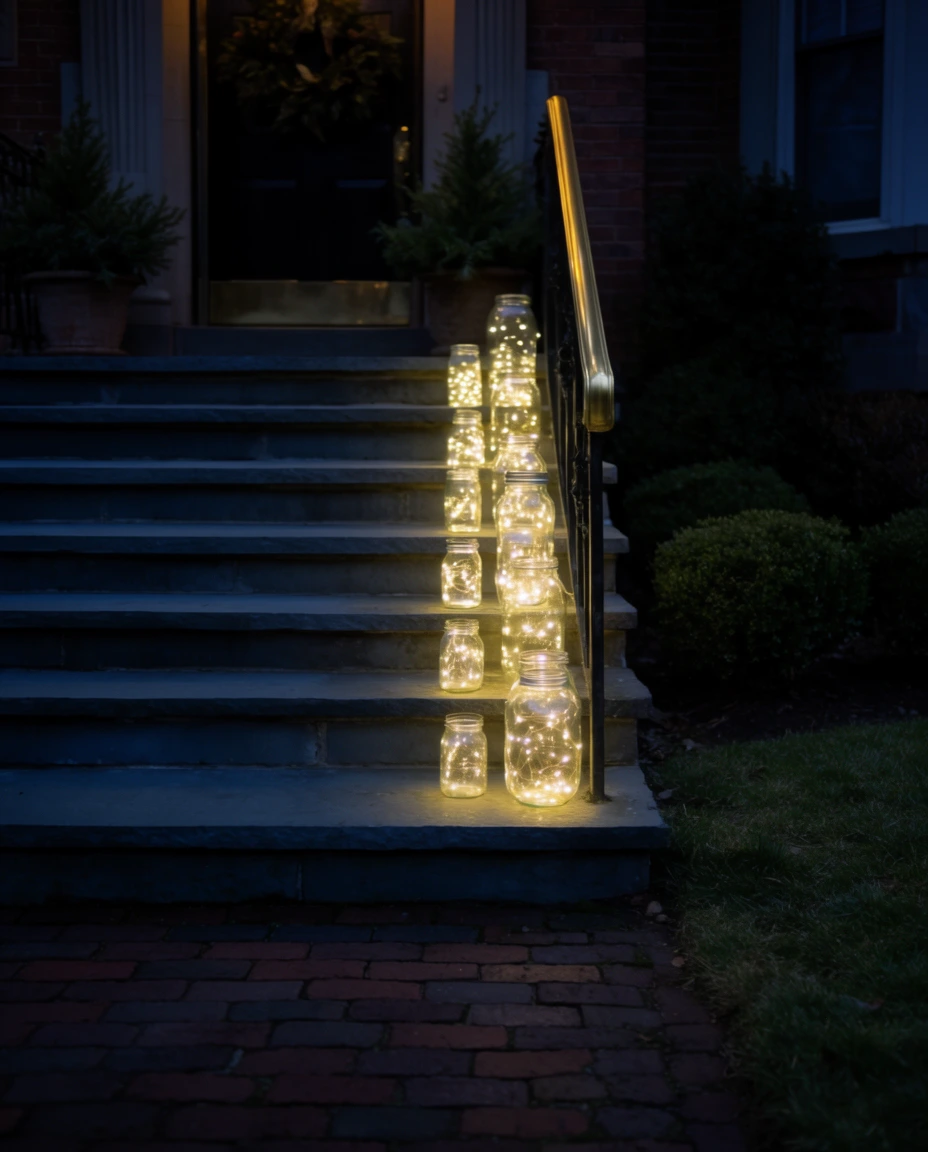
Total spend for eight jars usually lands between twenty and thirty dollars if the glass comes from a thrift store and the light sets are bought in a multipack, which is roughly what a single decent pathway stake costs at a garden center. Lithium coin batteries handle cold far better than alkaline, and spending an extra two dollars per set on those is the difference between lights that survive December and lights that quit at Christmas.
20. Rooftop Ridge Lines and Peaks
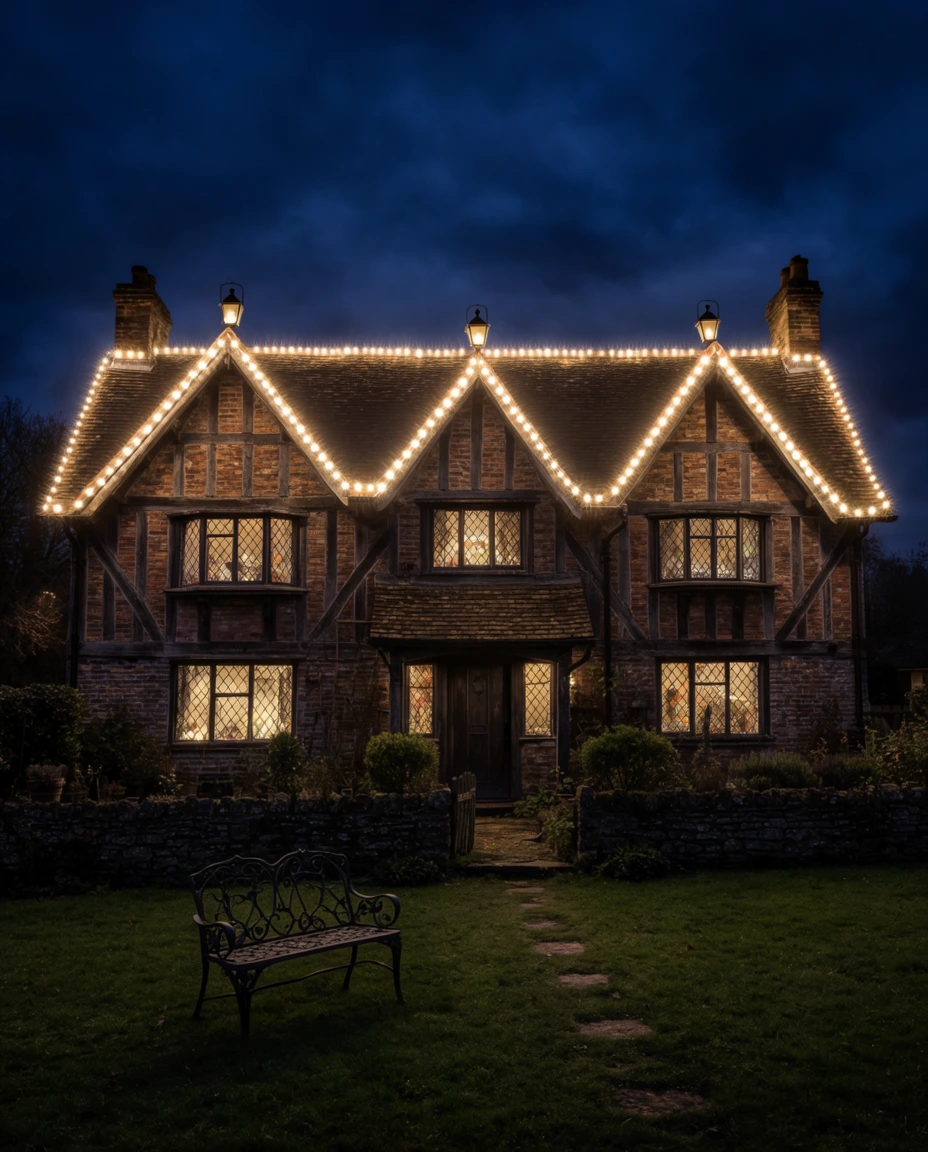
Running light along the ridge and up the gable peaks — not just the gutter line — is what separates the truly striking displays from the merely nice ones. Tracing every angle of the roof on house facades with steep pitches produces a drawn outline of the building against the night sky, and in warm white it looks architectural rather than theatrical. Victorians, Tudors, and anything with dormers gain the most.
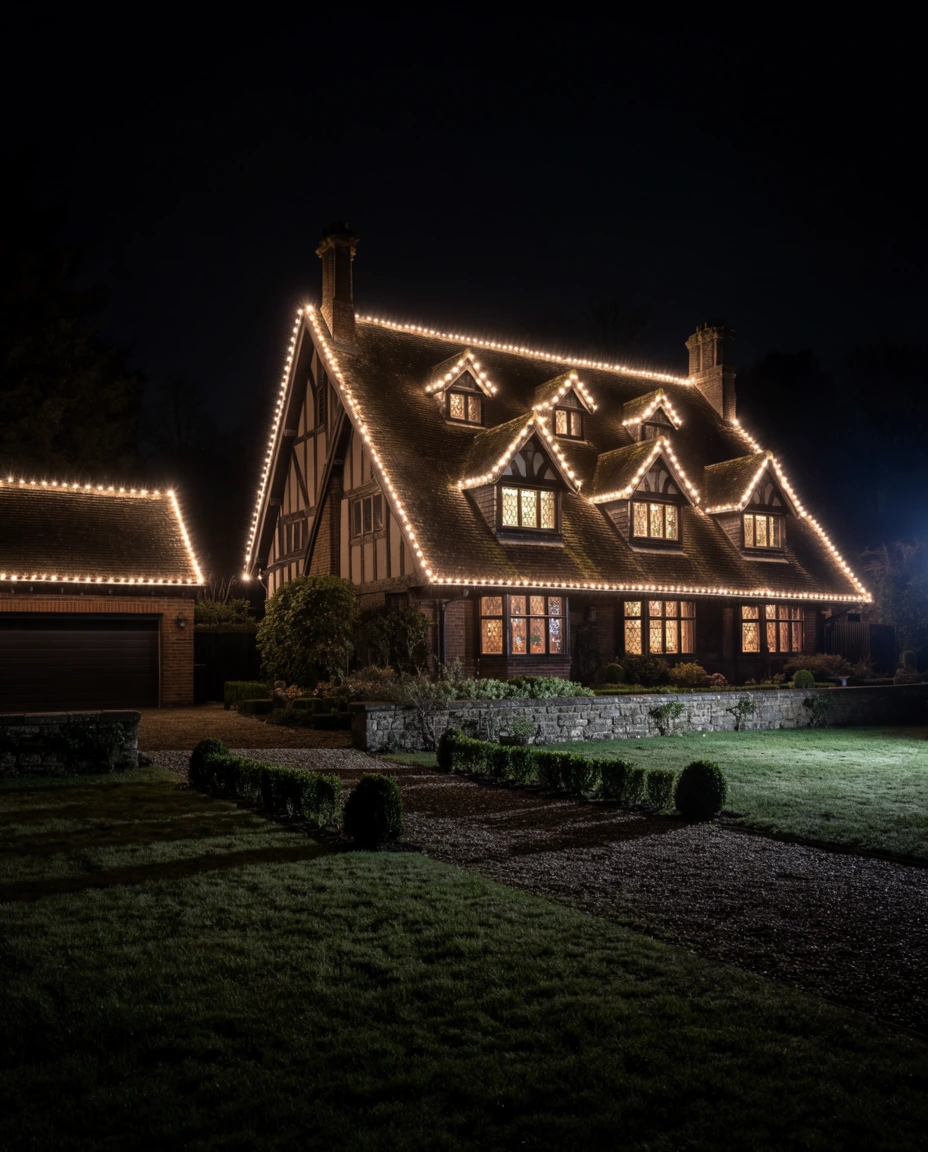
Installers who do this professionally will tell you the ridge run should be measured and cut to length before anyone leaves the ground, because splicing an extra strand halfway up creates a visible bright spot at the joint. They also favor ridge clips that straddle the cap shingles over anything adhesive, and most will decline steep slate or tile entirely — on those roofs, lighting the eaves and dormer edges only is the standard call.
21. Mailbox and Fence Post Glow
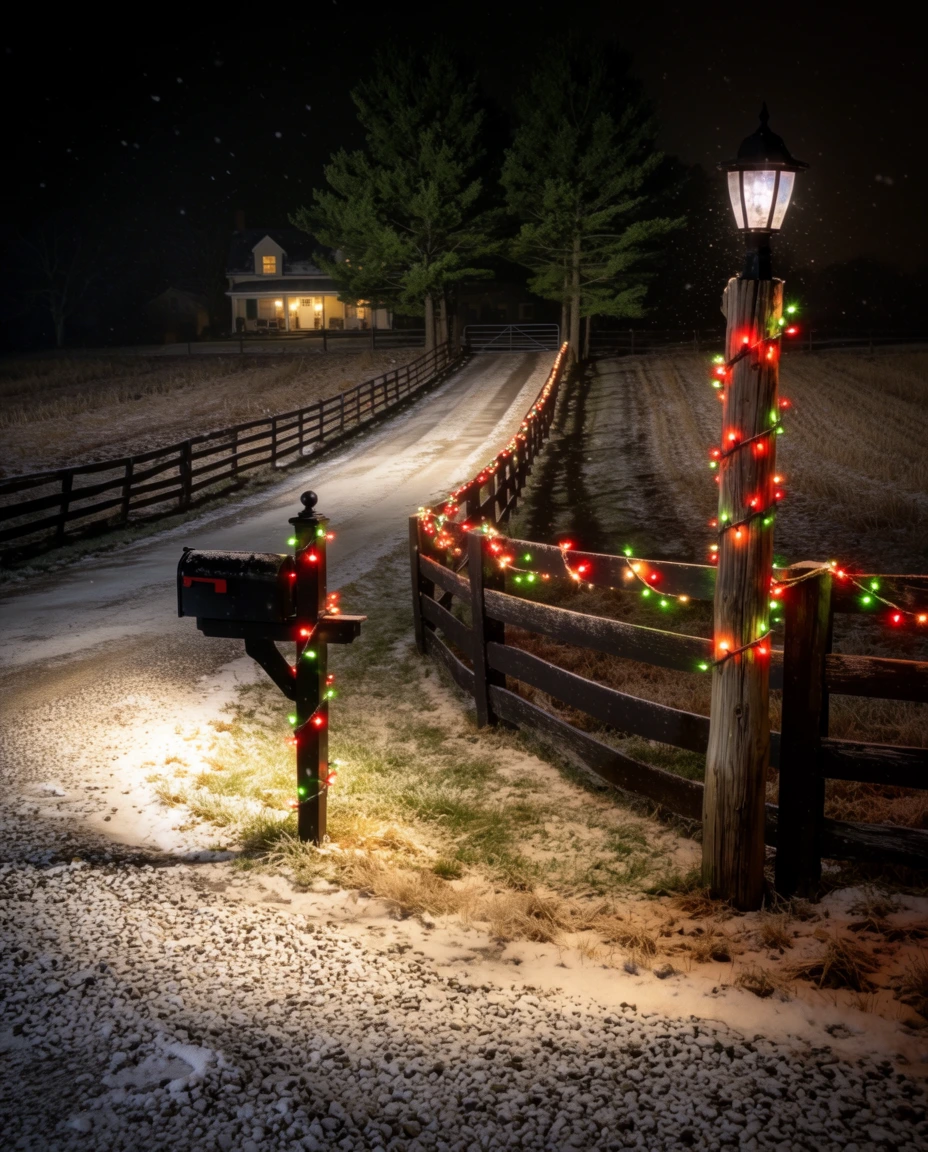
The mailbox and the fence line are the two spots almost everyone forgets, and lighting them extends the display all the way to the curb. A simple wrap of red and green around the post, a small wreath on the box, and a strand along the top rail of the picket fence pull the whole property together. It’s the finishing decor move that makes a yard feel deliberately composed rather than concentrated in one bright clump.
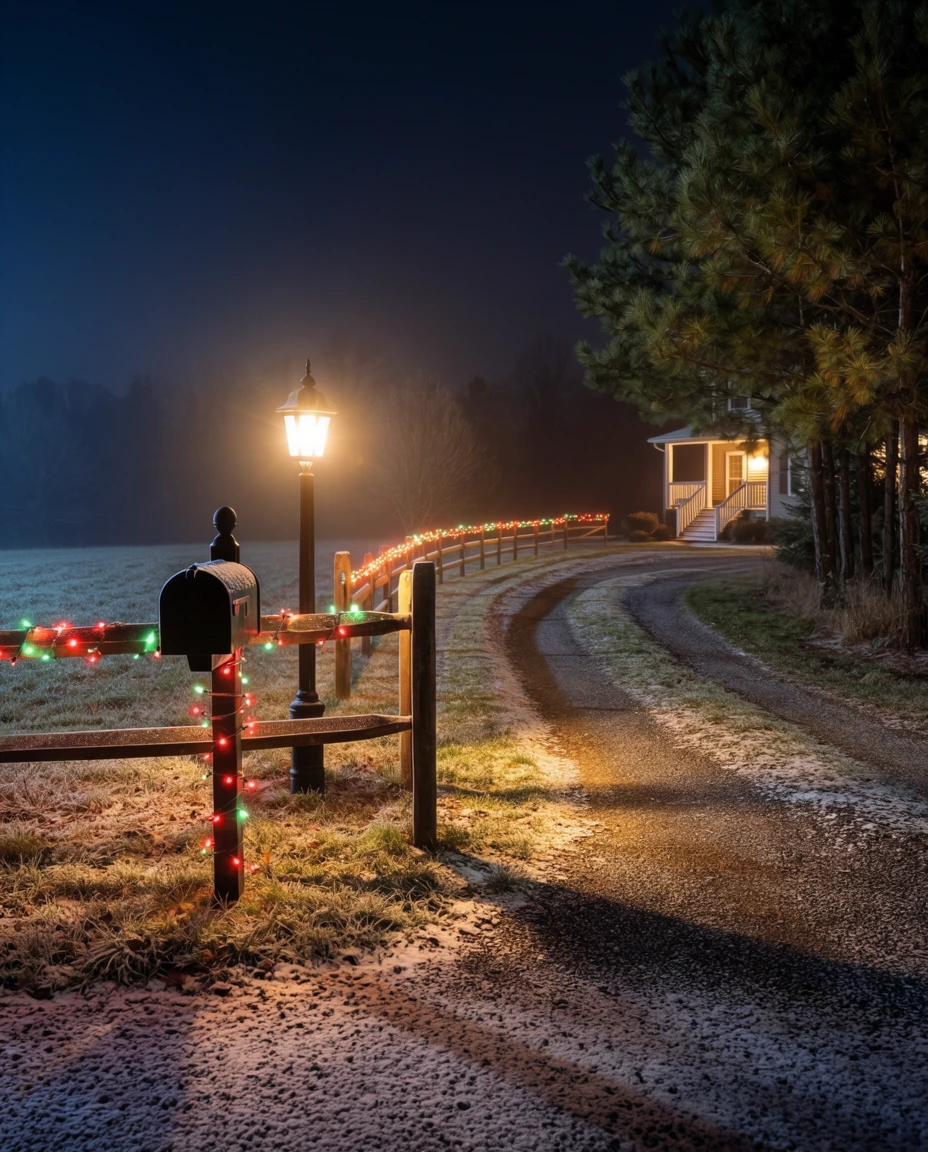
In practice this is the piece that goes up last, usually on a Sunday afternoon when someone walks to the end of the driveway, turns around, and realizes the front of the house looks great but the approach looks bare. It takes fifteen minutes and one extension cord. People who add it once never skip it again, because it’s the part visible from a moving car — which is how most neighbors actually see the house.
22. Lit Evergreens for the Entry
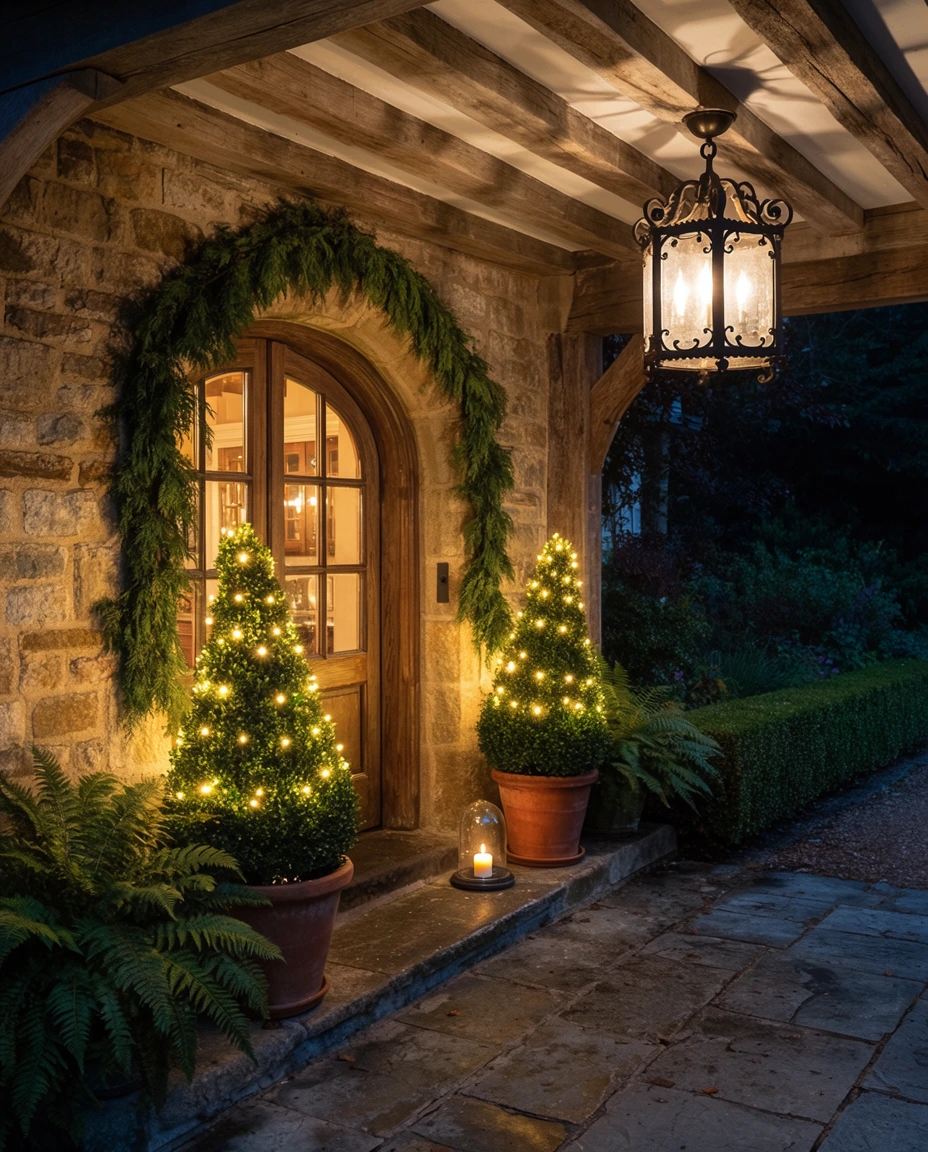
Of all the ideas here, a matched pair of potted evergreens flanking the front door might be the most reliably beautiful. Lights on trees in planters read as intentional in a way loose strands never do, and each tree gives the doorway vertical structure that lasts long after the holidays. The look is deeply traditional — two upright spruces, a soft wash of light, a wreath between them — and it flatters absolutely every entry.
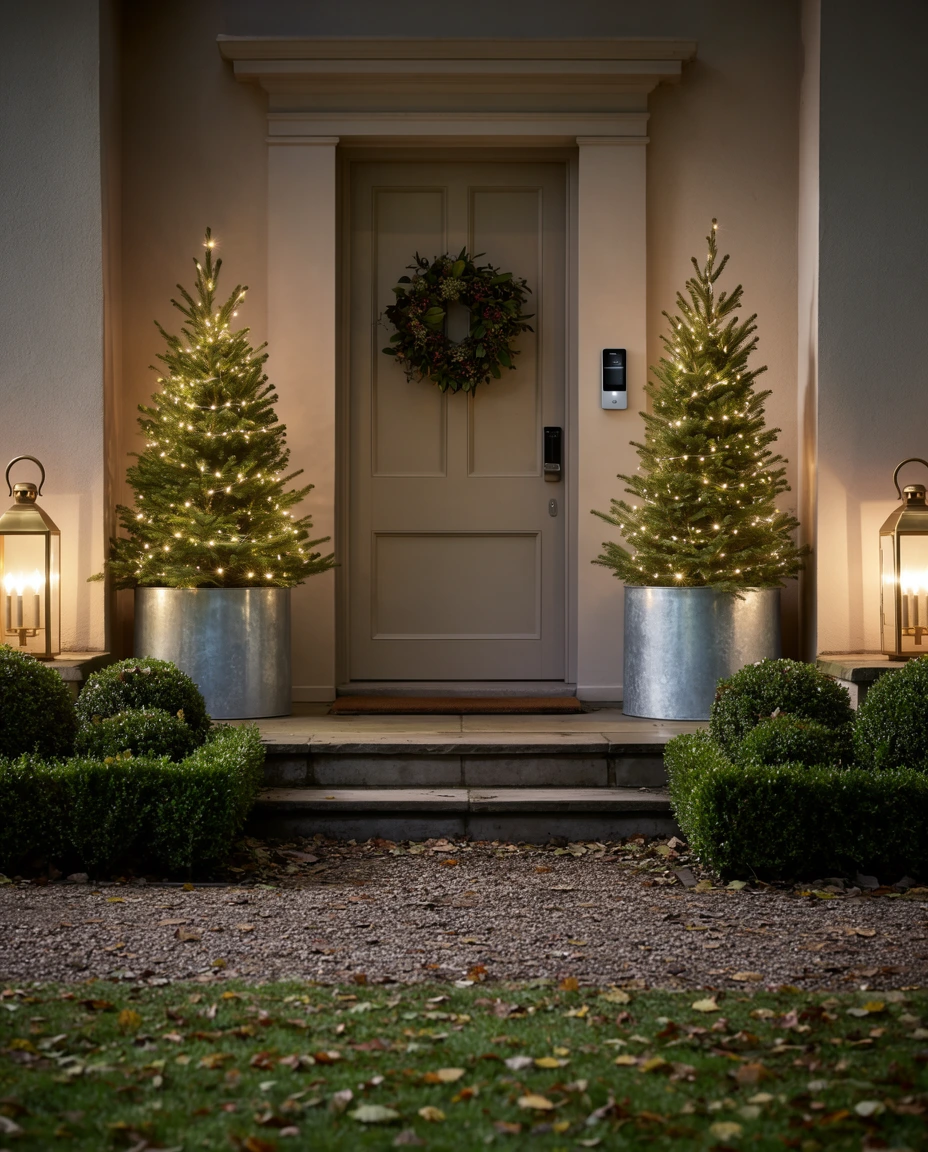
Garden centers across the Northeast and the Pacific Northwest sell potted alberta spruces and boxwood cones specifically for this from late November onward, and in those climates the trees survive the winter in their containers and go back out the following year. In Texas or Southern California, where nothing needs winter protection, dwarf cypress does the same job and holds its shape through the heat. Either way, the pair outlives the season by years.
Every one of these looks started as somebody’s experiment on an ordinary street, which is exactly why they’re worth stealing. If you’ve found a trick that made your own display come together — a color combination, a shortcut, a spot everyone else forgets — leave it in the comments so the rest of us can try it this year.